

Jinbochō, Kanda—the Book Town where antiquarian and other bookshops gather. I suspect more than a few people have struggled to find a building by address alone while walking this district.
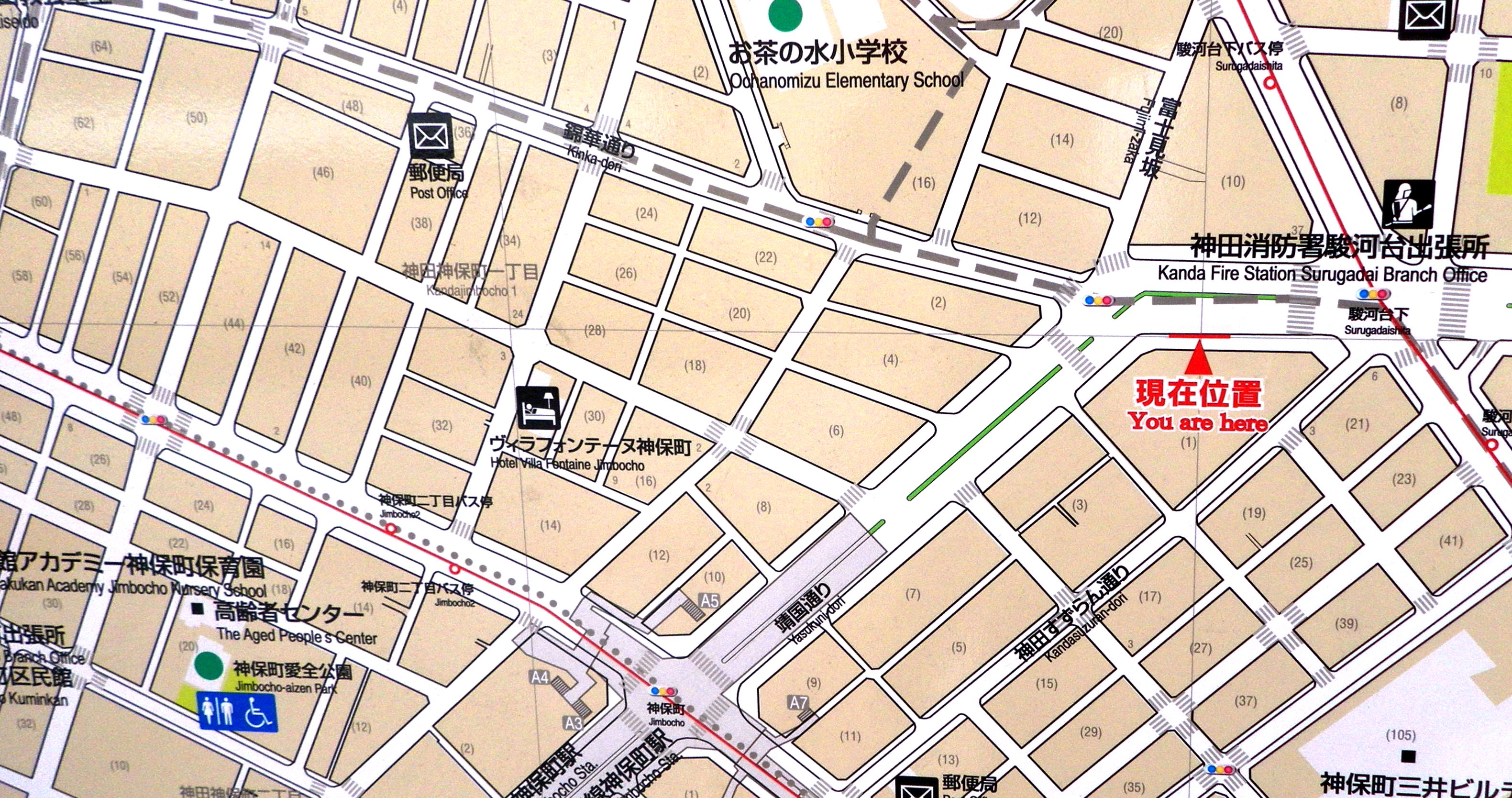
The area has chōme 1 through 3, but odd numbers are assigned south of Yasukuni-dōri and even numbers north—they are not adjacent. As numbers increase, both odd and even shift two at a time to western blocks; at a chōme boundary, odd blocks move south and even blocks north, gradually separating. Block counts differ between south and north, so as numbers advance, one side may increase by twos while the other has no number at all.
For example, Kanda Jinbochō 1-chōme 1-banchi is the block with Sanseidō; 2-banchi is north of Yasukuni-dōri at McDonald's Jinbochō; 3-banchi is south again at Shosen Grande; 4-banchi is north at the fountain-pen specialist Kingpendō—and so on. Numbers proceed west; 9 and 10 mark the border with 2-chōme at the Jinbochō intersection; 11 moves just south of 9, 12 north of 10, then numbers split north-south and advance east. At the next chōme boundary they separate further. Odd numbers south of Yasukuni-dōri end at 41 except 101, 103, 105 in redevelopment buildings; even numbers north go to 64. Banchi 41 and 42 are some 400 meters apart in a straight line.
Kanda Jinbochō 2-chōme follows a similar pattern: odd numbers from 1 (Iwanami Hall) to 23; even from 2 (Select Inn Kimuraya Jinbochō) to 48. In 3-chōme the same system applies, but even numbers end at 12 while odd numbers south reach 29.
This numbering is not unique to Jinbochō. Kanda Ogawamachi 1–3 also assigns odd south and even north across Yasukuni-dōri. Kanda Nishikichō near the Palaceside Building in Takebashi also has 1–3 chōme, with odd and even split north-south across Kanda Police Street; Kanda Surugadai assigns odd and even east-west across Meidai-dōri in chōme 1–2 and Hongo-dōri in 3–4.
These districts still use old lot numbers because the Residential Address Display Act enacted in 1962 (Showa 37) had not yet been implemen
ted. Chiyoda Ward began rollout from 1964, but after Kioi-chō in 1980 progress stalled; about 26% of the ward remains without the new system. Unimplemented districts exist in seven of Tokyo's 23 wards; the ward says it consults neighborhood associations and experts but "progress is hard to see. Chiyoda is lagging even within Tokyo."
Recently, smartphone and PC map searches show destinations, so perhaps we feel the inconvenience less.