

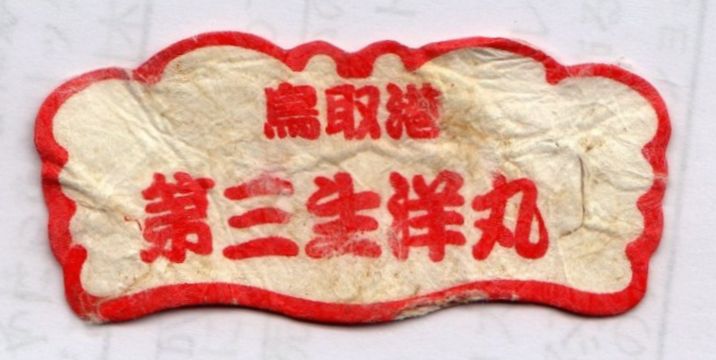
The Tottori "matsuba crab" I finally got the other day. The tag on the left front leg—or rather, the claw arm—reading "Tottori Matsuba Crab"=photo top= is said to be attached only to crab with a carapace width of 11 cm or more. Of course, broken legs or damaged shells disqualify them. It is a "birth certificate" for branded crab that will not tolerate false origin claims.
On the back of the tag=photo bottom= are the words "Tottori Port, Third Seiyo Maru." Tags usually list the fishing boat and home port. Tottori? Wasn't Sakaiminato—Japan's top crab landing port, including beni-zuwai crab—ranked third nationwide in 2011? Tags from "Sakaiminato" certainly exist, but many large boats that go far and long freeze most of their catch on board. For live crab, I also hear that small ports where small boats fish nearby are the ones to watch.
It is not only Tottori. Colorful tags exist everywhere. Let's look at the photos below in order. First, Fukui Prefecture: yellow tags read "Echizen Crab" on the front and "Echizen Port," "Mikuni Port," and so on on the back. By the way, "Echizen Port" is in Echizen Town, but the actual port names "Kokonogi Port"=photo ①, and "Okonogi Port" appear in small print. Separately, there is a special tag only for crab of 1.1 kg or more landed at Mikuni Port—Imperial gift level, I hear.
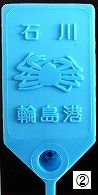
In Ishikawa Prefecture, where brand names were not unified, tags used to say "Ishikawa Snow Crab" and the like, but in November 2006 the prefectural fisheries cooperative chose "Kano Crab"—combining "Ka" from Kaga and "No" from Noto—through a public contest and unified the blue tag design=photo ②.
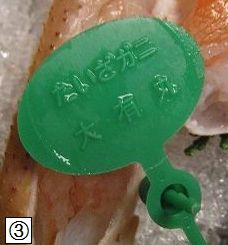
Kyoto uses green tags set by the prefecture. The front shows "Kyoto" and a crab illustration; the back lists "Maizuru," "Taiza Crab"=photo ③, and "Amino" with boat names. Rich fishing grounds lie 20–30 km off the Tango coast, and day trips allow quick landing and shipment of fresh crab. Among them, "Taiza crab" is called a "phantom crab." Taiza boats are small and few; in rough winter seas on the Japan Sea, fishing may be impossible for days, so landings are unstable—yet that has made it a prized luxury brand.
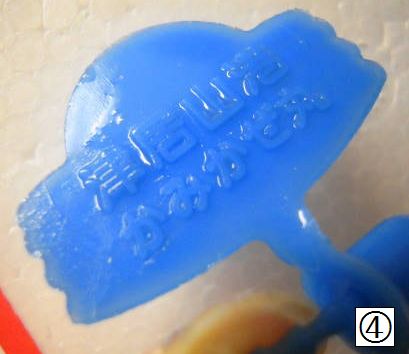
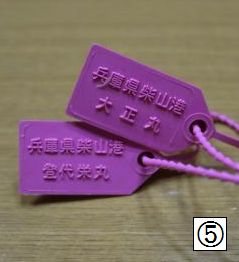
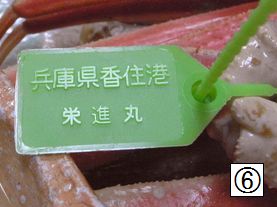
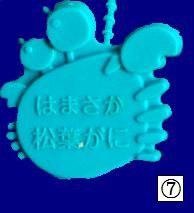
Neighboring Hyogo has no unified tag. "Tsuiyama crab" from Tsuiyama Port on the Kyoto border uses a blue tag=photo ④; "Shibayama crab" from Shibayama Port to the west is purple=photo ⑤ (Shibayama also has orange). Further west, "Kasumi crab" from Kasumi Port uses green for snow crab=photo ⑥ and white for the similar beni-zuwai crab. Even green tags may differ in shape by boat size. These share fishing grounds with Kyoto's "Taiza crab," but Tsuiyama has larger boats and relatively stable landings; crab are ranked in 26 grades, and only those passing strict selection by fishermen and brokers get tags. "Hamasaka crab" from Hamasaka Port on the Tottori border wears a light-blue tag=photo ⑦.
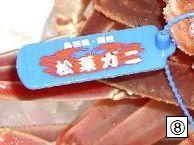
Finally, Shimane Prefecture—Oki matsuba crab from the Oki Islands is caught with pots set around the islands, so compared with bottom trawling common elsewhere, legs are less likely to break. Only crab of 700 g or more with good meat yield may be tagged and proudly sold as "Oki Matsuba Crab"=photo ⑧=.
To eat crab in Hokuriku from downtown where Palaceside Building stands, flying from Haneda to Komatsu is the usual route. But the Hokuriku Shinkansen opens within fiscal 2014, linking Tokyo and Kanazawa in two and a half hours (currently three hours forty-seven minutes on conventional lines). Extension work to Tsuruga, Fukui (125 km) also broke ground last summer. Opening is expected around the end of fiscal 2025—still a way off, but getting closer bit by bit.