

A five-minute walk from Palaceside Building brings you to the Chiyoda Ward Library (1-2-1 Kudan-Minami, Chiyoda-ku, 9th floor of the ward office), where we recently introduced "Library Book Exhibition VOL.59: From Edo Shogunate Go and Shogi Masters to Popular Games" on this blog. The first-half shogi exhibition ended on the 28th (closed the 27th; the second-half go exhibition runs from the 29th through February 25), but I looked into shogi history while I had the chance.
According to the Kansai Shogi Kaikan website (http://www.kansai-shogi.com/museum/ryakusi.html) and elsewhere, the leading theory traces shogi's origin to ancient Indian chaturanga=photo top=, which spread across Eurasia and diverged into shogi, Western chess, Chinese xiangqi=photo bottom left, Korean janggi=photo bottom right, Thai makruk, and others. Xiangqi and janggi are similar and relatively close to Japanese shogi. (Photos from the Kansai Shogi Kaikan site.)
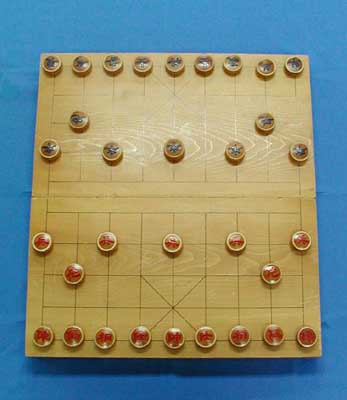
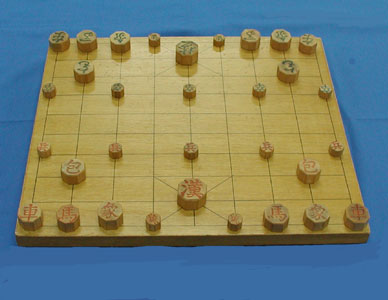
Introduction to Japan is thought to date to the 6th or 7th century; one theory holds that Kibi no Makibi (695–775), sent as a kentōshi envoy, brought it back—which would place transmission in the 8th century. In the Heian period it developed as "Heian shogi" (8×8 or 9×9 squares) and "Heian dai shogi" (13×13). Shogi's distinctive "captured pieces" rule—using pieces taken from the opponent—is dated to the 11th–15th centuries. In the Edo period, along with go, shogi enjoyed strong shogunate protection; masters received stipends. Under that stability, standard tactics and rules were refined into roughly today's form. After the shogunate's fall, players sought independence; private organizations were founded, leading to today's Japan Shogi Association. From the Meiji 30s (1890s), newspapers began publishing game records—a major contribution to shogi culture.
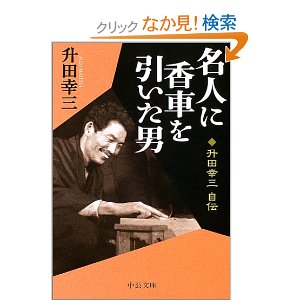
After World War II, GHQ considered banning shogi as an extension of its hostility to martial arts, even arguing that "the captured-pieces rule is prisoner abuse." Masuda Kōzō of the Kansai headquarters of the Japan Shogi Association went to GHQ and countered: "In chess, captured pieces are not used—that is the massacre of prisoners. ... (In shogi) all pieces always live. It respects ability and gives each a place to work. Even when an enemy piece switches to your side, gold stays gold and rook stays rook—it keeps its rank and duty. Is this not true democracy?" Perhaps thanks to that, the ban was avoided (from The Man Who Promoted the Lance to Bishop: Autobiography of Masuda Kōzō, Chūō Kōron Bunko=photo bottom).
Captured pieces and other shogi-specific features are indeed Japanese. At a roundtable, Yoshiharu Habu (currently holding the Ōi, Ōza, and Kisei titles) explained it clearly—here is a summary.
"In chess and Chinese xiangqi, captured pieces cannot be reused—the number on the board only decreases. That suggests war of extermination between different peoples. Japanese shogi, by contrast, makes captured enemy pieces your own strength; perhaps because it is war within the same people, it does not exterminate the enemy. Or when a piece enters the opponent's camp and 'promotes'—that resembles a samurai's rise for merit. The rule that you cannot checkmate the king with a pawn from hand—I interpret as a rejection of revolution."