

The boat disaster at Zushi Kaisei Middle School on January 23, 1910 (Meiji 43), in which all twelve students aboard perished—known through the song "Shiroki Fuji no Ne." When the then Crown Prince (later Emperor Taishō), recuperating at the Hayama Imperial Villa, learned of the disaster he was deeply worried; he rode on horseback to the school, listened to students about the search, and encouraged the searchers—a story reported by Tokyo Nichi Nichi Shimbun, predecessor of The Mainichi Newspapers, as we noted in this column on the 22nd.
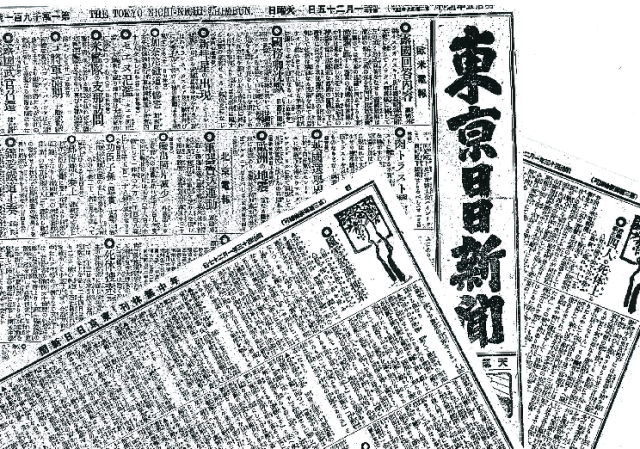
The accident drew public attention, and the paper reported daily on the search and, on February 6 of the same year, the memorial service.
According to the paper, the search was headlined "Great Joint Official–Civilian Search." On the 24th, twenty local fishing boats, two motorized vessels, and three boats provided by volunteers from Shinjuku—twenty-five in all—set out. Eighty-nine police officers and several school staff boarded and swept the sea with various fishing gear; two destroyers from the Yokosuka Naval District also joined. From the night of the 25th through the 26th, despite snowy bad weather, the large joint search continued; torpedo boats "Kamome" and "Kō" from Yokosuka, exercising near Shimizu Port, also rushed to help. The signal station behind the school sent "Kamome" the message "Your activity in wind and snow is truly beyond words of gratitude," to which "Kamome" replied, "Our boat fears not wind and snow, yet we regret that our efforts cannot be greater."
Reports also describe the recovery of bodies. Of brothers Tokuda Katsuharu (then 22) and Take (11), the paper wrote that "Take wore a kasuri haori with a coat over it; Katsuharu, in formal dress, had his younger brother's body bound to him with a black heko obi," and inferred that "Katsuharu likely carried his brother on his back when the boat capsized, tried to swim toward land, but lacked strength and both drowned." It also told how Katsuharu was "a calm man rich in chivalry"—"when a teacher once oppressed students, he angrily visited the teacher alone and demanded love for students, threatening a duel if refused, and finally made the teacher yield."
The brothers' last moments later moved people; a statue imagining their figures stands as the "Boat Disaster Monument" in a park at Inamuragasaki, Kamakura.