

The Tokyo area was forecast for snow from the night of the 21st into the 22nd, but it was rain instead. Commuters worried about their routes breathed a sigh of relief. The cold wave was less severe than expected, and temperatures did not fall as much. Thanks to this rain, the snow that had turned the rooftop of Palaceside Building in Takebashi, Tokyo, into a silver world on the 14th has completely melted. Winter weather is truly hard to predict.
Tomorrow, the 23rd, marks notable disaster accidents in Japanese history—both in the mountains and at sea.
In the mountains, it is the 1902 (Meiji 35) Hakkōda Mountain Corps disaster that inspired the film "Death March on Mount Hakkōda," famous for the line "Heaven has abandoned us." With the Russo-Japanese War approaching, the Japanese Army 8th Division 5th Infantry Regiment conducted a snow march on Mount Hakkōda to prepare for fighting in Russia's bitter cold, but 199 of 210 participants, including commander Captain Kannai Fubuki, died from the cold. On January 25, two days after the disaster, −41°C was recorded in Asahikawa, Hokkaido—a record that stood as Japan's lowest temperature for 110 years until updated last year; that winter was extraordinarily cold.
Because the army was involved, disclosure was cautious; reporting finally appeared in the morning edition of January 30. In the predecessor Tokyo Nichi Nichi Shimbun it ran under "Army Ministry bulletin" with the headline "Mountain march unit disaster."
This snow march left major lessons; the Self-Defense Forces and others tried repeatedly afterward. In 1972 (Showa 47), members of the SDF 9th Division 5th Infantry Regiment marched across the snow in skis with heavy equipment=photo.
At sea, it is the boat capsizing off Shichirigahama, Zushi Kaisei Junior High School—known for "At the foot of white Fuji, green Enoshima." Eight years after the Hakkōda disaster, on this day around 9:30 a.m. in 1910 (Meiji 43), 12 students from grades 2 through 5 rowed a boat decommissioned from the navy from Hayama toward Enoshima. The sea suddenly turned rough, and off Shichirigahama the boat capsized; all 12 were thrown into the sea and found dead.
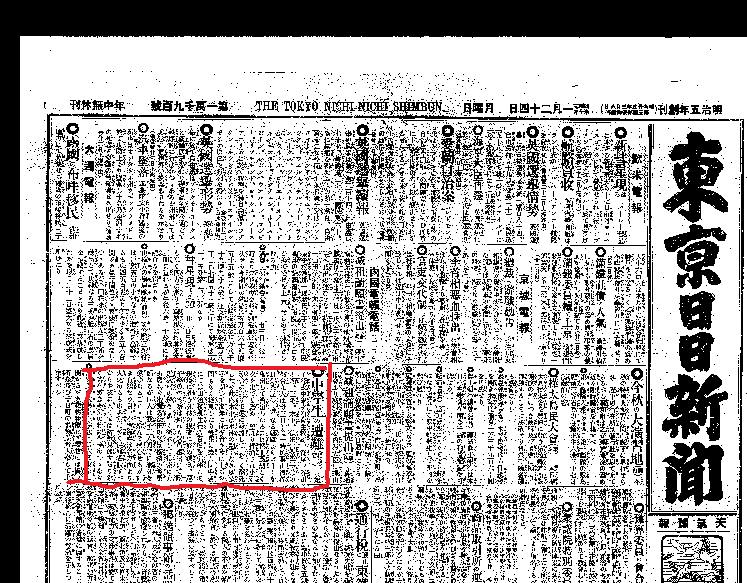
The January 24 Tokyo Nichi Nichi Shimbun carried the first report on page 1. On January 26 it reported the accident extensively, including that the Crown Prince (later Emperor Taishō), resting at the Hayama Imperial Villa, learned of the accident, rode his horse back and forth two or three times before the school gate, spoke to students, and asked about the search.
To mourn the victims, teacher Shizuko Misumi of Zushi Kaisei and the affiliated Kamakura Girls' School wrote "At the Foot of White Fuji," first performed as a memorial song at a memorial service at the school on February 6.