

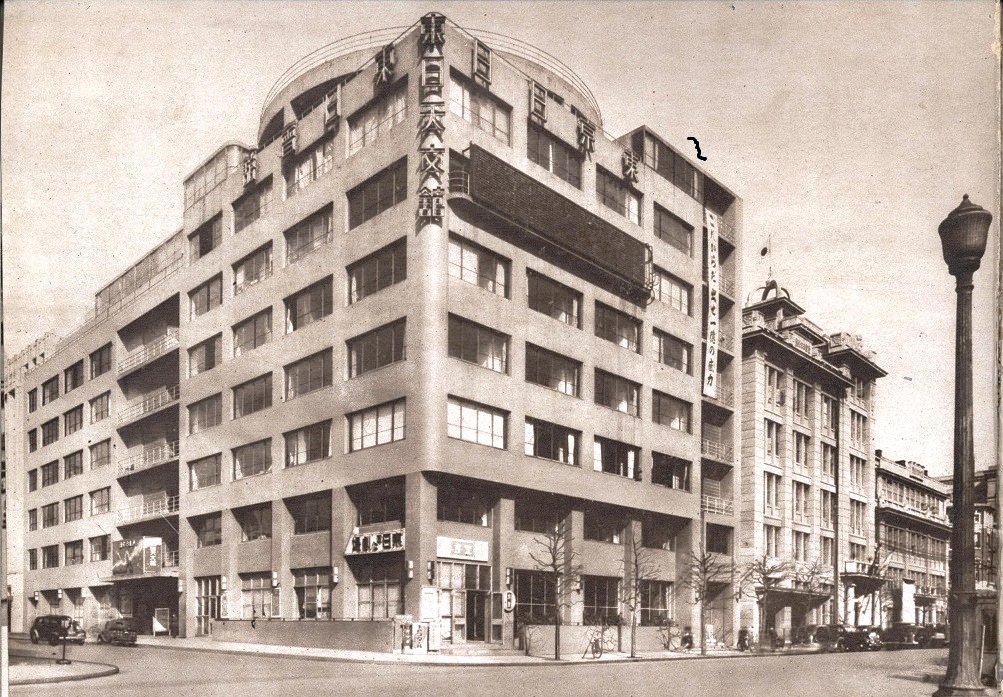
Amateur astronomer Seiji Ogawa, who often contributes to this column, provided a picture postcard with a foreground illustration of the Tō Nichi Kaikan (Yurakuchō, Tokyo—the building of the predecessor Tokyo Nichi Nichi Shimbun of The Mainichi Newspapers), where Tokyo's first planetarium, the Tō Nichi Planetarium, was installed. In a monochrome photo of the Tō Nichi Kaikan Ogawa sent earlier, the words "Tō Nichi Planetarium" appear on the upper corner of the building, but in the illustration they are on the third-floor wall—so the postcard is probably a pre-completion image.
When Tokyo Nichi Nichi Shimbun changed its name to The Mainichi Newspapers in 1943 (Showa 18), the Tō Nichi Kaikan and Tō Nichi Planetarium were renamed Mainichi Kaikan and Mainichi Planetarium.
Did you know that the "Tō Nichi Planetarium" and "Mainichi Planetarium" became settings in SF novels? One is Hideaki Sena's "The Rainbow Planetarium" (Shōdensha Bunko, 400 yen), published in 2001 (Heisei 13).
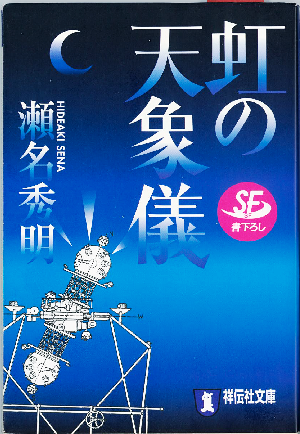
The story begins when, the day after the Gotō Planetarium astronomical museum in Shibuya, Tokyo, closed on March 11 of that year, a boy visits and pleads with the narrator, a lecturer doing closing work, to show him the planetarium. While opening the projector and explaining the mechanism, the narrator is drawn in, feels a slight shock, and time-slips to October 4, 1943 (Showa 18). Holding keys to the Mainichi Planetarium, the narrator goes there, meets a lecturer and a female culture-desk reporter from The Mainichi Newspapers, tells them "this hall will burn down in an air raid in a year and a half," and advises storing precious materials in a safe place—and the plot unfolds from there.
In fact, the Mainichi Kaikan was hit by incendiary bombs in the May 1945 (Showa 20) air raid; the Mainichi Planetarium burned down with its machinery. The novel also depicts damage to the Mainichi Kaikan and nearby areas, postwar Yurakuchō, the Mainichi Kaikan, and The Mainichi Newspapers. It includes visiting the popular writer Oda Sakunosuke on his sickbed and weaves in a story about Oda and the planetarium.
It is not only SF. Though the Tō Nichi Planetarium (Mainichi Planetarium) lasted only eight years, it was loved by people of the time and even appears in pop songs about Yurakuchō's planetarium.
In 1939 (Showa 14), Noriko Awaya sang "Tokyo Blues" (lyrics by Yasushi Saijō, music by Ryoichi Hattori). The second verse runs: "In the rush-hour dusk, with you in the elevator—ah, the beautiful starry sky of the planetarium......" It does not say "Tō Nichi Kaikan" directly, but Tokyo had only one planetarium then, clearly the Tō Nichi Planetarium.