

Happy New Year. Amid continuing bitter cold, astronomy fans already had an intriguing celestial show. From late night on the 3rd into early morning on the 4th, the Quadrantid meteor shower—one of the three major meteor showers—peaked, and shooting stars appeared one after another in the winter night sky. The Quadrantids are named after the quadrant, an instrument once used for astronomical observation; also called Quadrans Muralis, it lay near Draco, Hercules, and Boötes. It was dropped when the International Astronomical Union defined 88 constellations in 1928 and is no longer recognized as a constellation.
According to the Nippon Meteor Society, about forty Quadrantid meteors per hour were observed before dawn on the 4th; especially at 4:03 a.m. on the 4th, a huge fireball like the parent of the shower was seen from Kantō to western Japan. Those who missed this celestial show may find planetariums that replay it—a good place to enjoy it at leisure.
Speaking of planetariums, amateur astronomer Seiji Ogawa, introduced earlier, sent a pamphlet from January 1939 (Showa 14) of the Tō Nichi Planetarium in Yurakuchō, Tokyo—the city's first planetarium, housed in the Tō Nichi Kaikan building of the Tokyo Nichi Nichi Shimbun (predecessor of The Mainichi Newspapers).
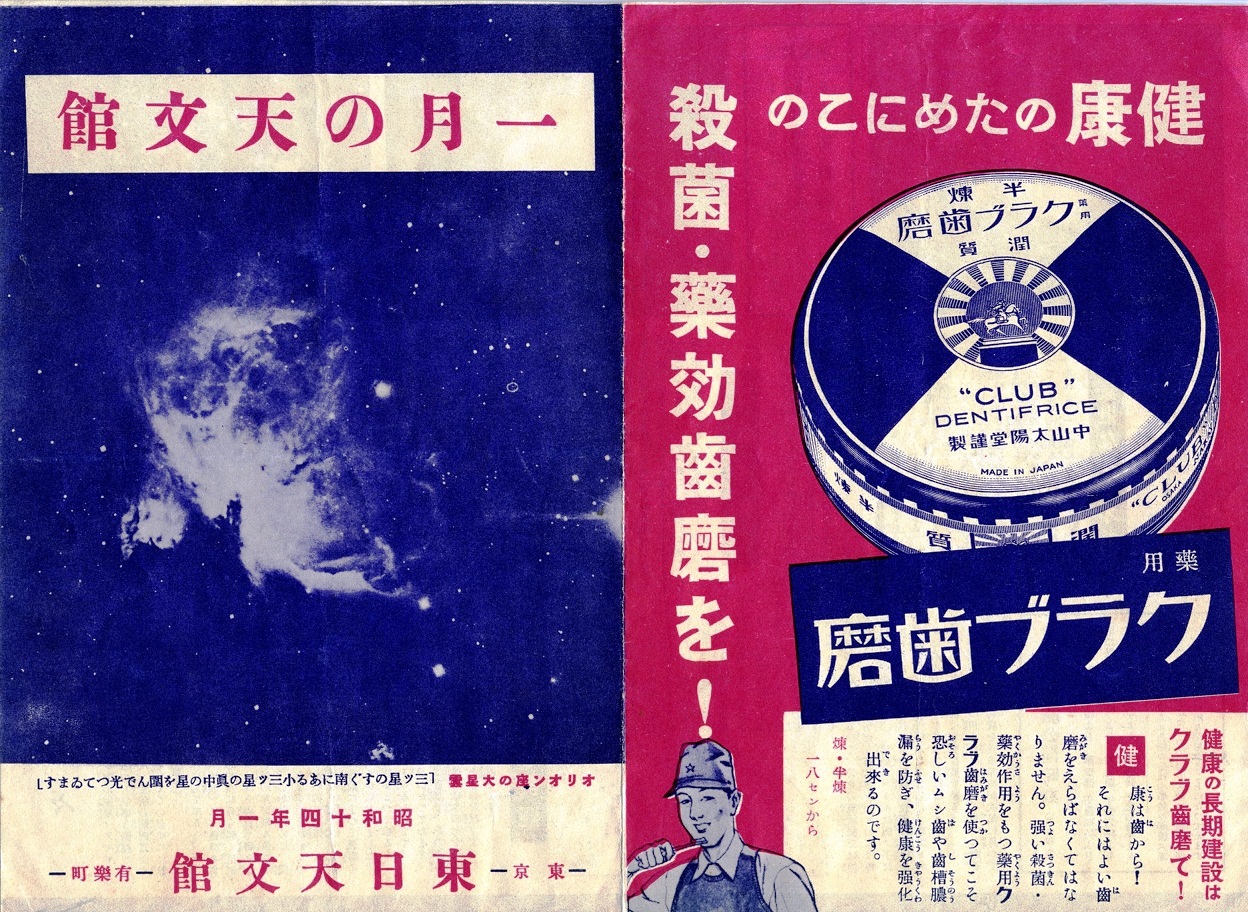
Issued in the year after opening, the explanation titled "Flickering Stars" at the beginning reads: "Withered treetops are lashed by the winter wind with a sharp whistling sound. In the crisp clear night sky, clusters of stars like jewels shine. It is a good season for stargazing, but fierce air currents are a drawback. Star images flicker and are hard to see. At worst, stars dance in the telescope field."
The latter part of this explanation notes of the moon: "This month at full moon it comes closest to Earth, at about 357,000 km. The average distance is 384,400 km, so it approaches considerably." The moon, orbiting on an elliptical path, was nearest to Earth—what we now call a "supermoon," appearing larger and brighter than usual.
"Supermoons" in recent years occurred on March 19–20, 2011 (Heisei 23), and May 5–6, 2012 (Heisei 24). In March 2011 the moon and Earth were at their closest in eighteen years—an "extra supermoon." This year there will be a supermoon on June 22–23.