
Militarism accelerated by the February 26 Incident of 1936. On the fiscal front as well, the incident became a turning point.
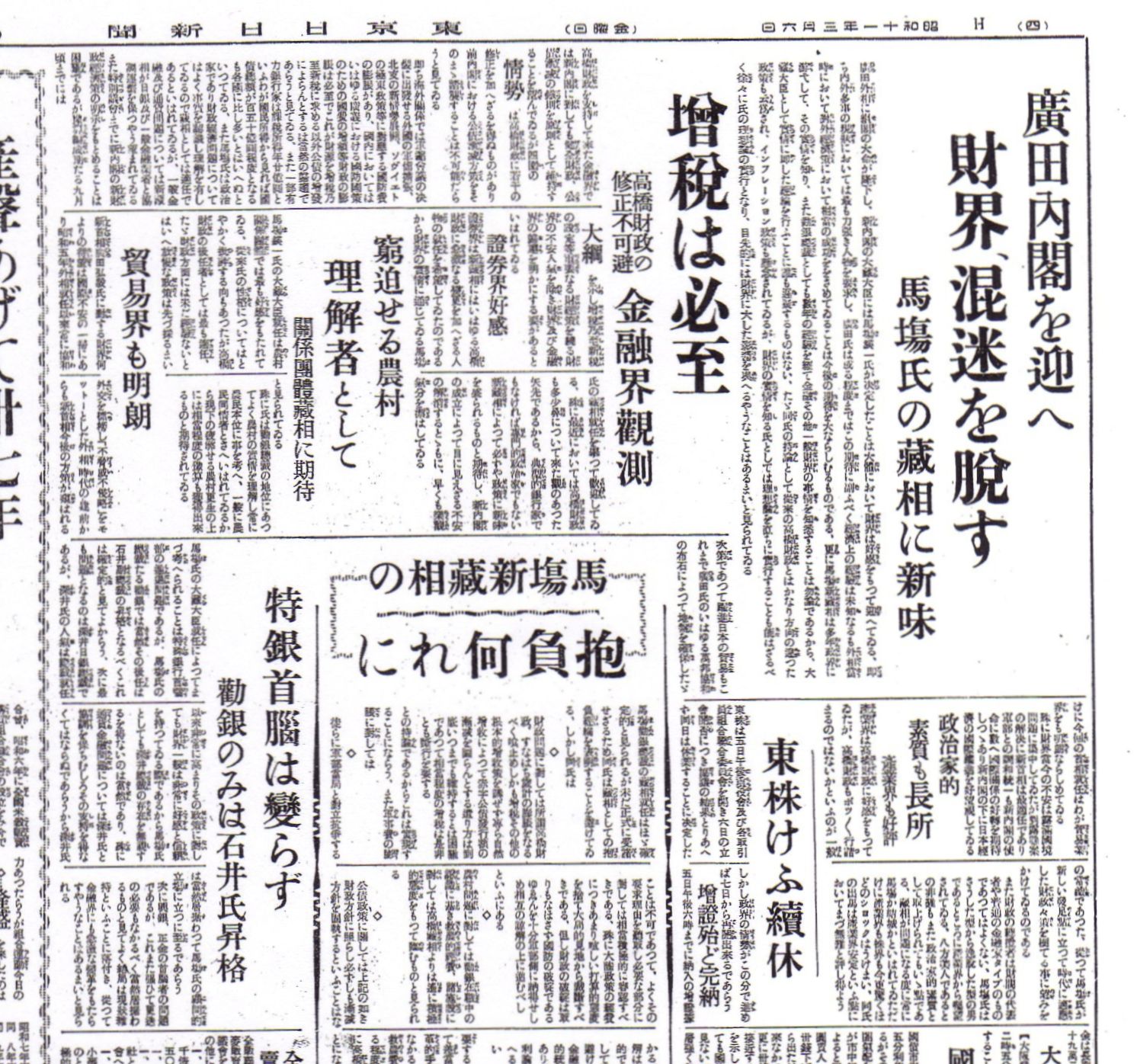
Following the Tokyo Nichi Nichi Shimbun (predecessor of The Mainichi Newspapers), once the incident settled and the Hirota Kōki cabinet was formed, headlines about "tax increases" appeared in the papers day after day. This was the consequence of Finance Minister Takahashi Korekiyo of the Okada cabinet being assassinated in the February 26 Incident.
Takahashi is famous for bold reflation—printing money hand over fist to pull the Japanese economy out of the deflation of the Great Depression. Under the Okada cabinet, however, the backlash against fighting deflation raised fears of inflation instead, and a austerity course was pursued with cuts to the military budget. This earned the ire of the military.
The finance minister in the Hirota cabinet was a man named Baba Yūichi. He moved from the Ministry of Finance bureaucracy into politics, but is not widely known.
The March 6 morning edition, anticipating Baba's appointment as finance minister, ran an article under the headline "Tax increase inevitable—revision of Takahashi finance unavoidable," arguing that "the situation on all sides requires some revision of Takahashi finance," that fiscal expansion was inevitable to meet foreign arms buildups, developments in North China, Soviet Far East policy, and the like, and that "aside from tax increases or new taxes, increased bond issuance is naturally to be expected"=photo bottom. The top story of the March 10 morning edition announcing the cabinet's inauguration carried the bold type "Rising national expenditure unavoidable—establishing the foundation of finance essential," reporting Finance Minister Baba's statement advocating fiscal expansion=photo top. The March 6 edition also introduced Baba as someone who "while president of the Agricultural Bank of Japan well understood rural realities... is even called a friend of farmers, and is expected to secure a considerable budget for the revival of today's exhausted countryside."
Incidentally, Finance Minister Baba drafted a fiscal 1937 budget with spending up 34 percent year on year, military spending up 33 percent, and bond issuance up 41 percent—a lavish spread. The Hirota cabinet resigned en masse in January 1937; the budget itself never saw the light of day, and Baba himself later fell ill and passed away at the end of 1937.
In any case, fiscal policy lost its brakes after the February 26 Incident, continued to expand as the war front spread from China to the Pacific, and led to postwar hyperinflation.