

This is the third postcard from amateur astronomer Seiji Ogawa showing the Tō Nichi Planetarium in Yurakuchō, Tokyo—the city's first planetarium facility.
The postcard titled "Corona" depicts a total solar eclipse. The sun hidden by the moon. Around it, large rays of the sun's gaseous body extend radially, and at the edge of the black shadow one can also see red rising flames called prominences.
Unlike the postcard "A Solar Eclipse as Seen from the Moon" introduced earlier, which was imagined, "Corona" is quite realistic. As the explanation on the postcard notes, it is based on an observation and sketch made in Hokkaido during the total solar eclipse on the afternoon of June 19, 1936—about a year and a half before the Tō Nichi Planetarium opened.
This year's annular eclipse on May 21 set all of Japan abuzz, but the total eclipse of 1936 seems to have caused an even greater frenzy. Excluding the eclipse viewed from Torishima on June 9, 1918, it had been forty years since an eclipse was observed in Japan—in Hokkaido on August 9, 1896—so the country was awash in eclipse observation.
Dark sunglasses sold like hotcakes nationwide; in Hokkaido, where conditions were considered best, many schools closed for observation, and student groups traveled on special trains for viewing tours. Observation stations were set up across Hokkaido, with many street stalls nearby. When the sun was eclipsed, security staff rushed toward the telescopes to see for themselves, causing such chaos that they could no longer maintain order—or so the story goes.
The media, of course, covered it on a grand scale. NHK relayed broadcasts from 28 stations nationwide, from Kagoshima to Memanbetsu. With no television images yet, conveying the scene in words alone while looking at the sky was quite a struggle for announcers.
The Tokyo Nichi Nichi Shimbun and Osaka Mainichi Shimbun (both predecessors of The Mainichi Newspapers) also filled their pages day after day with eclipse articles, beginning with advance notices. They reported precautions to avoid eye damage and anxiously tracked the weather. On the day itself, headlines such as "Strange sight in the telescope!" and "This wonder in daylight without light" described observations in Hokkaido and elsewhere, while in Tokyo, where a drizzle fell, headlines like "Heartless skies over Keihin" and "The telescope yawns" told of disappointed amateur astronomers. Photos taken in Hokkaido were also flown in on company aircraft for a special extra edition=photo bottom.
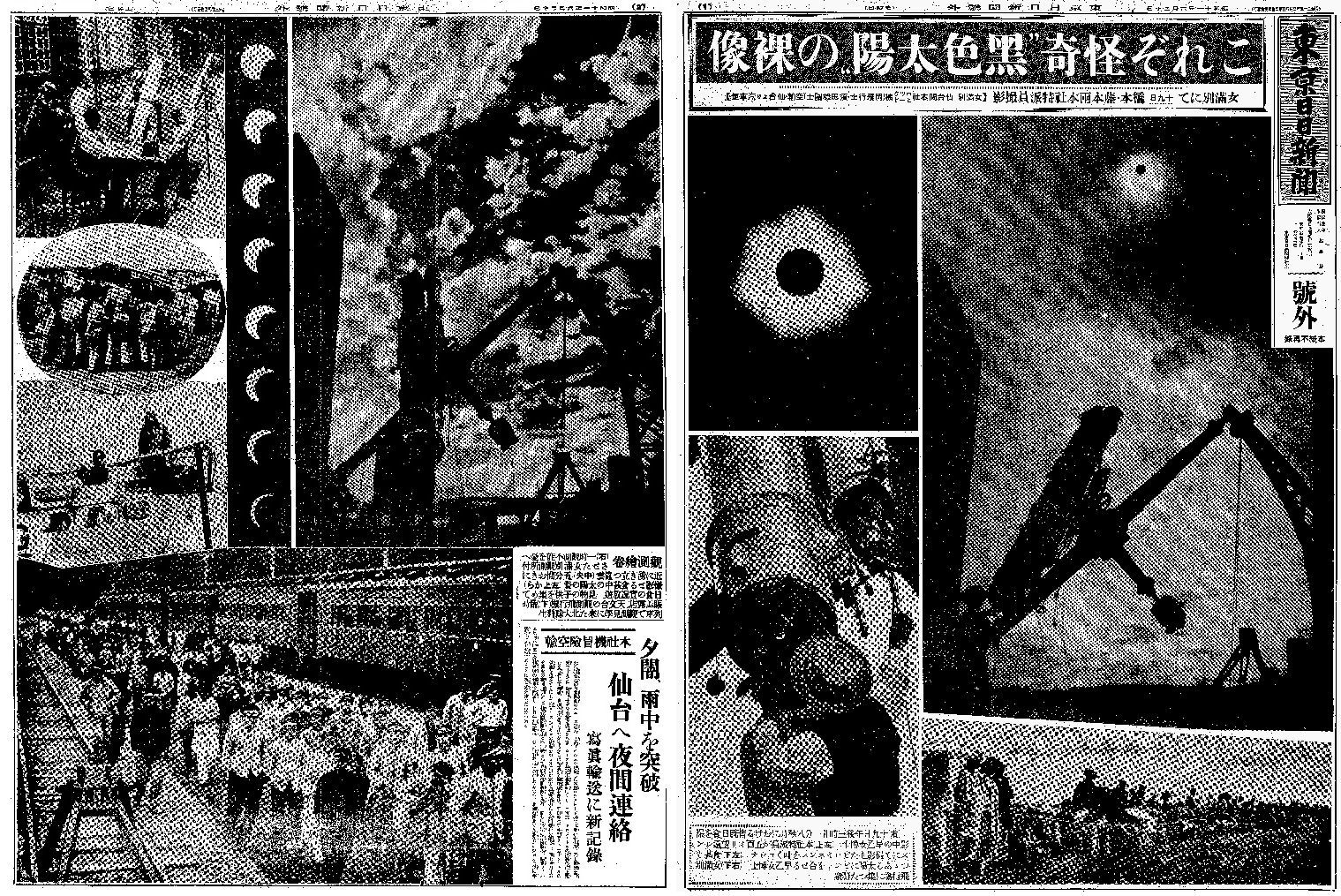
With this great celestial event, romance for the cosmos must have surged—and the Tō Nichi Planetarium's popularity likely grew as well.