
In 1936, the February 26 Incident also sealed off the area in front of Takebashi with barricades. Let us turn a few more pages of the Tokyo Nichi Nichi Shimbun of that time (predecessor of The Mainichi Newspapers).
The February 26 Incident accelerated militarism, and Japan plunged into the Second Sino-Japanese War with the Marco Polo Bridge Incident in July 1937—heading toward ruin. Yet articles that confirm what kind of era it was also filled the pages at the time of the incident itself.
The February 29 morning edition carried the headline "Large Communist forces—situation of sweeping through Shanxi," reporting that "if the main force of the bandits (the Communist army) concentrates in Shanxi, it will be difficult for the Shanxi army alone to stop them." Relations with the Soviet Union were also covered: "Manchuria conflict incidents—270 in all; Russia's attitude lacking sincerity" (February 29 evening edition), conveying rising tensions. Incidentally, the Nomonhan Incident, in which Japanese and Soviet troops clashed on the Manchurian-Mongolian border, came three years later.
Footsteps toward world war were steadily growing louder. The February 29 morning edition reported clashes among nations at the London Naval Conference. This was the "Second London Naval Conference" following the 1930 conference that had at least reached agreement among Japan, the United States, and Britain on naval reduction—but Japan had withdrawn in January of that year, and the article ran under the headline "Naval conference after Japan's withdrawal—U.S. versus France and Italy; Britain's worry as mediator; a wagon with a broken axle," in a cool tone. Italy also withdrew afterward; although the United States, Britain, and France reached agreement in late March, it was not enough to prevent world war.
Furthermore, the March 8 morning edition took the headline "Another bomb in European politics" in bold reverse type, reporting "Locarno Treaty abrogated—as expected, German government notifies"=photo top. It described the advance of German troops into the demilitarized zone; a same-day extra followed with "War clouds over the Rhine—French government holds emergency meeting." It brings back exam cramming and world history class. This was the end of the Versailles Treaty system that had guaranteed peace after World War I. Japan had signed the Anti-Comintern Pact with Germany the previous year, so the papers took a pro-Germany line.
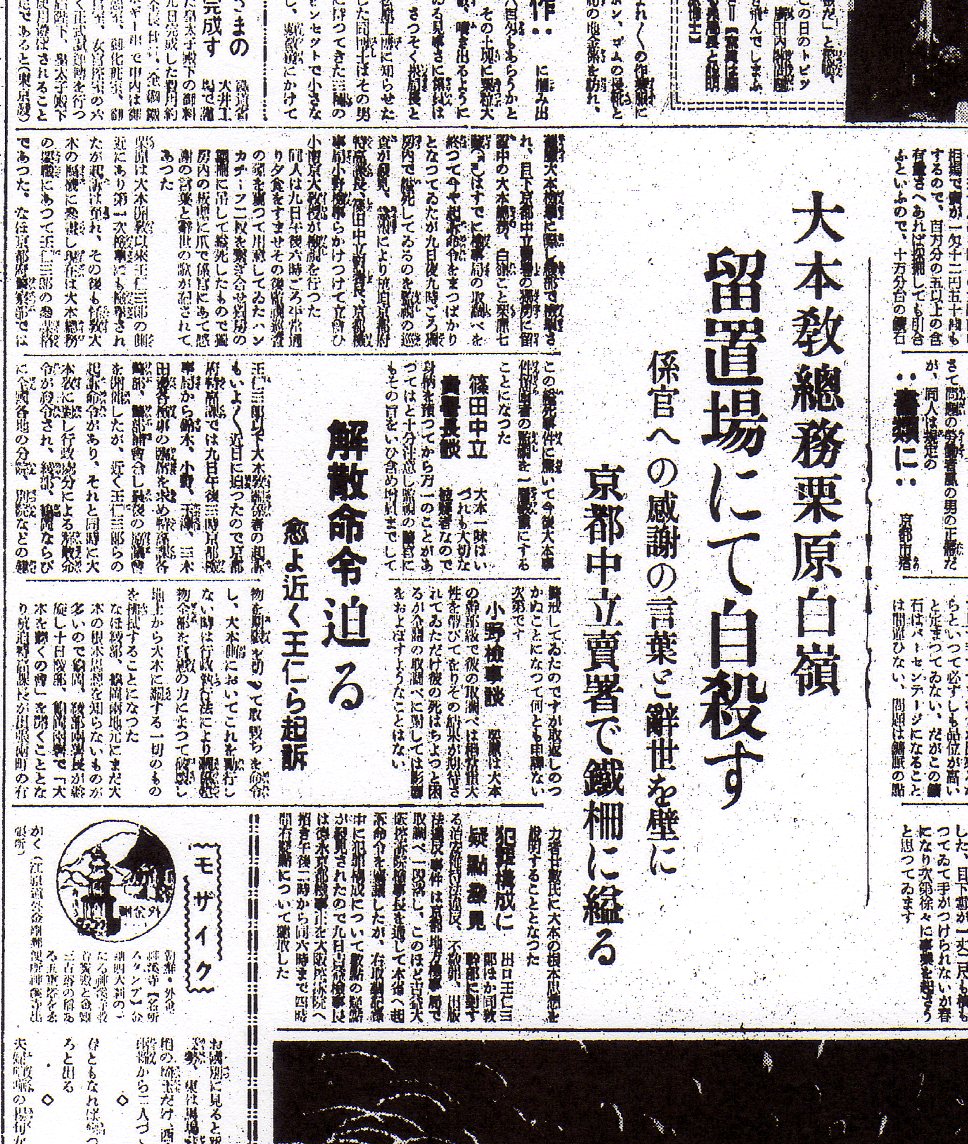
There were also notable domestic articles. The March 10 morning society page ran a large headline: "Ōmotokyō general affairs chief Kurihara Hakurei commits suicide in detention"=photo bottom. This was the first case in which the Peace Preservation Law, aimed chiefly at suppressing communist movements, was applied to a religion; Takahashi Kazumi's Sect is said to draw on this case. Opinions on Ōmotokyō vary, but in any event it was one frame in the larger flow toward a wartime system.