

Amateur astronomer Seiji Ogawa, who sent pamphlets from the Tō Nichi Planetarium—the first planetarium in eastern Japan, in the Tō Nichi Kaikan building of the Tokyo Nichi Nichi Shimbun (predecessor of The Mainichi) in Yurakuchō, Tokyo—has now sent copies of souvenir postcards sold at the planetarium. These are precious materials as well.
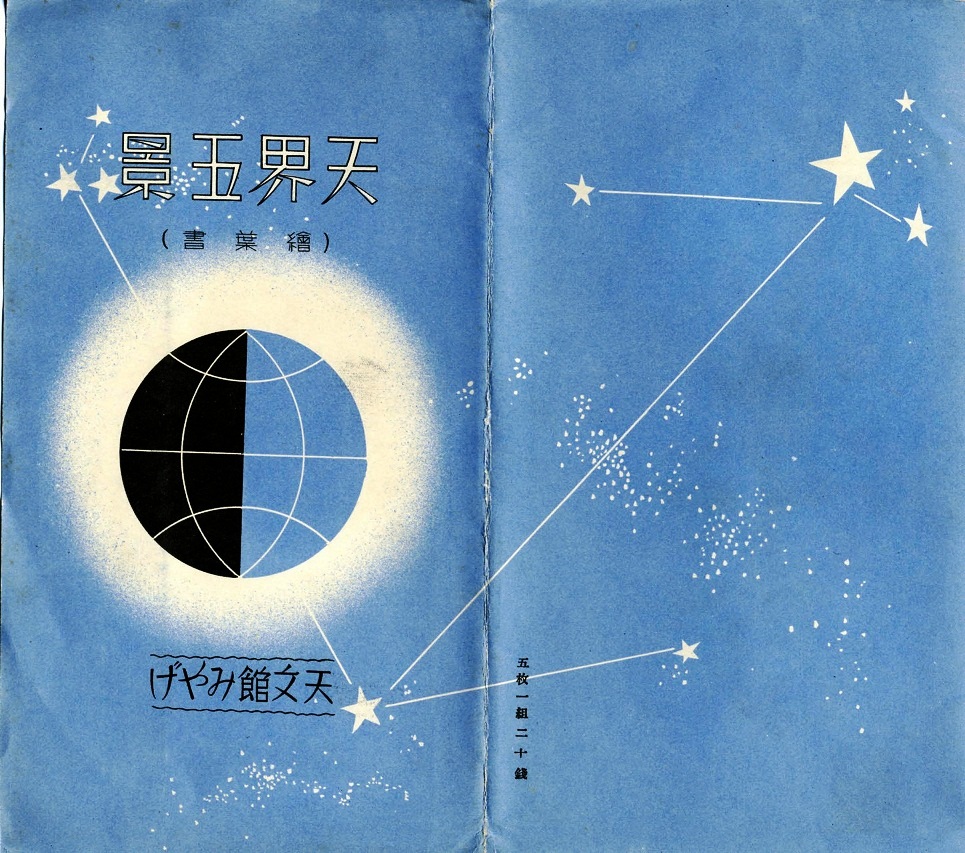
The five-card set titled "Five Celestial Views" cost 20 sen. It came in an envelope illustrated with the Winter Triangle—Sirius in Canis Major, Procyon in Canis Minor, and Betelgeuse in Orion—and a total solar eclipse.
All five are hand-drawn with titles: "Aurora," "Corona," "Solar Eclipse Seen from the Moon," "Earth Seen from the Moon," and "Great Comet."
"Great Comet" depicts the comet that appeared in early February 1843 (Tenpō 14), with the note: "Appeared in the Nordic sky and terrified people of the time. Tail length sixty degrees; period five hundred years."
The postcard shows the view from northern Europe, but records remain of observation in Japan. By late February it was easily visible by day, brighter than magnitude −6 through March, then faded in April and was last seen on the 20th.
The tail was 150 million km—3,750 times Earth's circumference; light from one end to the other takes over eight minutes. Until amateur astronomer Yuji Hyakutake discovered Comet Hyakutake in Kagoshima in January 1996, it was the longest comet tail on record. People feared the long-tailed comet and rumors spread that Judgment Day was near.