
Browsing prewar pages in The Mainichi Newspapers database at the Palaceside Building in Takebashi, I have been looking at how the predecessor Tokyo Nichi Nichi Shimbun and Osaka Mainichi Shimbun covered the February 26 Incident (1936). Even when a major event occurs, ordinary incidents still happen—and the way they are reported is quite something.
What surprised me a little was the morning edition of February 27, the day after the incident, on the society page=photo top. It did devote the top third of the page to the incident with three photos and headlines such as "The capital under emergency guard—an eerie scene along the moat; lights out at banquet halls and pleasure quarters." But the rest included accident reports such as "Police officer suspected of bribery shows favoritism in election enforcement" and "Train collides with truck; five killed or injured," plus "Spurned lover kills beautiful waitress in gruesome murder"—the kind of story that would set off a word processor alert today. There were also "Gold scattered for villagers sunk in reservoir—Ogouchi storage lake," "Girl, 15, dies of stomach cancer—a rare case," "Sweeping away summer train heat—cold-air system first on Tokaido limited express," and "Seventy-year-old woman to South America—Akita emigrant group," among many others. Incidentally, the cold-air system was initially limited to dining cars: "A freezer room is built by converting a storeroom or cabinet, and a fairly powerful fan blows cold air over the ice surface into the car"—the latest weapon of its day.
It was also the season for selecting schools for the national middle-school baseball tournament (today's Spring Koshien), and the headline "Twenty schools chosen for the sunny tournament—East Japan hopes Sōji and Kiryū advance" appears (March 4 morning edition). Last year, after the Great East Japan Earthquake, whether to hold Koshien was debated; one wonders whether similar anguish existed around February 26—"at a time like this" versus "precisely because it is a time like this."
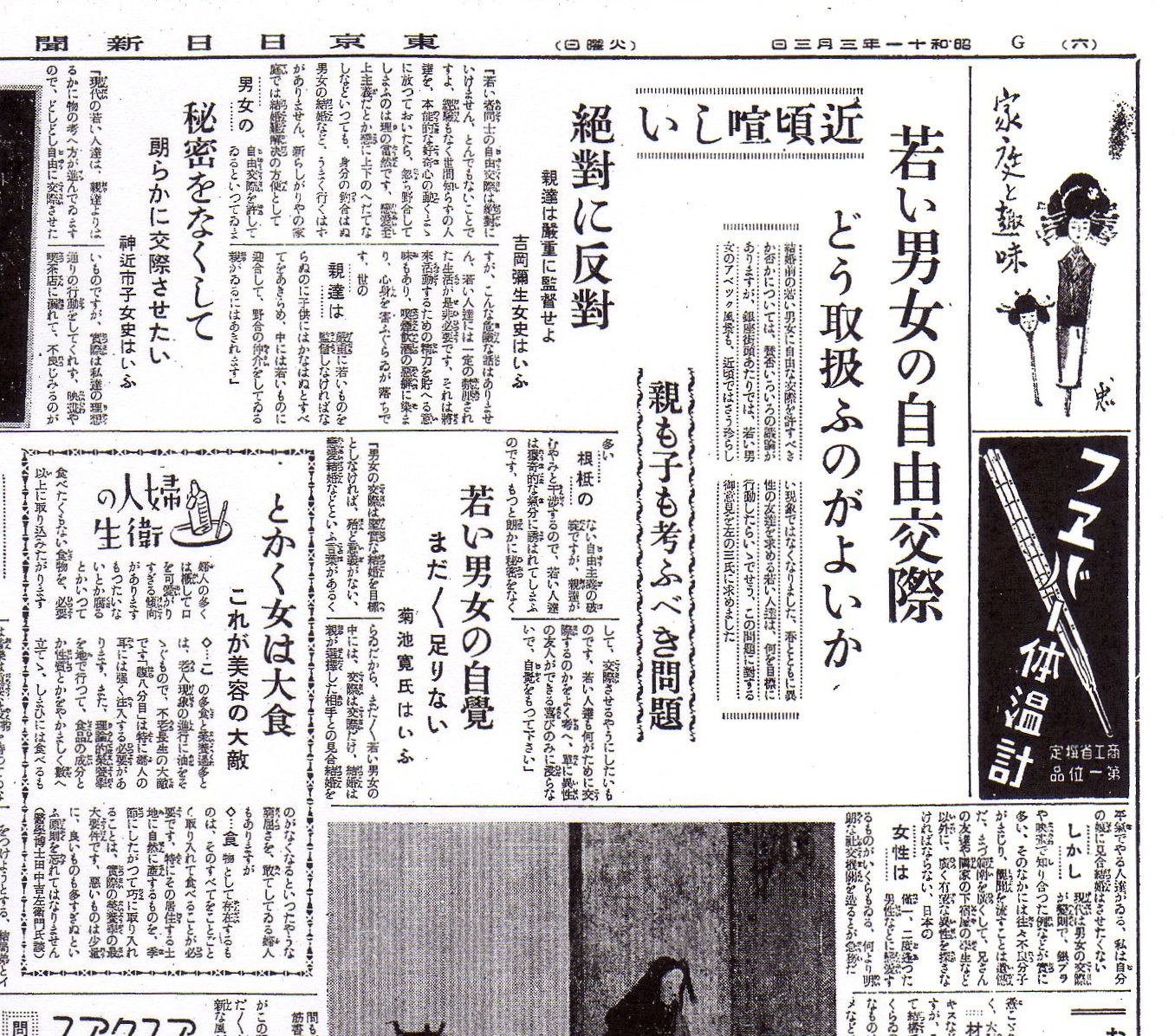
Going its own way is the "Home and Hobbies" page (today's lifestyle section)=photo middle. The March 3 morning edition ran a feature titled "The noisy free association of young men and women lately—how should it be handled?" presenting views from three experts. The lineup is formidable. Yoshirō Yoshioka, physician and educator who founded the predecessor of Tokyo Women's Medical University, said "Absolutely opposed—parents must supervise strictly." Feminist and later Socialist Party Diet member Ichiko Kami said she wanted "open association without secrets." Journalist Kan Kikuchi wrote that "young men and women still lack sufficient self-awareness"—a theme that would be hard to imagine today, discussed in all seriousness.
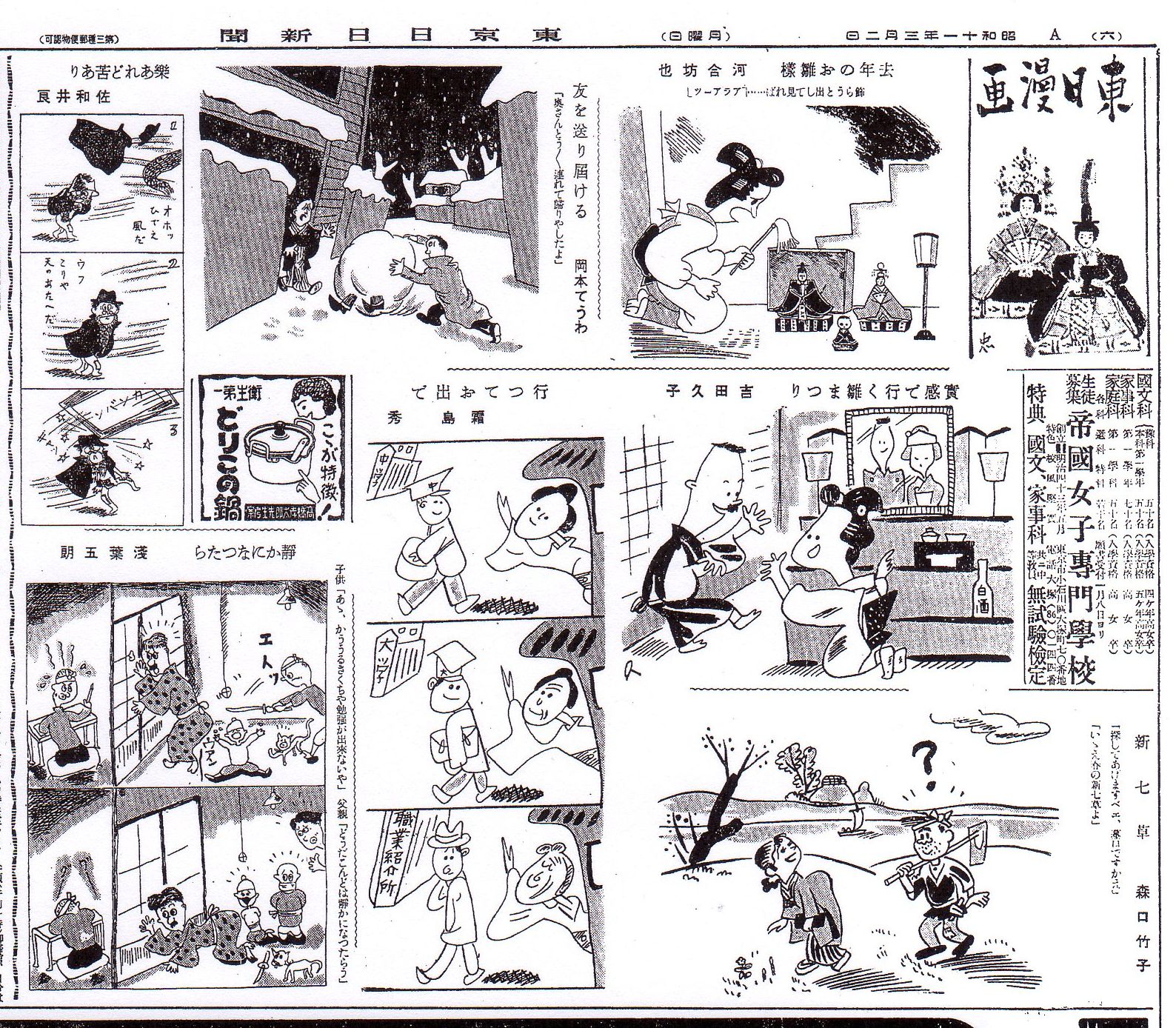
Cartoon features also reflect the times nicely. On the first Monday of each month there was an "Tō Nichi Manga" page publishing several reader submissions; it was not suspended on March 2. One that caught my eye was a three-panel strip titled "Go on, off you go," in which the destination a mother sees off her son changes with age: ① middle school ② university ③ employment agency=photo bottom, center. On the same page April 6, a man who became a bill collector for an electric company grumbles, "Who'd have thought I'd end up dunning myself?"—probably reflecting the difficulty of finding work.