
The February 26 Incident paralyzed the Imperial Palace including Takebashi and the heart of Japan. This continues our look at how the predecessors of The Mainichi Newspapers — Tokyo Nichi Nichi Shimbun (1872, Meiji 5) and Osaka Mainichi Shimbun (1876, Meiji 9) — covered it.
For so great an event, related articles appear mainly on pages 1 and 2, society, and economy — surprisingly concise. Morning editions ran 8–14 pages and evening 4–8, fewer than today, so they still devoted considerable space ...
The main thread of the incident and political aftermath, covered chiefly on page 1, was supplemented by side stories on the society pages — each paper surely competed to "make readers read."
First to catch the eye: articles on the five police officers killed in the incident. Four died at the prime minister's residence and one at the former home minister's official residence. The first report came on the March 1 morning front page; the March 2 society page filled the top third with the story, writing that "the four officers guarding the prime minister's residence would surely rejoice underground to know of Okada's miraculous survival, that their service had meaning."=photo top. Condolence funds were collected for the five officers; as "nation stirred by tragic police spirit" (March 3 morning) was reported, more poured in — "Whirlwind sympathy for bereaved families — soon 3,000 yen" (March 3 evening), "Contributions finally break 100,000 yen" (March 8 morning). "Stirred by emotion," "whirlwind sympathy" ... what expressions!
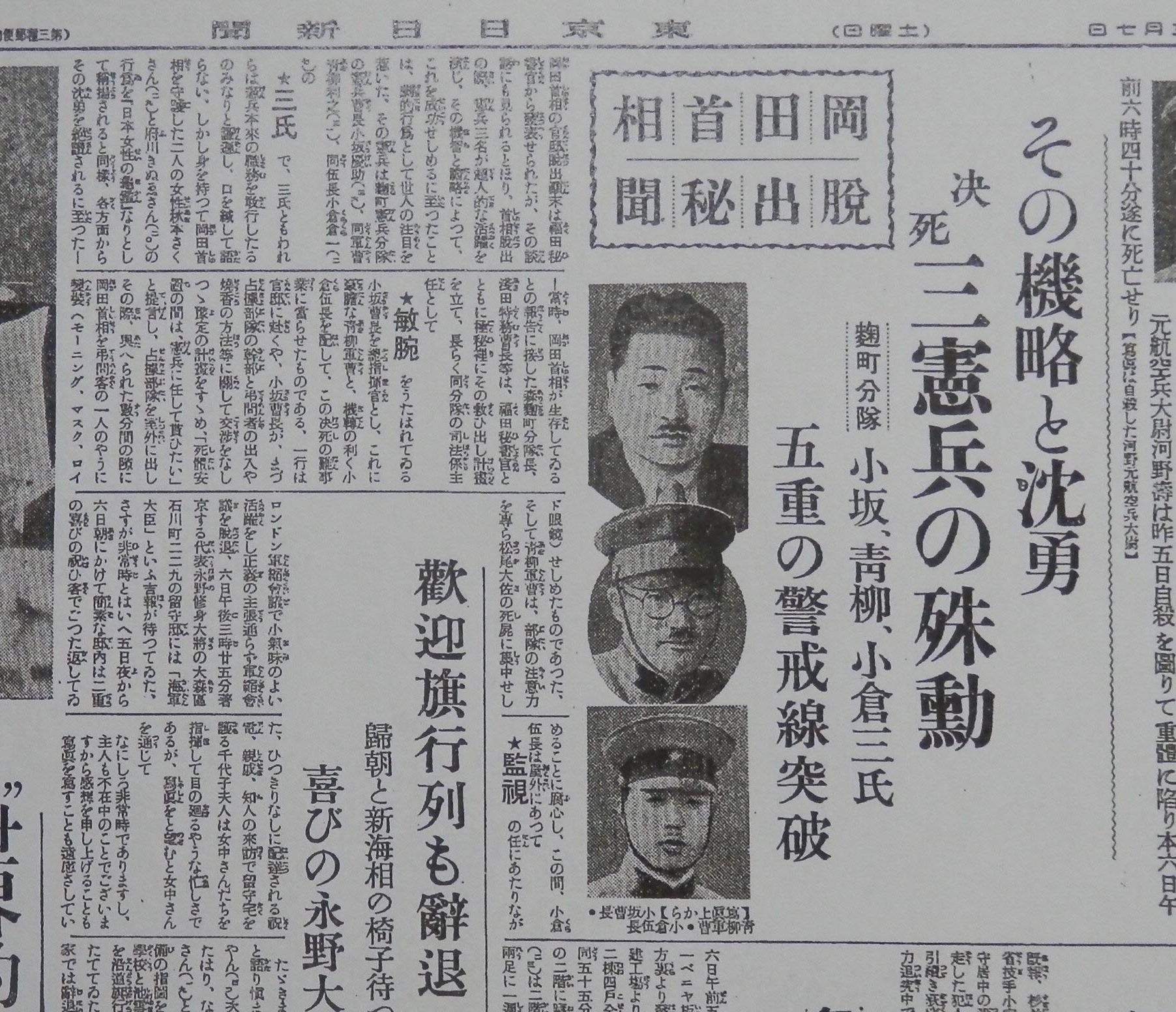
Colonel Matsuo Denzo, who died in Prime Minister Keisuke Okada's place, was also profiled in detail on the March 2 society page alongside the five officers, filled with praise: "upright, warm-hearted, a true old samurai." Okada's escape drama surely drew interest too. On March 7 morning the headline leaped: "Secret of Prime Minister Okada's escape — his stratagem and calm courage — distinguished service of three gendarmes who risked death," with body text in a somewhat storytelling tone: "... proposed 'Let the gendarmes handle the room where the body lies,' sent occupying troops outside, and in a few minutes' gap disguised Prime Minister Okada as a mourner (morning coat, mask, Lloyd glasses) ... seized the moment to break through five layers of guard like a falcon ..."=photos bottom left.
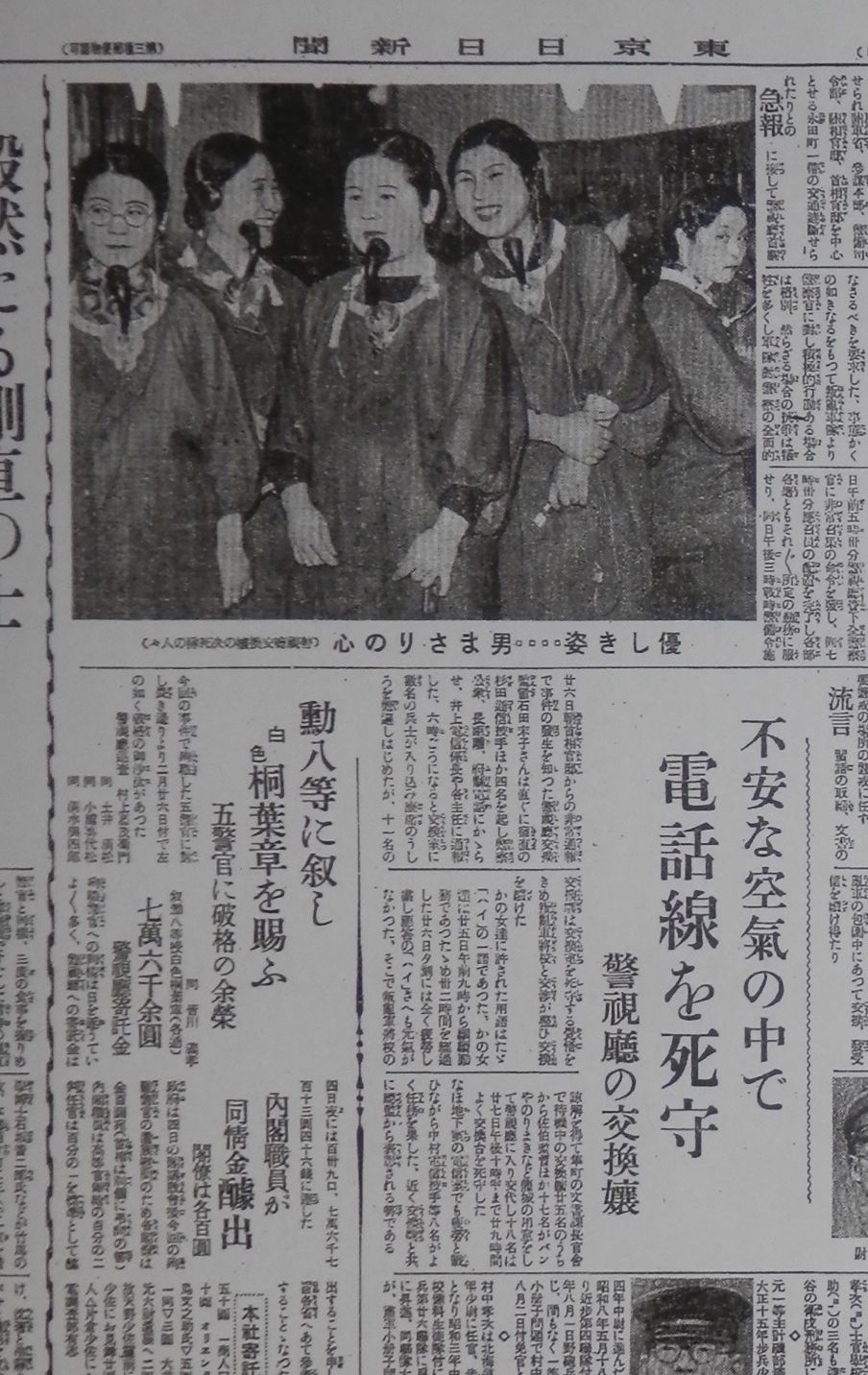
Another "heartwarming tale" widely reported was the telephone operator at Metropolitan Police Headquarters. With headquarters at Sakurada Gate in rebel-held territory, an emergency command was set up at Kanda-Nishikicho Police Station for general public order. The police telephone hub could not be moved — it had to stay at headquarters — hence "Defending the lines in uneasy air — telephone operators at Metropolitan Police Headquarters" (March 5 morning=photo bottom right). "Operator" sounds retro, but under rebel surveillance, ordered to say nothing but "yes," they kept working for 32 hours after the incident — reported at length with photos.