
The other day I introduced photographs of Takebashi during the February 26 Incident. Looking through The Mainichi Newspapers' pages of the time is full of interest. The Mainichi's predecessors were Tokyo Nichi Nichi Shimbun (founded 1872, Meiji 5) and Osaka Mainichi Shimbun (1876, Meiji 9); the two merged in 1911 (Meiji 44), but the unified masthead Mainichi Shimbun came only in 1943 (Showa 18) — so at the time of the incident they were still separate papers.
Following the story: on the 26th an extra edition announced the outbreak; the morning edition of the 27th reported "Prime Minister, Home Minister, Education Superintendent dead on the spot; Lord Chamberlain seriously wounded; Finance Minister injured"=photo top. Prime Minister Keisuke Okada survived when his brother-in-law Colonel Matsuo took his place, as is well known, and Finance Minister Takahashi Korekiyo's death was later confirmed.
Suppression came on the 29th. Before dawn that day a punitive order was issued, leaflets scattered, balloons reading "Do not salute the army flag" raised, and radio broadcast an appeal titled "To the Soldiers" beginning "An imperial command has been issued. His Majesty's order has already been given." The ringleader officers were arrested. Rebel privates and noncoms returned to their units by 2 p.m.
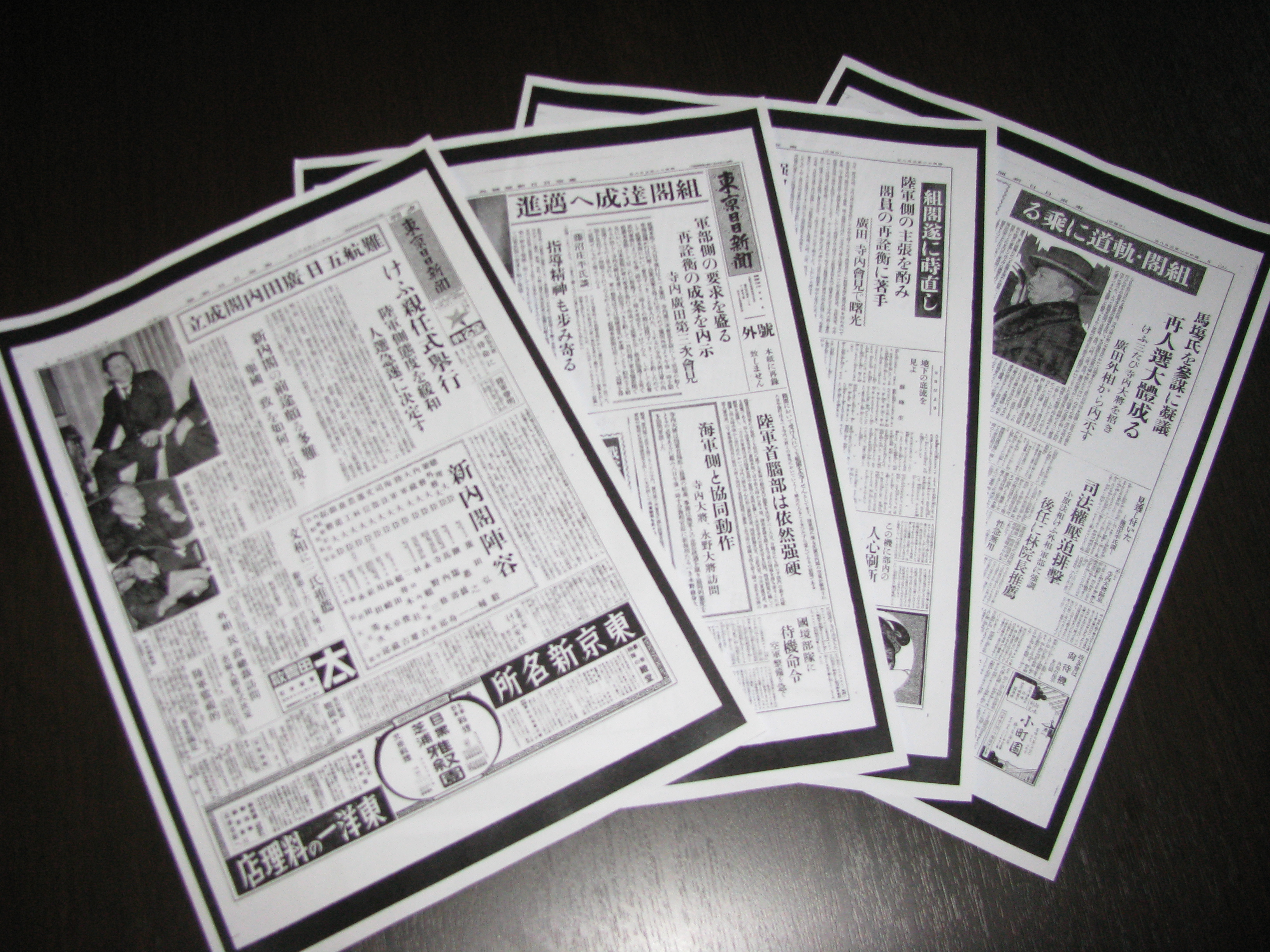
Thereafter the papers were filled day after day with cabinet formation after the mass resignation. Elder statesman Kinmochi Saionji handled recommendations for the next prime minister, reporting his movements in huge type as "Lord Saionji." Konoe Fumimaro, first chosen, declined (March 4); Foreign Minister Koki Hirota was to form a cabinet, but after the March 5 extra "Imperial command to organize cabinet — conferred on Foreign Minister Hirota," difficulties mounted. Yoshida Shigeru and others briefly coalesced — "Cabinet framework formed" (March 6 morning) — but army interference brought "Hirota cabinet on brink of miscarriage" (March 7 morning); the evening edition of the 7th reported "Situation shifts" and a swap of home minister from Takuyoshi Kawasaki to Ambassador Matsudaira in London. "Cabinet reshuffle — weighing army demands" led to a full review of ministers. Then "Advancing toward cabinet completion" (March 8 extra), "Cabinet work postponed again" (March 9 morning), and finally the March 9 extra "Hirota cabinet formed" with a roster, and March 10 morning "Five days of struggle — Hirota cabinet established"=photo bottom. The foreign minister post, the main focus, was held concurrently by Prime Minister Hirota; Home Minister was Ennosuke Uki.
Knowing the history of the army holding the nation "hostage" by refusing to supply an army minister, it all makes sense — yet following the daily pages while revisiting a historic event yields many discoveries.
The Mainichi Newspapers has digitized past pages and surviving photographs. Photos can be searched at the Mainichi Photo Bank (https://photobank.mainichi.co.jp/php/KK_search.php), and pages can be copied at The Mainichi Newspapers in Palaceside Building (for a fee).