

Autumn deepens; clear nights make stars shine brighter. This year brought a "triple 金" of celestial shows — annular solar eclipse in May, Venus transit in June, Venus occultation in August — and November still brims with cosmic events.
On the 14th an total solar eclipse was seen in Cairns, Australia; on the 17th the Leonid meteor shower peaked. On the 27th Venus and Saturn made a close approach; from after 9 p.m. on the 28th a penumbral partial lunar eclipse occurred, and on the 28th–29th the Moon and Jupiter drew near.
Planetariums nationwide will likely reproduce and project these shows.
Planetariums tie closely to The Mainichi Newspapers, tenant of Palaceside Building in Takebashi. Tokyo's first — Japan's second, the world's 27th — opened November 2, 1938 (Showa 13) at the Tonichi Kaikan, headquarters of the predecessor Tokyo Nichi Nichi Shimbun in Yurakucho, as the Tonichi Observatory.
Amid marching boots and jingoistic reporting, the Tokyo Nichi Nichi Shimbun on November 2 announced the opening and explained the planetarium — "Made by Germany's Carl Zeiss; 180 lamps project 9,000 stars." The November 3 evening edition splashed front-page headlines such as "Essence of scientific culture — Tonichi Observatory" and "Planetarium demonstration wins acclaim," with speeches by chairman Takamagohara Takagoro and construction committee chair General Suzuki Takao, and Education Minister Araki Sadao
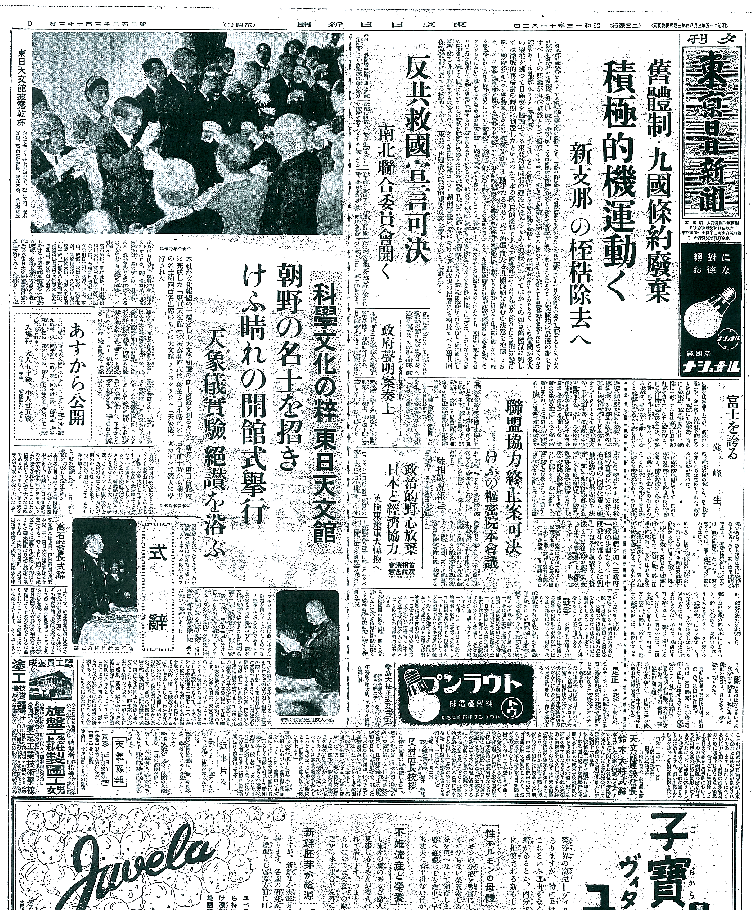
congratulating the morning opening, plus lavish coverage on pages two and three. Planetariums were called "planetarium instruments" (tenkogi) then.
Prime Minister Konoe Fumimaro, Navy Minister Yonai Mitsumasa, the German ambassador to Japan, and others sent greetings; some 400 dignitaries attended. Guests included Tokyo Asahi Shimbun chief writer Ogata Takekazu, Tokyu president Gotō Keita — who later built the postwar Goto Planetarium — and suffragist Ichikawa Fusae. Painter Yokoyama Taikan said: "When stars first appeared in the planetarium, I thought the roof had opened — the sun moved so fast I knew it was artificial, yet it was as beautiful as the real thing." Children's author Muraoka Hanako said: "Ideal for children's education — perfect teaching material; for city children who cannot know the stars, splendid moral education." Both remarks appeared in that day's paper.
Tonichi Kaikan later became Mainichi Kaikan. The Tonichi Observatory, a Tokyo attraction that showed countless celestial scenes to prewar children and became Mainichi Observatory, was sadly destroyed in the May 1945 (Showa 20) air raids.