
In the 1878 (Meiji 11) Takebashi Incident, Konoe Artillery 1st Battalion soldiers rebelled and shelled Councilor Okuma Shigenobu's (1838–1922) residence — now the area around Chiyoda Ward Office, as I wrote recently. Before the ward office stands a monument to "Marquis Okuma Shigenobu's Kijibashi Residence Site"=photo top.
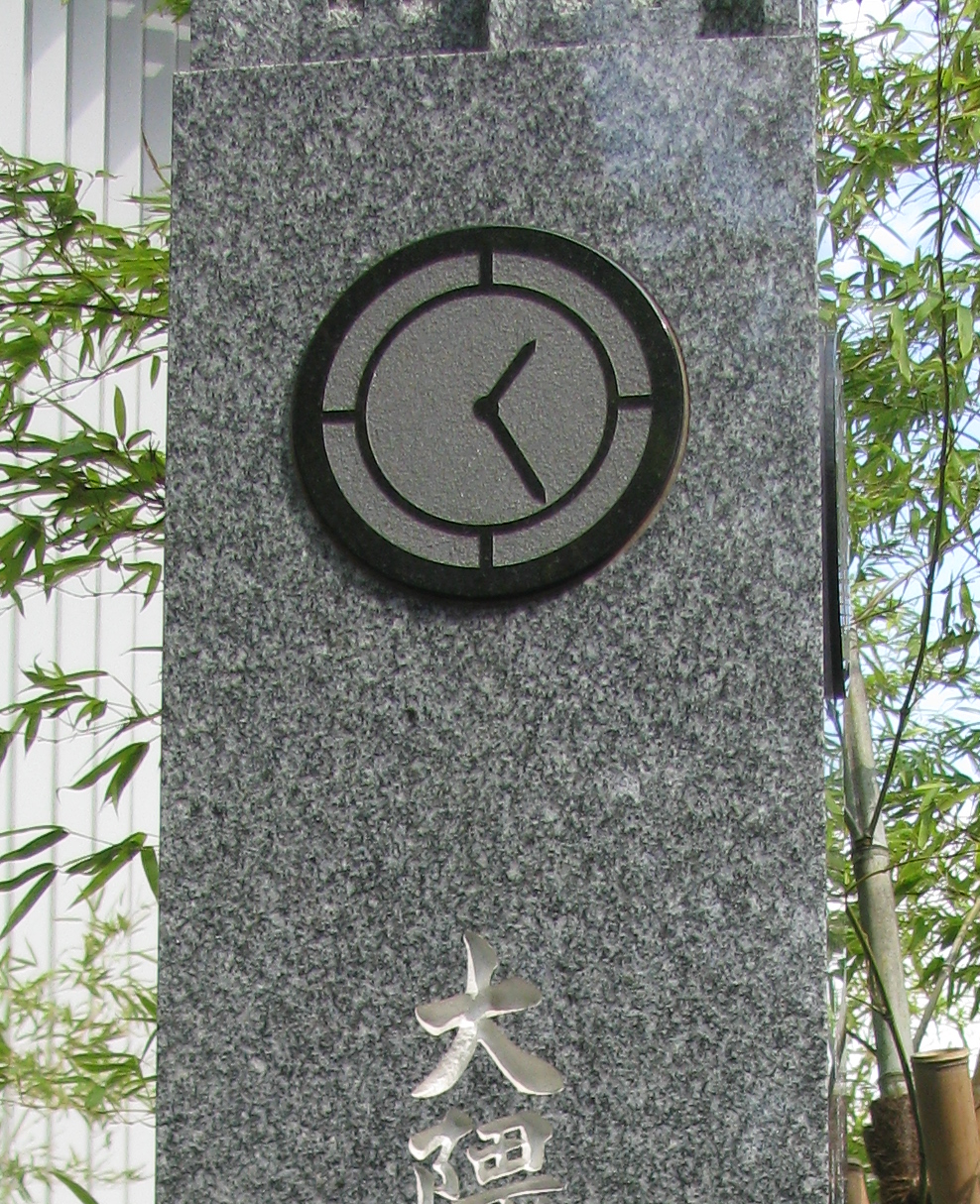
Over 2.5 meters tall, perhaps. The stone is "Tenzan mikage-ishi" from Okuma's home prefecture, Saga — among the hardest domestic stones with the lowest water absorption. The top mimics the clock tower of Okuma Auditorium=photo bottom left. Wait — a strange clock up there too=photo bottom right. It seems to point to about 1:25. What could it mean?
The inscription reads: "Commemorating the 125th anniversary — October 2007 (Heisei 19) — Waseda University Chiyoda Inamon-kai." A joke tied to the 125th anniversary.
Just in case, I asked Chiyoda Inamon-kai: "125" is a very important number for Waseda. Okuma Auditorium's tower is 125 shaku (about 38 meters) high, and the 125th anniversary matters far more than the 100th; 2007 was positioned as the start of the "second century," with major faculty reorganization and a large Okuma Auditorium renovation.
Why 125? It goes back to Okuma's "125-year life theory." Based on a German physiologist's idea that "animals live five times their maturity," and "human maturity is about 25, so five times that — 125 years is possible," he is said to have argued.
What set Okuma apart was not merely preaching the theory but practicing it: up at 5 a.m., bed at 9 p.m., and the daily rule — "see everything optimistically; do not anger, covet, or complain; work for the world." He formed his second Okuma cabinet at 77 and lived to 83. Average male life expectancy in Japan then was about 42; reaching one's fifties came only after the war, in 1947 (50.06 years). Okuma lived 41 years beyond the average — add that to today's roughly 80 and you get about 120. He lived almost as his "prophecy" predicted.