

Mornings and evenings have turned sharply colder lately—it really feels like deep autumn. Even in central Tokyo, trees tinged red and yellow are starting to stand out. Among autumn foliage trees, winged spindle (nishikigi) is especially spectacular. Its blazing red that overwhelms everything else is deeply impressive. The name is said to come from comparing its splendid autumn colors to brocade.
Near Palaceside Building in Takebashi, Tokyo, Kitanomaru Park has about 100 winged spindle trees planted, and some have begun to turn. On a single tree, branches with reddened leaves mingle with branches still holding green leaves—a curious sight. The whole tree will redden further from here; according to the park management office, foliage is running quite late this year, with peak viewing expected in late this month or early next.
Winged spindle autumn color ranks with America's lily-of-the-valley tree (suzuran-no-ki), which in summer bears flowers resembling li
ly-of-the-valley, and China's nissaboku, whose leaves shift gradually from orange to red, among the world's three great autumn foliage trees. (Some say the third is maple rather than nissaboku.)
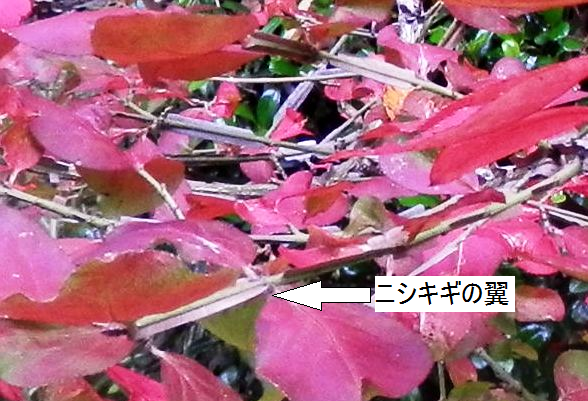
A major feature is the corky wings on the branches—easy to spot in a grove. The wings also resemble razor blades, giving the name kamisori-no-ki (razor tree). Because birds cannot perch on winged branches, it is also called toritomarazu (birds-do-not-stop). Charred wings applied to rice grains on affected skin are said to draw out splinters—a folk remedy known as togenukisan (splinter-removal plant).