
Shibata Gorō (1860–1945), later Army general, left a vivid account of the "Takebashi Incident" (1878=Meiji 11), when soldiers of the 1st Battalion, Imperial Guard Artillery, stationed near Takebashi, rose in revolt—though at the time he was an Army Officer School cadet. I recently introduced Records of a Meiji Man—The Posthumous Writings of Shibata Gorō of Aizu (1971, Chūkō Shinsho), based on his memoirs; this time the Ishimitsu family of the author Ishimitsu Mahito (1904–75).
Before the war Mahito was a reporter for the Mainichi Shimbun predecessor Tokyo Nichi Nichi Shimbun, but his tie to Shibata goes back to his father Makiyo (1868–1942)=photo top.
Among Shibata's benefactors was Noda Hiromichi. After serving as the first governor of Aomori Prefecture and other posts, Noda became a baron and House of Peers member; originally he held various Army finance posts, built the foundations of military accounting, and looked after juniors including Shibata. Noda came from the Ishimitsu family of Kumamoto domain—Makiyo's uncle. When Makiyo came to Tokyo to take the Army Cadet School exam but idled away his time, Noda scolded him and entrusted him to Shibata. That was how Shibata and Makiyo met.
Thanks to Shibata's guidance, Makiyo passed and served as an officer in intelligence in Siberia and Manchuria. According to the National Diet Library site, after the Sino-Japanese War he went to the continent, took leave, studied in Russia, entered the reserves, lived as a continental adventurer in Manchuria and Siberia, and was recalled for the Russo-Japanese War and Siberian intervention, again in intelligence—with titles such as "interpreter attached to the Kwantung Governor-General's Army Department, May 1906" and "contract employee, Kwantung Governor-General's Army Department, December 1917." Shibata also served in intelligence in China; one theory holds that Makiyo disguised himself as a photographer on intelligence work, following Shibata's methods.
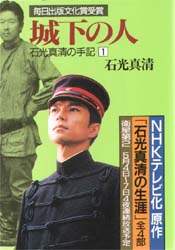
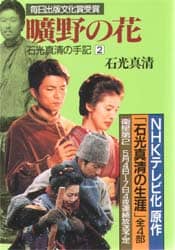
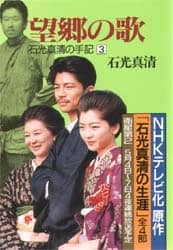
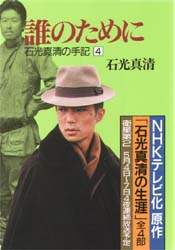
Makiyo's notes were edited by Mahito into a four-volume series (Chūkō Bunko) released in 1958: People of the Castle Town, Flowers of the Wilderness, Songs of Homesickness, and For Whom. They include diaries, notebooks, Russo-Japanese War materials, intelligence reports, orders, cipher tables, and photographs from Siberia and Manchuria. For Whom, for example, tells of being sent back to the continent after the Russian Revolution, thrown onto the front lines of the strategically incoherent Siberian intervention without support, driven from town to town, and withdrawing from intelligence in despair—highly praised literarily and winner of the 12th Mainichi Publishing Culture Award that year. Some may remember NHK's 1998 drama The Life of Ishimitsu Makiyo—A Spy Who Risked His Life on a Dream, starring Nakamura Tōru=photo bottom shows the paperback cover of the time.
The Ishimitsu family had many other distinguished members. Makiyo, second of four brothers, had an elder brother Masumi who was an executive of Japan Beer (predecessor of Sapporo Beer); a younger brother Masami became Army lieutenant general. Sister Matsuko married Hashimoto Utarō, once Masumi's subordinate and later an executive of Dai Nippon Beer after Japan Beer merged; their grandson is former Prime Minister Hashimoto Ryūtarō. Mahito worked prewar for the Japan Newspaper Publishers and Editors Association and postwar as managing director of the Japan Audit Bureau of Circulations, which certifies and publishes newspaper and magazine circulation.
Starting from one incident and tracing various people and their ties to the age—one way to enjoy history.