

North of Palaceside Building in Takebashi, the Kanda Nishikicho area was once an academic district home to the University of Tokyo, Tokyo University of Foreign Studies, Tokyo College of Commerce (Hitotsubashi University), and more. We noted on the 25th that Masaoka Shiki once stayed at a dormitory here. In the late Edo period, however, it was a vast open field called "Gojoin Plain." A temple named Gojoin once stood there, but after burning in the great fire of 1717 (Kyoho 2), the site became a firebreak — open ground to stop the spread of flames. Fukuzawa Yukichi, who often walked the area while commuting from Tsukiji to Koishikawa for language study, called it a place where "highway robbers might appear" — that desolate.
Two famous acts of vengeance unfolded on this plain in the closing years of the shogunate. One became Mori Ogai's short story "Vengeance on Gojoin Plain."
In December 1833 (Tenpo 4), Yamamoto Sanemon, a senior magistrate of the Gold Office staying at an inn, was killed by Kamezo, a twenty-year-old who delivered a forged letter. Sanemon's son Uhei and his sister Riyo obtained permission to avenge him. Riyo remained in Edo while her uncle Kuroemon and Bunkyichi, who knew Kamezo's face, joined Uhei in the hunt. The three traveled through much of Japan — Takasaki, Maebashi, Nagaoka, Niigata, Toyama, Yoshino, Hyogo, and on to China, Shikoku, and Kyushu — everywhere except the northeast and Hokkaido — yet could not find Kamezo.
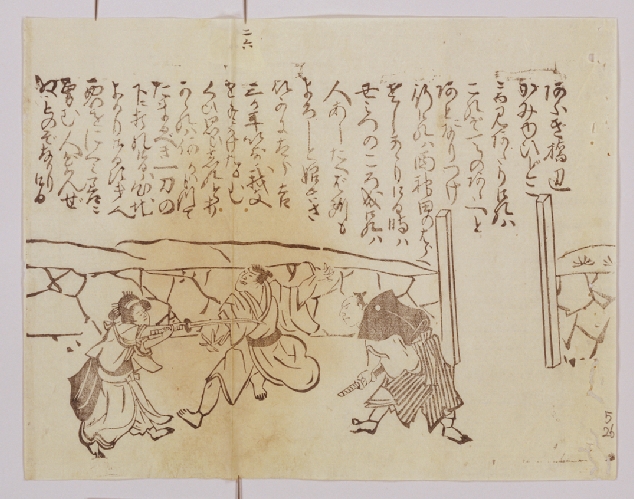
A year and a half after leaving Edo, in June Tenpo 6, they heard Kamezo was back in the city. The party returned, but Uhei, broken in spirit, dropped out. The two who arrived in July spotted Kamezo on a fireworks night in Ryogoku and followed him. On Gojoin Plain they seized him and sent for Riyo in haste. When his bonds were cut, Kamezo lunged at Riyo to escape, but she stabbed him with her short sword, and she and Kuroemon fulfilled their vow.
A successful vendetta was celebrated as highly auspicious, and Riyo, Kuroemon
, and Bunkyichi received lavish rewards and gifts of congratulation, and were specially honored by their lords.
Because Riyo was a woman in her twenties, the story caused a sensation, and many varieties of kawaraban broadsides=photo right= circulated throughout Edo.
The second vendetta came three years later, in December Tenpo 9, when a nephew and disciple avenged a sword-school master slashed to death in Shitaya.