
On August 23, 1878 (Meiji 11), more than 260 soldiers of the 1st Battalion, Imperial Guard Artillery, revolted at the barracks near Takebashi, where Palaceside Building now stands. A century later, nonfiction writer Hisae Sawaji shone a light on this "Takebashi Incident."
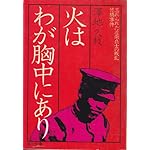
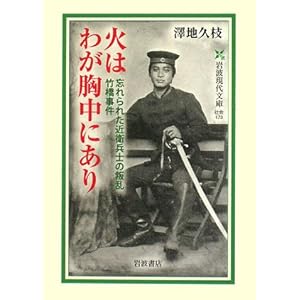
Her work Fire Burns in My Breast—The Forgotten Rebellion of Imperial Guards: The Takebashi Incident was published by Kadokawa Shoten in July 1978, exactly one hundred years after the event. It was also released in Kadokawa Bunko and Bungei Bunko, and more recently reissued in Iwanami's Gendai Bunko in September 2008=photo bottom: Kadokawa hardcover, Kadokawa Bunko, and Iwanami Gendai Bunko.
The book opens with a corner of Aoyama Cemetery and a tall stone inscribed "Graves of Former Imperial Guard Garrison Artillery"—the burial place of soldiers executed in the Takebashi Incident. Sawaji confirmed its location in 1977, the year before publication. According to Iwanami Shoten's website, 53 men were sentenced to death by court-martial just two months after the incident and executed at once; they were nominally pardoned when the Meiji Constitution was promulgated, as the back of the grave reads "Great Amnesty, Meiji 22, February 11." First erected near what is now the main gate of Tokyo Metropolitan Akasaka High School, the graves were later moved to Aoyama. To the left as you face them stands the larger, more prominent "Joint Burial Grave" for seventeen soldiers who died by execution or in prison at the Army Penitentiary with no one to claim their remains; to the right, a memorial "stele" for the victims was erected in 1987 by bereaved families and others=photo top, from Iwanami Shoten's website.
Sawaji's inscription on the stele reads in part:
"......The soldiers were taken into the Army by conscription; many had survived the previous year's Satsuma Rebellion. Fundamental doubts about conscription and discontent with post-Restoration politics drove them to action, including a direct appeal to the Emperor. The tradition of peasant uprisings in their home villages and aspirations linked to the later Freedom and People's Rights Movement seem to have been the fire that sustained them. ......We erect this stele here as a memorial to trampled Meiji youth, hoping the 'Takebashi Incident' will be a flame handed down to posterity......"
"The tradition of peasant uprising in home villages and aspirations linked to the Freedom and People's Rights Movement" refers to Chichibu natives among the executed and evokes the "Chichibu Incident" of 1884—a farmers' armed uprising under the influence of that movement. It was an age of civil war in the Satsuma Rebellion and severe economic hardship including fiscal crisis. Judgments on "rebellion" and "uprising" differ, but the effort to probe what lies behind an event that cannot be dismissed as "a riot by disgruntled rank-and-file soldiers" matters.