

Cross Takebashi from Palaceside Building, climb Kikunizaka along the moat in front of the National Museum of Modern Art, Tokyo, and in a small park beside Inui-mon you find a bronze maiden playing an instrument like a vertical flute. It is "Forest Melody" by Kagose Mitsuo, a Nitten member. The pedestal reads, "A maiden who welcomes, with music, those who compete in courage, skill, and health." Among statues around the Imperial Palace—Wake no Kiyomaro, Prince Kitashirakawa Yoshihisa, Kusunoki Masashige, Oyama Iwao, and other historical figures—"Forest Melody" is a healing sort of work.
What caught my eye was the instrument she plays. Look closely and you see two vertical pipes
and she seems to hold both to her mouth at once. What instrument is it, and what does it sound like?
There are performers who play two recorders at once, but those two recorders splay apart at the far end, so this does not look like a recorder. The "double whistle," which can play melody and harmony together, also opens into a V at the far end.
There are instruments with two pipes side by side as the maiden plays. But those are novelty whistles that mimic insect calls or train horns, and they would hardly become a "forest melody."
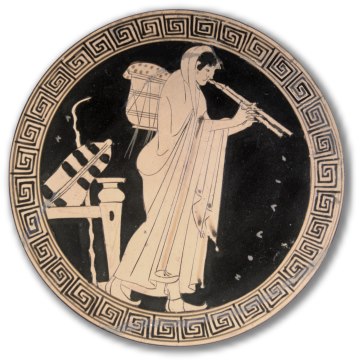
After looking around, it seems to be the aulos, an ancient Greek woodwind with a double reed like an oboe. Many are V-shaped like a double whistle, but some have two pipes in parallel. In Greek myth the goddess Athena, who governs wisdom, the arts, crafts, and strategy, made it, then threw it away because her cheeks puffed out and spoiled her beauty. Marsyas, one of the half-human, half-beast satyrs, picked it up and became a master. Female aulos players were a fixture at ancient Greek banquets. Marsyas is said to have contested Apollo, who played the lyre—so the tone must have been fine indeed.