

Continuing our "Wandering Palaceside" stroll around Palaceside Building — the story of Eiichi Shibusawa = photo top =.
In the Meiji era, Shibusawa founded many private companies and is called "father of Japanese capitalism." His start as a business leader was the First National Bank.
After helping build the new nation in the Meiji government, he left the Finance Ministry in 1873. With the founding of the First National Bank, which he had guided as a bureaucrat, he became managing director and head director two years later, then devoted himself to creating and nurturing enterprises.
The First Bank was Japan's first joint-stock company, rooted in Mitsui-group union banks; until the Bank of Japan opened in 1882 it was authorized to issue banknotes. Reorganized as ordinary First Bank in 1896, it passed through wartime Imperial Bank and returned to First Bank; merged with Japan Kangyo Bank in 1971 to form Dai-Ichi Kangyo Bank, then with Fuji and Industrial Bank of Japan in 2000 to become Mizuho Bank.
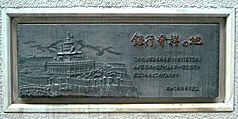
It was founded at 4-3 Nihonbashi Kabutocho, Chuo Ward — three stops east on the Tokyo Metro Tozai Line from Takebashi, Kabutocho exit: a financial district corner near the Tokyo Stock Exchange. Today "Kabutocho Building" houses Mizuho Bank Kabutocho Branch. At founding it took over the splendid five-story Japanese-Western "Kaiunbashi Mitsui Exchange House" from Mitsui; a plaque "Birthplace of Banking" with a picture of the old building is set in the south outer wall = photo bottom =.
Seven years before the First National Bank, an HSBC branch opened in Yokohama's foreign settlement — and HSBC erected a monument in 2006 calling it the "birthplace of banking business." The English reads "Memorial Commemorating Japan's Oldest Bank," and a 2006 HSBC release says "birthplace of banking in Japan" without "business." For Yokohama people, perhaps that is the birthplace.