
It may be late to say so, but the area around Palaceside Building at Takebashi—famous for its superb location along the Imperial Palace moat—has been the heart of Japan since the Edo period. It has been the stage for countless histories, and there are many spots tied to people whose names remain in history.
And so, under the name Wandering Palaceside, we begin an occasional series that strolls around Takebashi and introduces what we find. We have written in that spirit before; this is just a bid to make it sound more official. “Isn’t that a rip-off?” We can hardly deny it. Then again, “Bura Tamori” looks a lot like “Tamori Club” too… Well, never mind that.
Part 1 is Tokiwabashi and Tokiwa-bashi on the Nihonbashi River. They are about a 20-minute walk from Palaceside Building, so this season may be hard going. The address spans Chiyoda-ku Otemachi 2-chome to Chuo-ku Nihonbashi-Hongokucho 2-chome; the nearest station is Mitsukoshimae on the Hanzomon Line. Both names are read “Tokiwabashi,” but the characters differ. Tokiwabashi Park links the two bridges. In the photo above, Tokiwa-bashi (磐) is in the foreground, Tokiwabashi (盤) beyond, and the park is on the far bank to the right.
The bridges themselves are said to go back to Ota Dokan, who built Edo Castle, but in 1629 (Kan’ei 6), in the time of the third shogun Iemitsu, Tokiwabashi Gate was built in front of the bridge, so the name “Tokiwabashi” was already in use by then. The gate was removed in 1873 (Meiji 6); part of the stone wall still stands in the park.
As for the bridges, three span a little more than 200 meters of the Nihonbashi River running roughly north–south: from the north, Shin-Tokiwabashi, Tokiwa-bashi (磐), and Tokiwabashi (盤). Shin-Tokiwabashi is a large new bridge. The middle Tokiwa-bashi is the original bridge that once led to the gate; built in 1877 (Meiji 10) from stone used in the gate, it is now for pedestrians only. About 50 meters downstream, Tokiwabashi was built in 1926 (Taisho 15) after the Great Kanto Earthquake and still carries cars.
Leaving aside “Shin,” the two names have several origin stories. One is that Iemitsu himself ordered a renaming and called it “Tokiwabashi Gate.” Another takes the Kinyoshu poem “Iro kaenu matsu ni yosoete Azumaji no tokiwa no hashi ni kakaru fujinami” and ties it to the Tokugawa family name Matsudaira. Some say the bridge was already called Tokiwabashi Gate from the Edo period. Official documents of Chiyoda and Chuo wards write “Tokiwabashi Gate,” and the park’s formal name is also Tokiwabashi Park.
Another story says that when the bridge was built in Meiji 10, the character with “sara” (皿) under “han” (般) was thought unlucky—as if it would break—so it was changed to “ishi” (石) and the name became Tokiwa (磐).
Still another says that when today’s Tokiwabashi was built in the Taisho era, the older bridge was renamed Tokiwa-bashi (磐). If you know the right answer, please tell us.
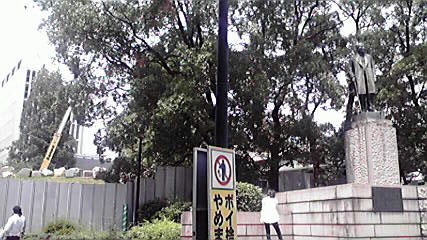
Because of last year’s earthquake, the remaining stone wall of the old Tokiwabashi Gate in the park has begun to crumble a little, so one corner is now fenced in silver and under repair (through the end of October) = photo below. Tokiwa-bashi is also closed as unsafe. We hope it soon returns as a place of rest for the city.