
About ten minutes from Palaceside Building, Meiji University's Surugadai campus Central Library 1F Gallery hosts "Publishing Censorship and Banned Books" (through July 22). On June 29 this blog noted finding books by Muku Kyusaburo, famed for children's and animal literature, among works banned by censorship.
A memory of Mr. Muku.
Born Kubota Hikoh in Nagano in 1905, he graduated from a Tokyo university at 25, hoped to go to the South Seas but was opposed and became a teacher in Kagoshima where his sister, a doctor, lived — remaining there until his death. "Song of the Eagle" was banned at 28; at 33 he published his first animal story "Yama no Taro Kuma" and wrote prolifically thereafter. At 42 he became Kagoshima Prefectural Library director and launched the "20 Minutes Reading for Mother and Child" movement nationwide. He also taught at Kagoshima Women's Junior College and died at 82 in 1987.
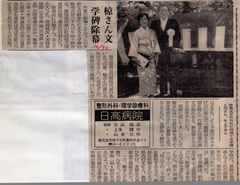
In the early 1980s in Kagoshima I met him when Rironsha began publishing "Books of Muku Kyusaburo, 25 volumes" — a true complete works including early "Sankacho" and earlier poetry. In October 1983 a memorial was unveiled at the prefectural library; photo bottom is from the Mainichi Kagoshima edition.
I greeted him, received his autograph on volume 2 (Sankacho monogatari, Song of the Eagle), and when I sent a New Year's card, he replied courteously; from the next year I received his cards.
Five days after sudden news of his death on December 27, 1987, a card from Mr. Muku arrived on New Year's morning in Kitakyushu — photo top. For me, truly his "last writing," kept as a treasure. "Emotion opens the window of life" — words on the Kagoshima monument return with his gentle face.