

Near Hirakawa Gate in the East Gardens of the Imperial Palace, in front of Palaceside Building, stands the "Memorial to Lord Ota Dokan." Built in July 1936 by Tokyo Mayor Torajiro Ushizuka, the stone bears: "In spring of Kansho 5, when Lord Ota Dokan, castellan of Edo Castle, went to Kyoto for audience, he answered the imperial question about his castle with this poem:
My hermitage adjoins pine fields, near the sea; Mount Fuji's high peak I see from my eaves
The castle faces east with a river, south to the sea, west with rolling hills, gazing afar at Fuji's noble peak." This is Dokan's most famous waka. Seeing Fuji's peak from today's Tokyo is hard — but where in Edo Castle, said to be the finest in the Kanto, did he compose it?
As candidate sites for Edo Castle, Dokan considered the Ueno plateau north of Shinobazu Pond, the Kojimachi plateau, Gotenyama in Shinagawa, Magome, and others. In 1457 (Choroku 1) he chose the site of the Edo clan hall on the Kojimachi plateau overlooking Hibiya inlet to the south (the present
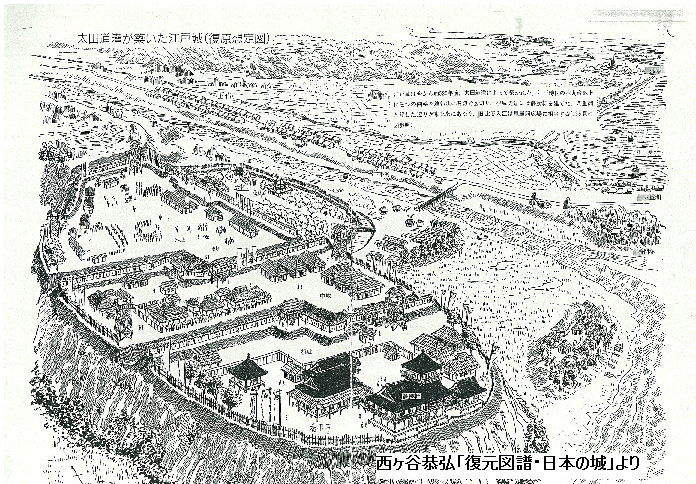
location). It is near the tenshu foundation that remains in today's East Gardens and the Imperial Household Archives. Hills of Kanda to the north, the Hirakawa (now Nihonbashi River) to the east, and a marsh (Tameike) to the west — ideal terrain for a castle.
The castle stood on cliffs about 20–30 meters high, divided into the honmaru core, ninomaru middle castle, and sannomaru outer castle. The core was the center, and here stood Joshoken, Dokan's lofty pavilion — a lookout like Kinkaku or Ginkaku. From Shinagawa to Asakusa and the Sumida River lay at his feet; Mount Fuji and Mount Tsukuba could be seen in the distance. Joshoken rivaled a tenshu; Dokan could view Fuji's snow from this tower. It is said to have stood where Fujimi Yagura remains today.
After building Edo Castle, Dokan won brilliant campaigns in Sagami and Musashi, but in July 1486 (Bunmei 18) he was assassinated in present-day Isehara, Kanagawa, amid his lord's suspicion.