
Tokyo Skytree, opening on the 22nd, was designed by Nikken Sekkei, which also designed Palaceside Building in Takebashi. Many know that Skytree was modeled on the five-story pagoda of Horyuji. A central pillar runs through the core, and independent timber framing in each story supports the others, giving seismic isolation and damping. Horyuji has thus withstood earthquakes and typhoons for more than a thousand years. That wisdom lives in the tower.
At the tower's foot, facing Oshiage Station plaza (the traffic plaza), is the Sumida Ward-run "Oshiage Station Front Bicycle Parking." It is hard to describe in words, but the rendering Sumida used in flyers makes it clear: the two-story structure itself looks like a small hill. You can climb a gentle wooden ramp with a handrail; the rooftop at the top is a "rest space" with a view of the tower, the plaza, and the Tobu Line running alongside — a very pleasant place. In the drawing the plaza is on the right, and the tower stands beyond it. Photo above is a weekday evening last week; people can be seen looking up to photograph the tower.
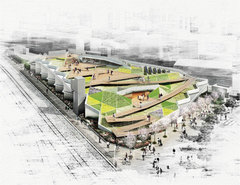
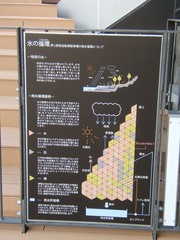
This bike park was also designed by Nikken Sekkei. The Toei Asakusa Line structure lies underground, so we will skip the difficult structural talk, but because piles could not be driven, various devices were used. A distinctive feature is a "rainwater-circulation roof," adopted so visitors will rethink the importance of the water cycle (photo below is the sign). Water is gathered without waste from three zones — wood (doubling as the ramp), stone, and greenery — into an underground cistern and used for plants and toilet flushing; the power to pump it up comes from solar generation, a thorough eco system.
The park is open from 4:45 a.m. to 12:45 a.m. Same-day spot use is a bargain at 50 yen per time.