
The carp streamer display in the basement-first-floor arcade atrium at Palaceside Building has become a fixture of early summer. The Meiten-kai association of building restaurants and shops organizes it; the carp display ends May 2.
As introduced before, the carp streamers are dyed in Gujo honzome, a technique passed down 430 years in Gujo Hachiman, Gifu Prefecture. Watanabe Somemono, which produced them, features the Palaceside Building display on its website (http://www8.ocn.ne.jp/~gujozome/index1.html).
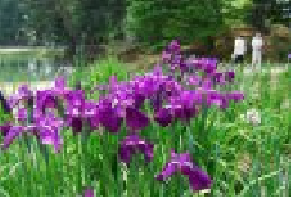
For a final event, Meiten-kai will give 500 purple hanashobu (Japanese irises) each to visitors on May 1 and 2 (Tue., Wed.) from 11:30 a.m. at the basement-first-floor central concourse.
Shobu (sweet flag) accompanies Boys' Day on May 5; people bathe in shobu-yu with shobu leaves for health. The shobu for baths and the hanashobu given here are entirely different species.
Bath shobu belongs to Araceae; roots and leaves are fragrant and used medicinally. Flowers attach near the stem base and are barely noticeable. Hanashobu is in Iridaceae—"eventually iris or kakitsubata." Iris grows in dry places; hanashobu and kakitsubata prefer wet ground and marsh.
Written 菖蒲 in kanji, both shobu and ayame read shobu, and leaves look similar, so iris, hanashobu, and shobu are easily confused—but Meiten-kai gives hanashobu, so put them in a vase, not the bath.