

News that Somei-yoshino cherries in central Tokyo were first in Japan to bloom came on Saturday, March 14. It was earlier than the forecast 17th, but that day brought the irony of sleet even in the city center. After the weekend, the 16th and 17th were cold too.
If they are out, we should go see them — so at lunch we slipped out of the Palaceside Building and walked the neighborhood, but the wind was chilly. The temperature seemed around 10 degrees, and buds along Uchibori-dori still felt tight. Among them, at the Takebashi crossing, on a tree by the moat across the street from the building, we stared and found bloom =photo above. Only one blossom could be clearly confirmed, but the buds around it were swelling as if about to burst.
From the 18th Tokyo is expected to warm, so cherries that still look asleep should open all at once.
The Japan Meteorological Agency defines cherry bloom as "five to six blossoms open" on each observatory's specimen tree. The specimen for central Tokyo is a specific tree at Yasukuni Shrine in Kudan. It seems to have started on the 12th, and "five to six blossoms" were confirmed on the 14th.
The "cherry blossom front" that joins bloom dates is not as simple as marching neatly from south to north. This year, after Tokyo, only Uwajima in Ehime Prefecture bloomed on the 16th and then it stopped (as of 5 p.m. on the 16th, Japan Weather Association site =https://tenki.jp/sakura/expectation/).
The Japan Weather Association's March 12 forecast expected Nagoya on the 19th (seven days earlier than average), Fukuoka in northern Kyushu on the 20th (three days early), and Hiroshima and Osaka the same day, while Kagoshima was the 30th — later than Sendai in Tohoku on the 27th. Why such scatter?
Wondering that, we found the Mainichi Shimbun digital edition explaining it: "Why does the cherry front reverse north and south? Tokyo first again this year; southern Kyushu quite late" (https://mainichi.jp/articles/20200316/k00/00m/040/248000c).
According to the article, flower buds need "endodormancy release" — a stretch of winter cold that wakes them — and after that they need temperatures high enough to grow and open. For Somei-yoshino, bloom is said to come when daily mean temperatures from February 1 add up past 400 degrees
. Cold winter, warm spring is best. It is not simply a rise in February–March temperatures.
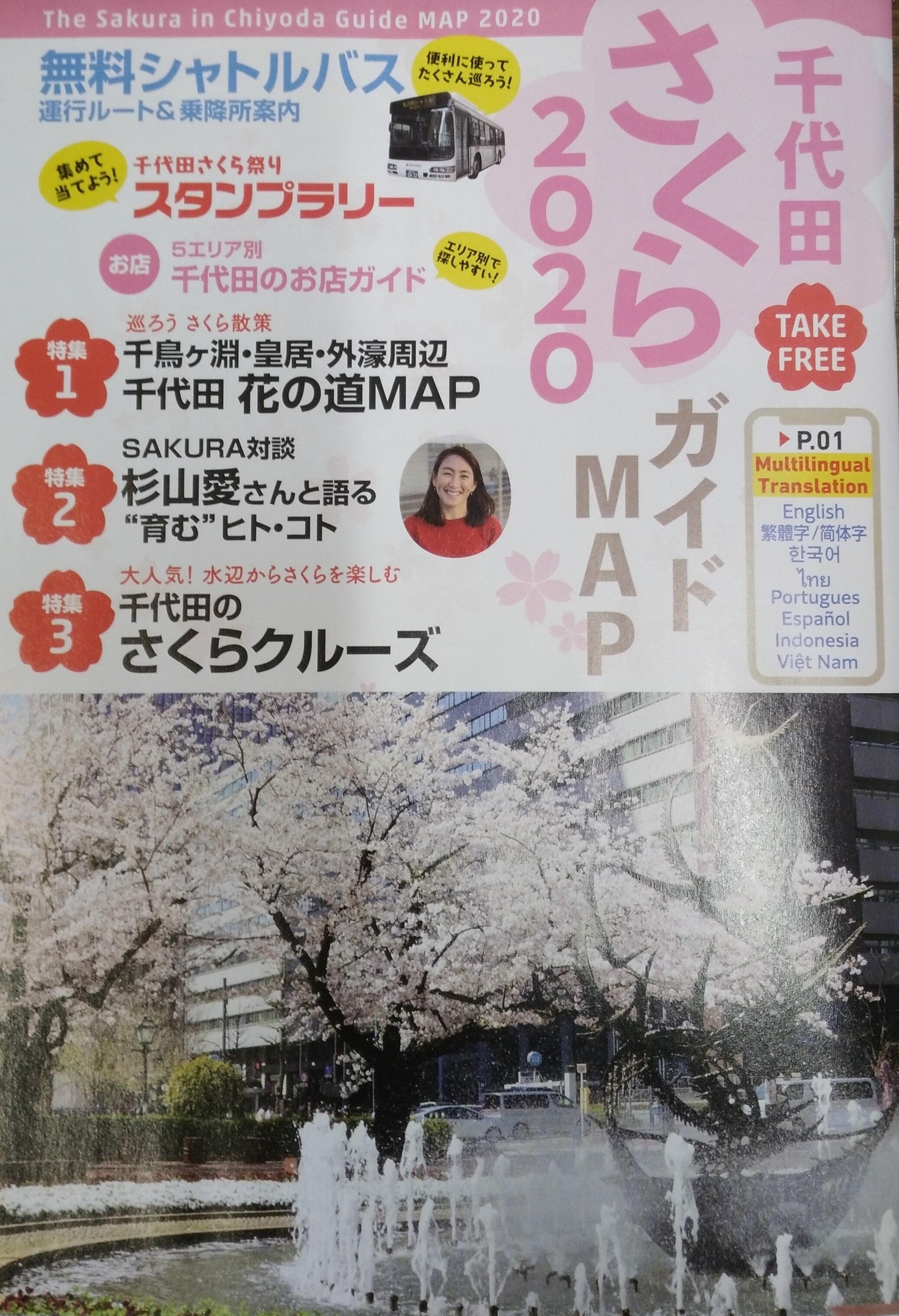
As we reported here the other day, "Chiyoda Sakura Festival" (March 25–April 5, hosted by Chiyoda Ward and the Chiyoda Tourism Association) was canceled, but the festival pamphlet was finished. Every year it was titled "Chiyoda Sakura Festival Official Guide MAP"; this year the cover was changed to "Chiyoda Sakura Guide MAP" =photo right= . Because cancellation came at the last minute, there was no time to revise inside pages, so notices for the canceled shuttle bus remain. Events listed may change or be canceled; please take note.
The Palaceside Building had planned a special Sunday opening on March 29 to match the festival and had that in the pamphlet; that too was canceled. We apologize for the inconvenience and ask for your understanding.
The pamphlet "Chiyoda Sakura Guide MAP" is at shops of the Palaceside Building Meitenkai, the association of restaurants and others in the building.