

The 7th is on the cool side, but the 8th is said to rise to 28 degrees again. Even on a clear autumn day, it is still often too hot and humid to call autumn-fine.
The Imperial Household Agency website "East Gardens of the Imperial Palace flower news (http://www.kunaicho.go.jp/event/hanadayori/hanadayori-top.html)" said "bright-red cluster amaryllis have begun to bloom around the gardens. Around Suwa Teahouse and Dozin Bansho, white spider lilies are also in bloom" (as of September 27), so we went last week. (As of October 4 the text has changed to other flowers.)
Cluster amaryllis is also called higanbana or manjushage; the white ones are also called shirobana higanbana.
Leave the Palaceside Building east entrance, cross Uchibori-dori and enter the East Gardens at Hirakawa-mon. Follow the left curve until Bairin-zaka appears on the right, and red cluster amaryllis bloom in the planting on the left =photo below. They are a little far from the path, though — a shame they are hard to see well.
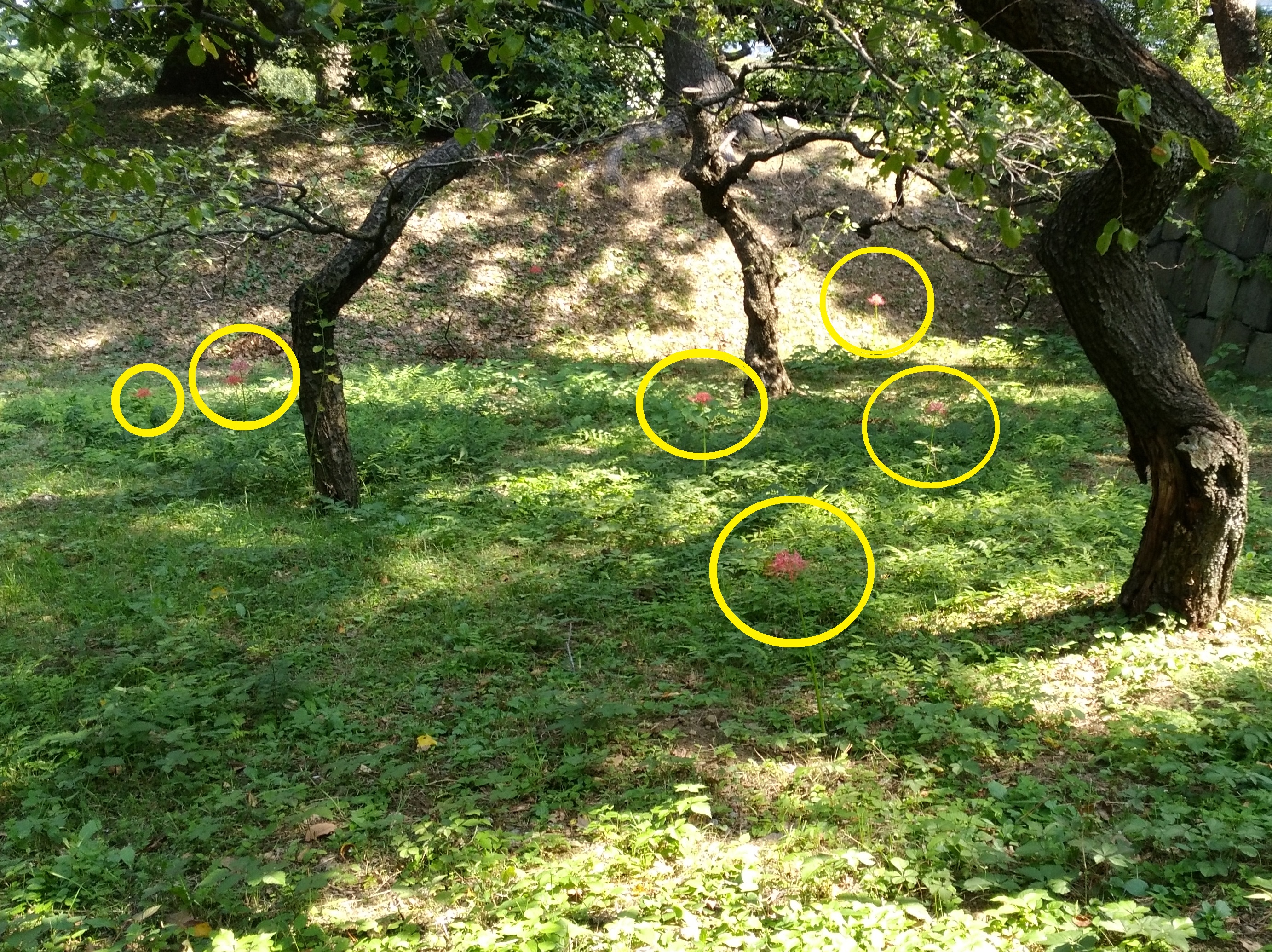
Continue along the path; at the foot of Shiomi-zaka on the right, in the planting just before Hakucho-bori, you can see them close =top photo. (Shiomi-zaka is closed for construction.)
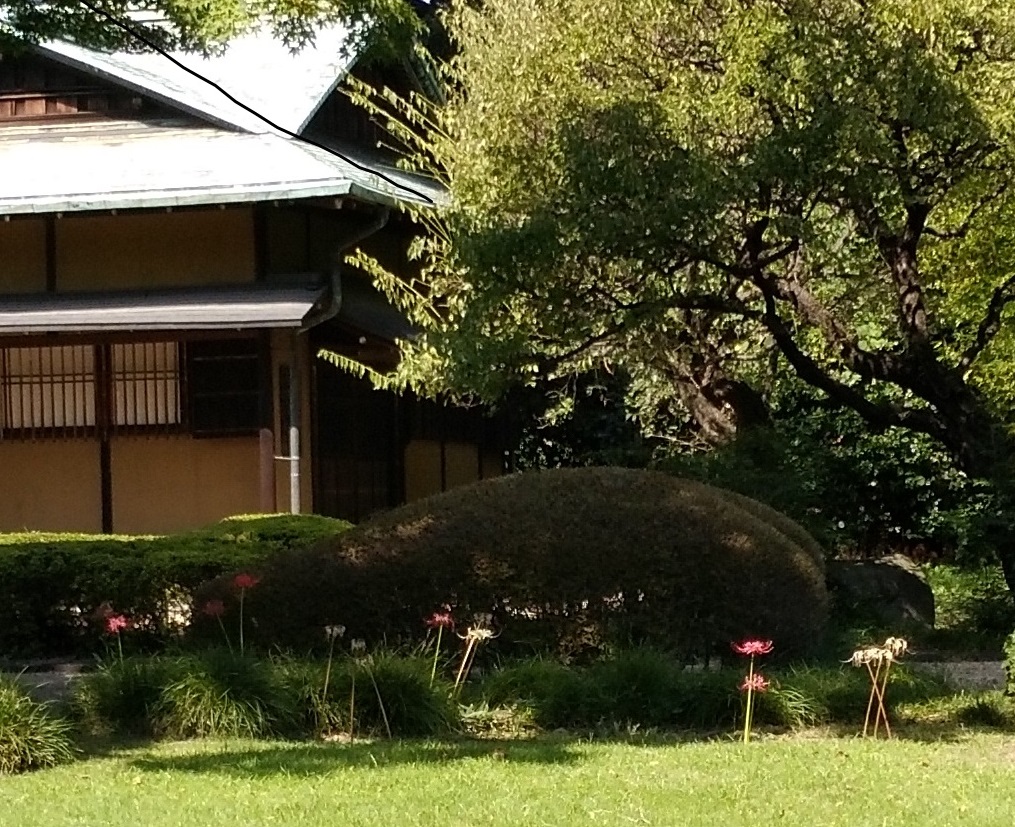
Turn left toward Ninomaru Garden and, in front of Suwa Teahouse on the left, white flowers mix with the red photo below. They are more than 10 meters from the path, so without a telephoto lens photos are tough. Worn out by the heat, we turned back here.
Cluster amaryllis is a perennial in the Amaryllidaceae; the scientific name is Lycoris radiata. It is said to have spread after arriving from China, growing in colonies near settlements, with six reflexed red petals on a 30–50 cm scape.
The white form is Lycoris albiflora. It looks a little yellowish rather than pure white. It is not a mutant of the red; it is a natural hybrid of Lycoris radiata var. pumila and yellow Lycoris aurea (shokizuisen).
The genus name Lycoris is the sea goddess of Greek myth, likely given in praise of the flower's beauty. The stem contains the deadly poison lycorine. Beautiful things have thorns.
The Japanese name, of course, comes from blooming around the equinox, but in Kanto this year a long rainy season followed by extreme heat delayed bloom by about two weeks in many places. The "Manjushage Festival" at Kinchakuda Manjushage Park in Hidaka, Saitama, famous for five million plants, was due to end in September but slipped into October and has only just passed its peak. If global warming proceeds, will even the name "higanbana" have to change?
Bloom in the East Gardens of the Imperial Palace also seems about two weeks late, so they can still be seen. Compared with photos from some years ago, though, perhaps because of the heat, the flowers look somehow lacking in vigor. Maybe it is just us.