

Mainichi Building Co., which manages the Palaceside Building, has received a letter of appreciation =photo above= from Tokyo Fire Department emergency-services director Toshimitsu Morizumi. It recognizes "a great contribution to the enrichment and development of emergency services."
The letter is dated September 9, Emergency Medical Services Day, and a presentation ceremony had been planned that day
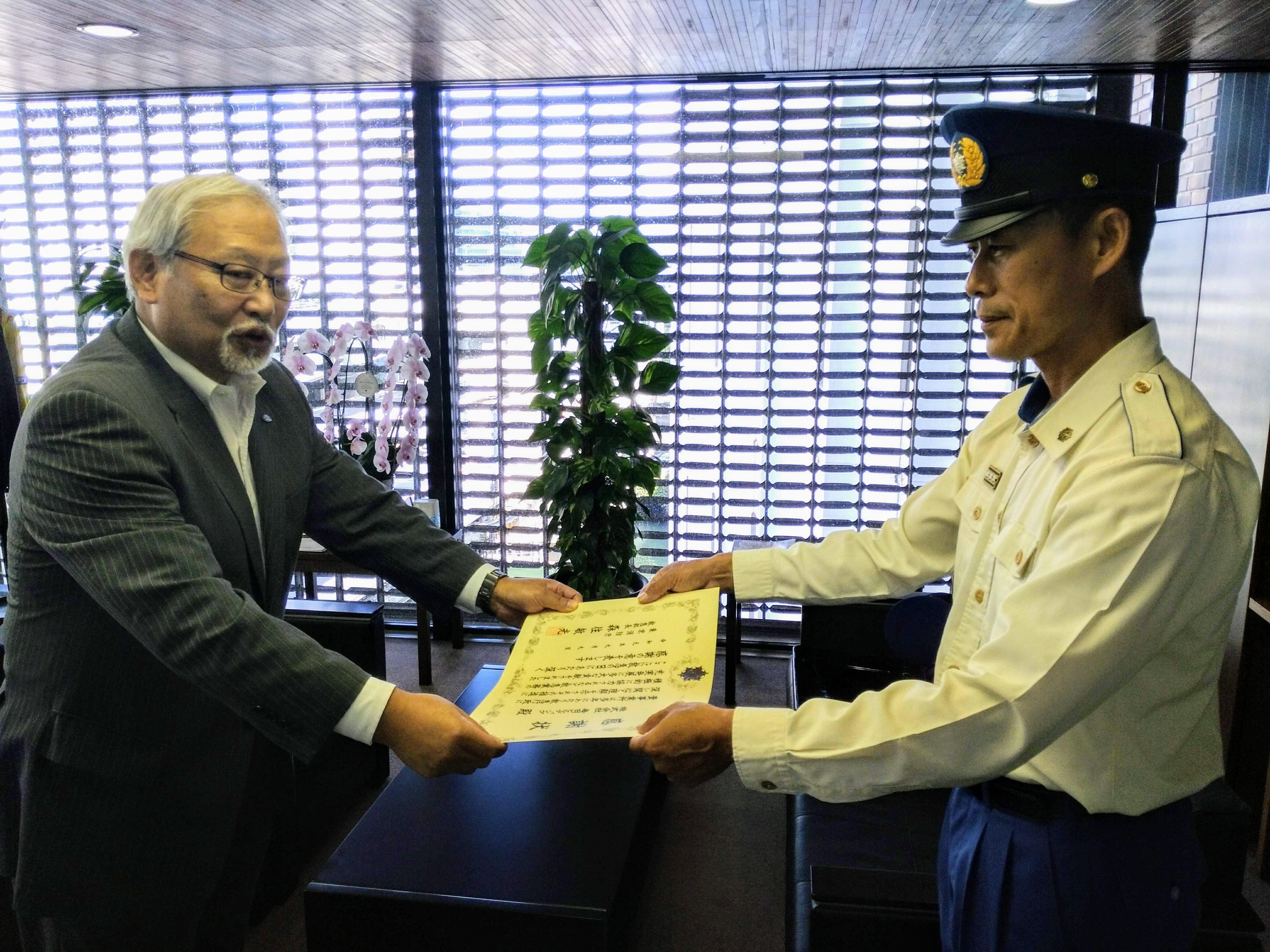
but a typhoon forced its cancellation; on the 25th Kojimachi Fire Station fire-prevention section chief Takeshi Asano (the person on the right in the photo at left) presented it to Mainichi Building Co. president Toshiro Hara.
A fire-service letter of thanks is not for a specific act such as a rescue. "Enrichment and development of emergency services" is abstract. What was actually done?
At Mainichi Building we of course keep equipment fully in line with fire laws, organize a volunteer fire brigade and, with tenants, train hard in spring and autumn. On "emergency" work in particular, the building holds advanced first-aid training every year so we can respond at once if someone falls ill or is injured. We think this steady effort was recognized.
The advanced course is a full eight-hour day: not only lectures but intensive practice of CPR and AED use on an upper-body manikin and first aid with triangular bandages. Being "advanced," it also covers resuscitation for children, infants and newborns. Restarting a stopped heart is "chest compression": for adults you place the heel of the hand at mid-chest, stack the other hand and press so the ribs sink 5 cm; that would crush a small child, so for "children" under 16 you press the lower half of the sternum with one palm, and for infants under one year you press slightly below mid-chest with two fingers. Learning that distinction is what makes it advanced.
We began the course in fiscal 2012 for Mainichi Building staff credentials, then invited security, facilities and cleaning partners, and from fiscal 2014, aiming for "at least one advanced-course graduate per workplace," we called widely on tenants; more than 200 people have earned the credential. It renews every three years, so we also run a half-day refresher, and many people keep the credential.
Two years ago we received a letter of the same title in the name of the Kojimachi fire chief. This time it is from a director at Tokyo Fire Department headquarters — one stage up, and we are grateful.
As a building operator we are only doing what we should, but having the work recognized is an honor. We will keep working so the building stays "safe and secure" in a way worthy of the letter.