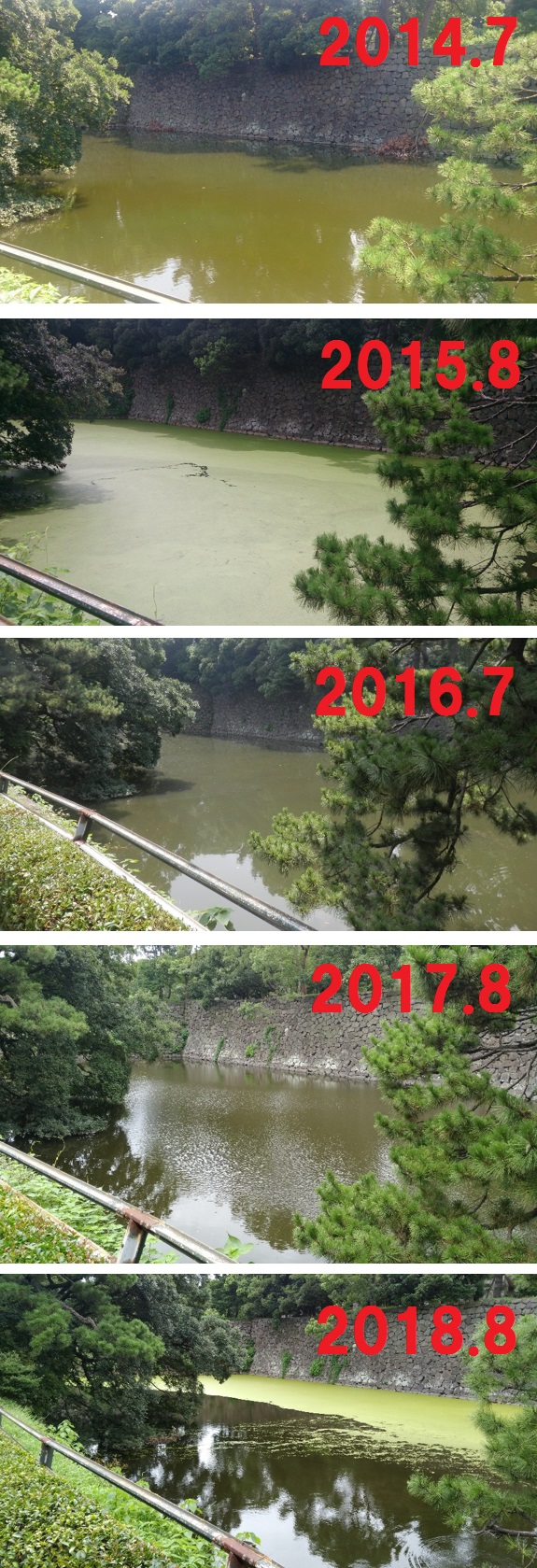

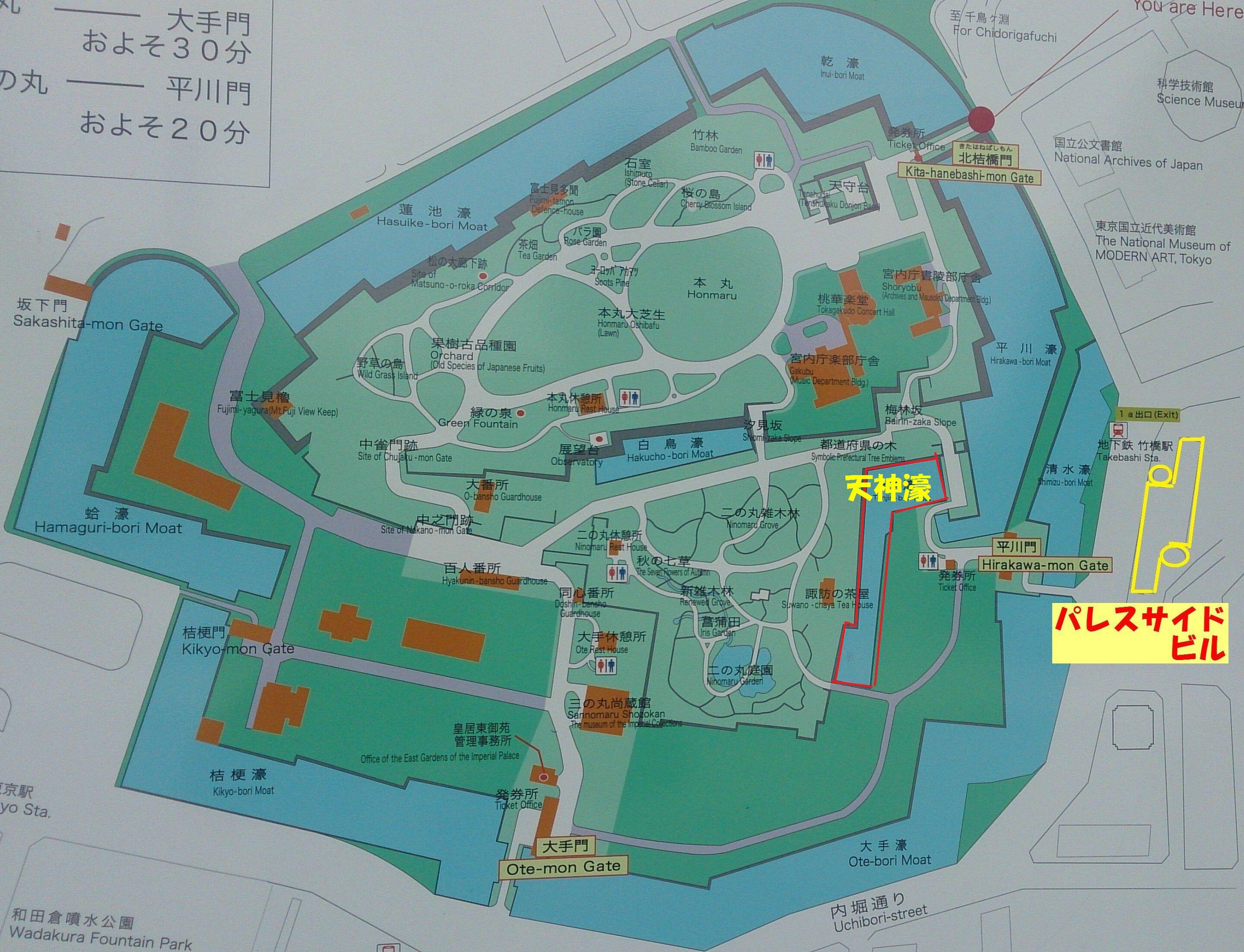
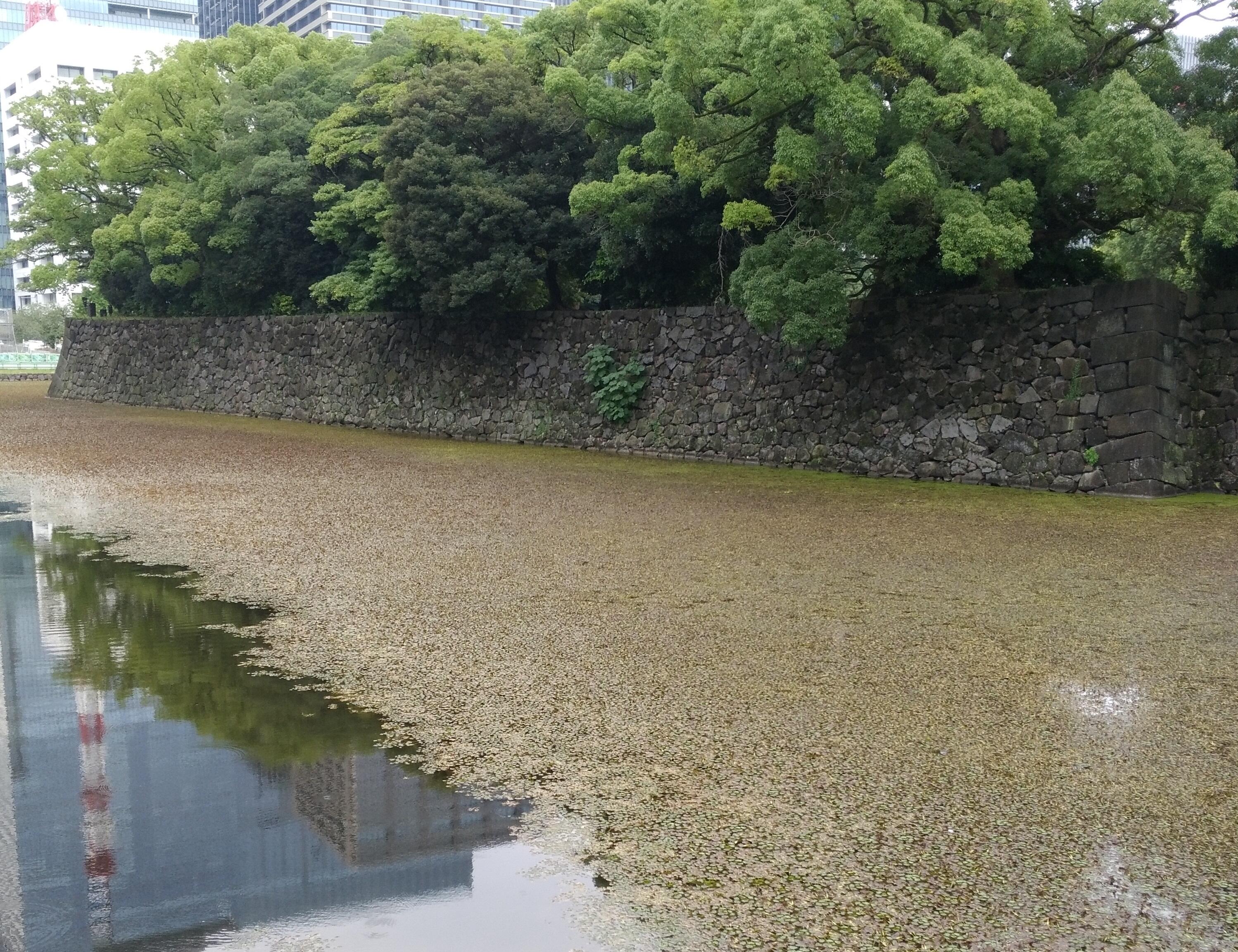
Straight across from the Palaceside Building, as you enter Edo Castle (the Imperial Palace) at Hirakawa-mon and climb toward Ninomaru Garden, Tenjin-bori appears on the left. It is not a formal fixed-point survey, but we have piled up photos taken whenever we passed in summer, so we thought we would line them up. Algae bloom (aoko) appears again and again. It is truly a barometer of the moat's water quality
, and even within one summer it changes in a short time.
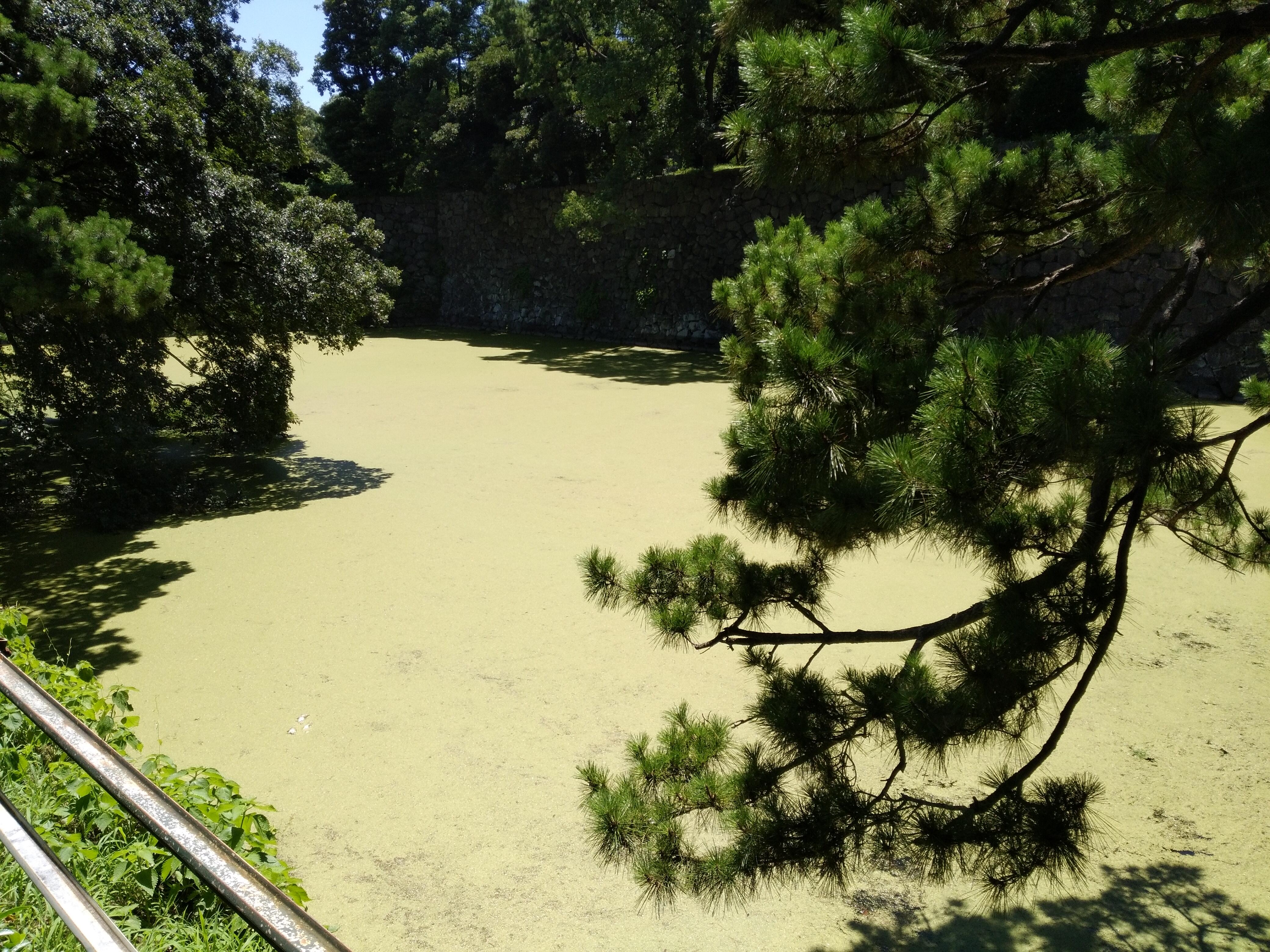
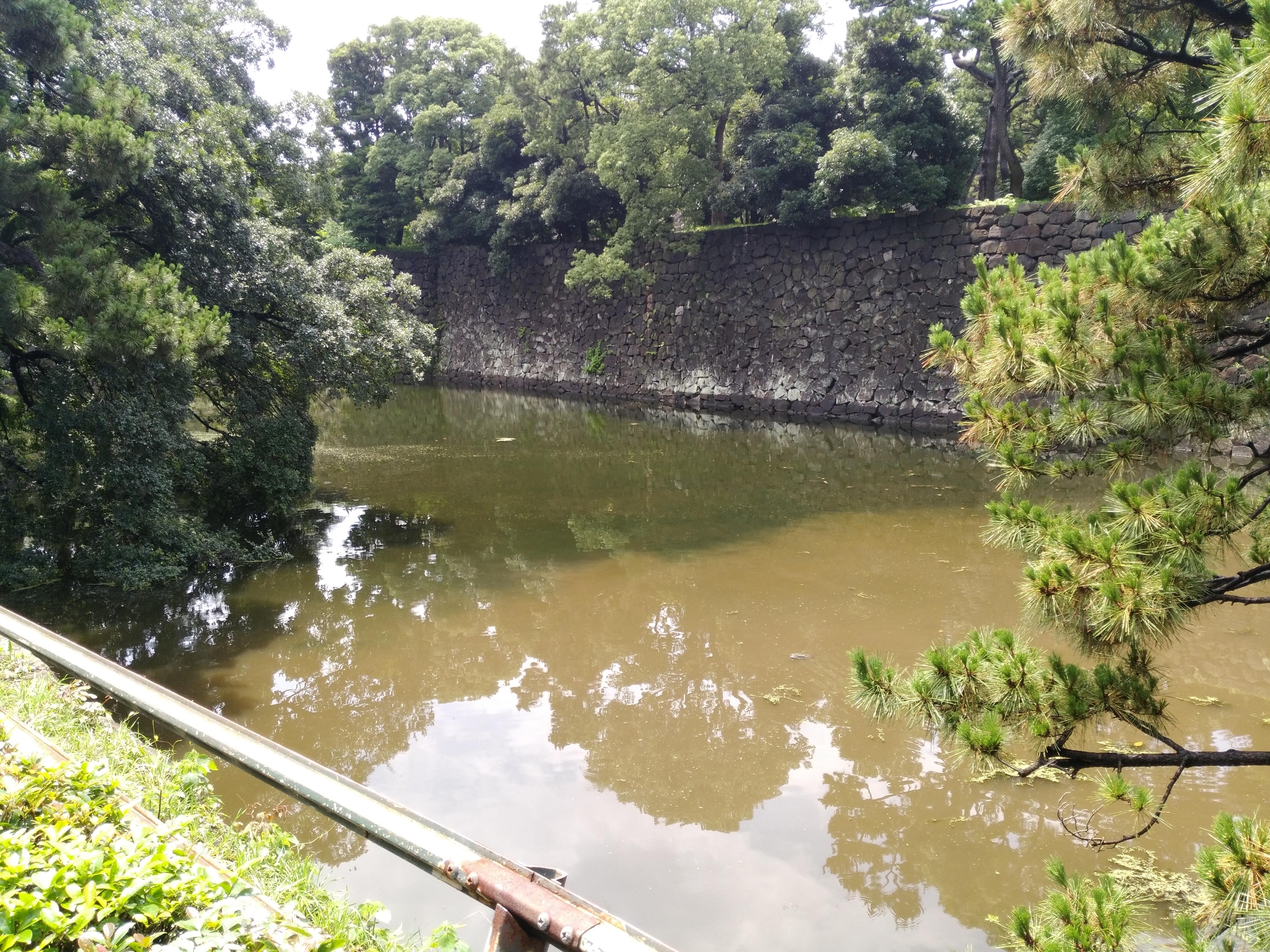
The photo above is last week, August 27. Almost no bloom. In fact August 6 =photos right, above= was covered end to end, about as bad as recent years get. July 24 =photos right, below= had only a little earth-colored turbidity and no bloom. In a little over a month it changed dizzyingly.
Aoko is a mass of fine algae that covers the surface of lakes and ponds where "eutrophication" — high concentrations of fertilizer components such as nitrogen compounds — has advanced. It breeds more as water temperature rises.
Looking back at this summer's weather: the rainy season did not break through July, chilly tsuyu days continued, and only on the 24th did we finally get a midsummer day of 31 degrees, so the bloom seems not to have grown.
Then temperatures jumped, day after day around 35 degrees, and from July 30 to August 10 there were consecutive days of zero rain, so the bloom seems to have spread all at once. That was August 6.
Whether someone cleaned it afterward is unknown, but the heat eased a little and rain fell in reasonable amounts, so the bloom may have faded.
The outer-garden moats of Edo Castle are under the Environment Ministry: Sakurada-bori, Gaisen-bori, Hamaguri-bori, Hanzomon-bori, Chidorigafuchi, Ushigafuchi, Shimizu-bori, Ote-bori, Kikyo-bori, Wadakura-bori, Babasaki-bori and Hibiya-bori — twelve in all, holding some 450,000 cubic meters. Tenjin-bori is classed as an "inner moat," unlike those outer-garden waters, and is under the Imperial Household Agency. The public can see only a sliver, but it spreads quite large north of Ninomaru Garden and, inside Hirakawa-mon, connects with Hirakawa-bori (also Agency-managed, as is neighboring Inui-bori) =see map below. It does not flow like a river; water tends to stagnate, conditions that favor bloom.
The outer-garden moats once took water from the Tamagawa Josui built in the Edo period, but supply stopped when Yodobashi Waterworks (Shinjuku) closed in 1965; now water from outside depends on rain. Conversely, heavy rain lets overflow from sewers — household wastewater — flow in and worsen quality further.
The Environment Ministry is advancing purification facilities. The key plant, the New Moat Water Purification Facility that started in 2013, can treat up to 20,000 tons of moat water a day. It takes water from Hibiya-bori, sends cleaned water by pipe to Sakurada-bori and Hanzomon-bori, and the water tours the moats and finally returns to Hibiya-bori.
The National Parks Association website (http://fng.or.jp/koukyo/news/2019/06/post-83.html) says "At Chidorigafuchi, Shimizu-bori downstream
, Ote-bori and others, thanks also to Tokyo sewerage measures, water quality has gradually improved in recent years, and the moat ecosystem is shifting from plankton such as aoko toward aquatic plants." Indeed, looking at Ote-bori from Hirakawa-mon, aquatic plants are everywhere =photo left. Not bloom, but there does seem a bit too much...
Finally, Tenjin-bori as we have seen it every summer from 2014 to 2018. A history of the fight with algae, perhaps.