
In Tokyo, from early morning to late night, every time you meet someone you know it is "Hot, isn't it." Really, how many times a day do you have to say it — you want to grumble.
So we went looking for shade, straight across from the Palaceside Building, to the East Gardens of the Imperial Palace (Edo Castle). From leaving the building, walking the sidewalk, crossing the light, crossing the moat bridge and passing Hirakawa-mon, the merciless sun stings the skin and it is hot, but once you reach tree shade it is somewhat better. Mmm, still hot, though.
This time we looked for lilyturf introduced on the Imperial Household Agency website "East Gardens flower news" (http://www.kunaicho.go.jp/event/hanadayori/hanadayori-top.html). Along Tenjin-bori
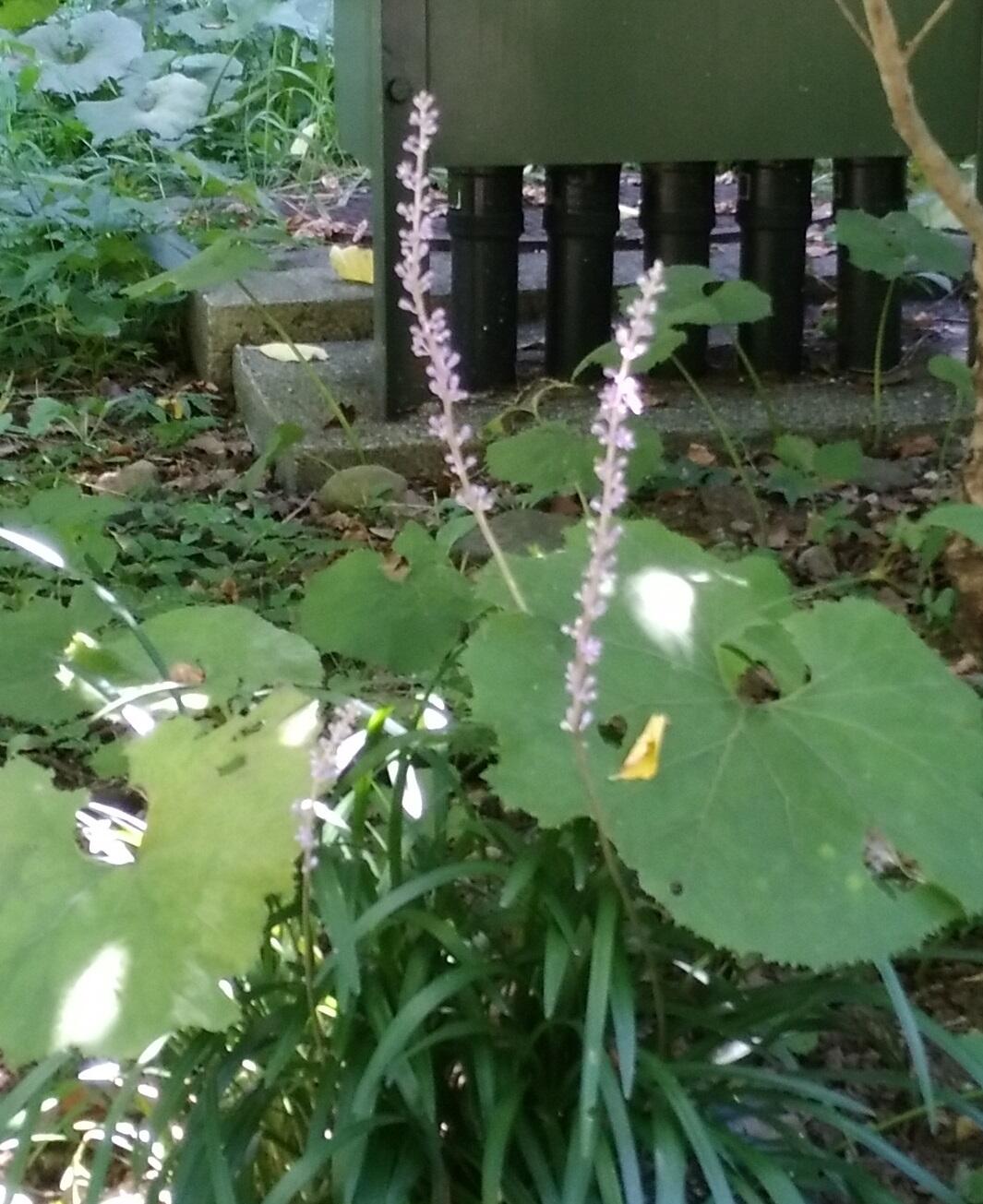
and then right up Bairin-zaka toward the tenshu-dai, we found it blooming quietly in the planting on the left =photo right. Small pale-purple flowers run vertically; the height is 15–20 centimeters. There is no name tag as famous (?) plants have, so if you walk in a daze you miss it. It blooms a little off the path, hard to photograph up close.
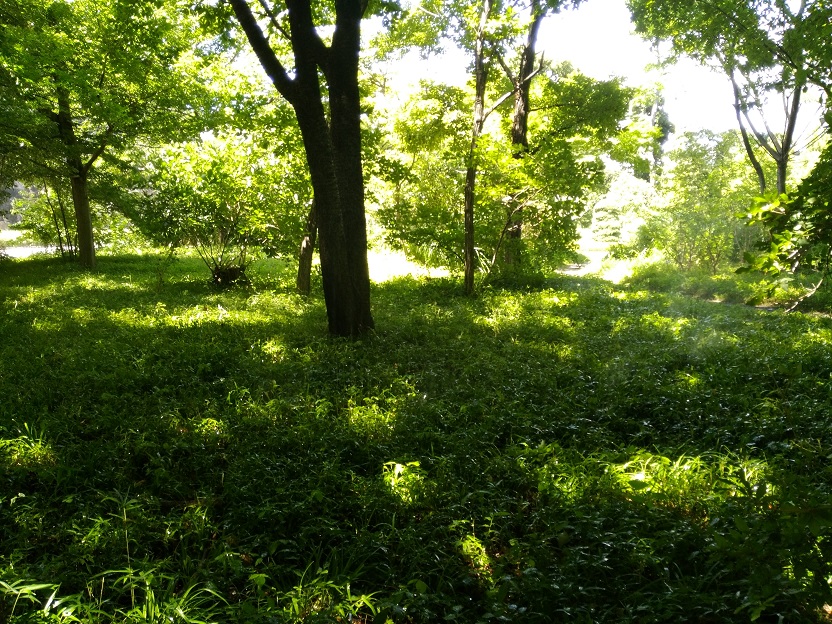
We went back down the slope toward Ninomaru Garden. Trusting the flower news that it also blooms in the Ninomaru woodland, we headed there: a dense wood, so the sun is blocked, quite cool and pleasant.
Yes, we found it in the shade of the trees. Photos were a struggle here too. On a smartphone the focus landed on a trunk behind, and these thin flowers were hard to catch cleanly. A passable shot is the top photo.
Can you see that the surrounding leaves are a little wet? We shot after 12:30 p.m. on August 6, and a fine mist — sprayed from the ground — was coming up. A mist shower. When it hit arms and face it felt quite good. Watering for the plants, perhaps. We do not know if it runs every day or at the same hour, but if you are lucky you may meet it. We have put a photo at the end for the record. The mist may not be clear, but perhaps the dampness comes through.
Lilyturf is a lily-family perennial, scientific name Liriope platyphylla. The Japanese name is said to come from growing in thickets (yabu) and resembling orchid (ran) leaves. It grows in mountain shade; rhizomes are thick and short; leaves are linear, 30–50 cm, deep green and glossy. From August to October a 30–50 cm scape bears many small flowers. Fruit exposes the seed, 6–7 mm across, ripening purple-black.