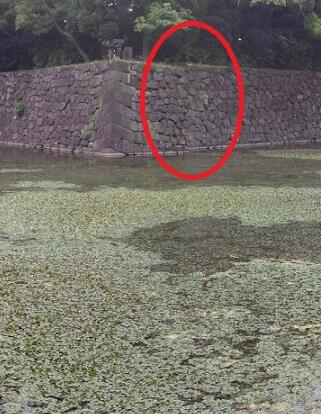

Today's topic is this photo. How was it taken?
It is the Ote-bori of Edo Castle (the Imperial Palace), across from the Palaceside Building. At the far right is Hirakawa-mon, directly opposite the building's main entrance. The spot is around the statue of Wake no Kiyomaro on Uchibori-dori and Hirakawa-mon. (Photographed autumn 20108.)
Even a phone that shoots wide still cannot go this wide as-is. Panorama mode can go wider, but with a bit more distortion.
The reveal: this is a composite Google made on its own (?).
The source shots are the two below. Tone and the rest are beautifully corrected.
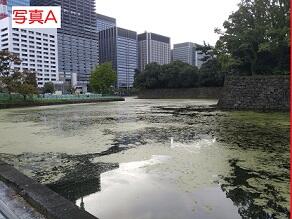
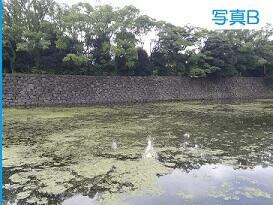
The finish is quite high. The red line in the photo is the right edge of photo A, the blue line the left edge of photo B; the join
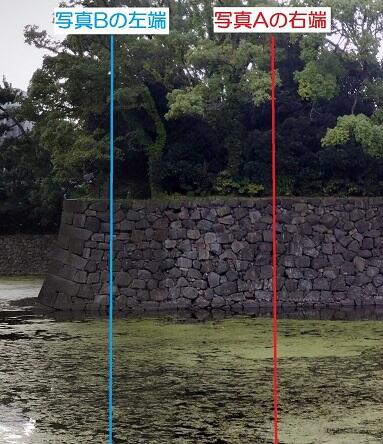
should sit between those lines — can you tell? Photo B is whiter, so from where the stone wall lightens it is probably B, but even staring at each stone you cannot find the seam.
Once before they composited stone-wall shots the same way; a close-up of the join is the photo at the end. The water plants are beautifully merged, but look closely and the wall is slightly off (circled in red). In about a year Google's compositing has improved a lot.
Google Photos, if you have a Google account, automatically saves phone shots to the cloud — very handy — but once photos are stored it sometimes processes them unasked. Whether on a schedule or when a batch gathers is unclear; one such product is the panorama. It does not always make one, but it did make a moat panorama.
Not only panoramas. Once we shot several family photos around a flower pot and it turned them into a slideshow that moved as if it were video.
It also auto-makes albums by date or place and applies filters.
If this much already impresses us, we worry whether we can live in the age of AI (artificial intelligence)... (´;ω;`)