

In summer the whole of society slows down; around Obon in particular many people take long holidays, and the trains run empty. On a blog like this, too, running short of material is what you might call the “summer lull.”
So, though stepping out of an air-conditioned room felt like a chore, I decided to wander out of the Palaceside Building for a change, and at lunch I went to the East Gardens of Edo Castle (the Imperial Palace). I peered about expecting flowers, but found almost none.
Reaching Ninomaru Pond I finally spotted deep-pink and white crape myrtle around the water. But I had just written about the crape myrtle on Uchibori-dori two weeks ago…
Then I looked at the water’s surface and saw charming yellow flowers.
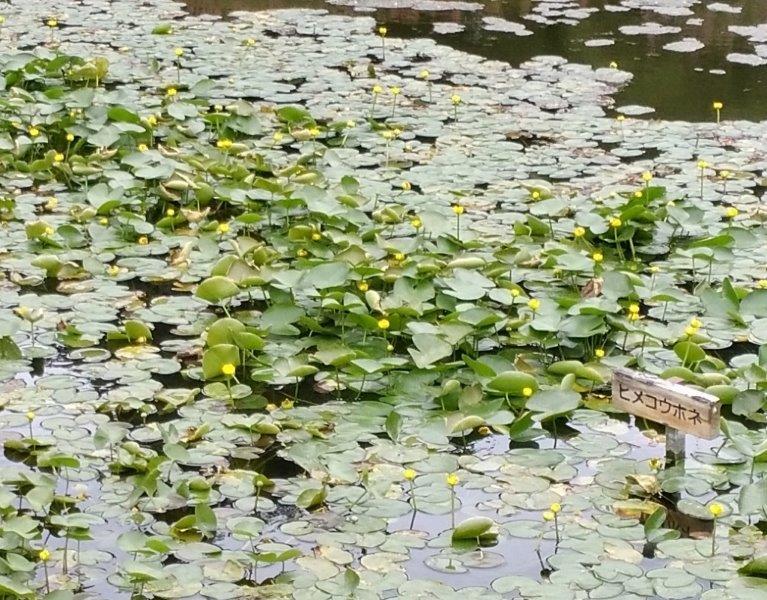
First, asaza (Nymphoides peltata) (photo above). A member of the Menyanthaceae in the order Solanales. It bears yellow flowers 3–4 centimeters across whose edges are finely split like frills. There are five petals, but they join at the base — a fused corolla. It grows not only in Japan but widely across Eurasia, from Asia to Europe. The flower language is said to be “grace” and “calm.”
Next, hime-kohone (Nuphar japonica, a smaller relative) (photo at right). Stems rise from the water and each holds one vivid yellow flower 3–4 centimeters across. Native to Japan and widespread from Honshu through Shikoku and Kyushu, it belongs to the water-lily family; the underwater rhizomes look white and knobby, like bone, which is why the parent plant is written “river bone” (
kohone). The flower language is “sublime” — rather stylish.
Asaza blooms from mid-May to mid-October, kohone from late April to late September, so they can be enjoyed for quite a while. In a season when other colorful flowers are scarce, even small blooms stand out.
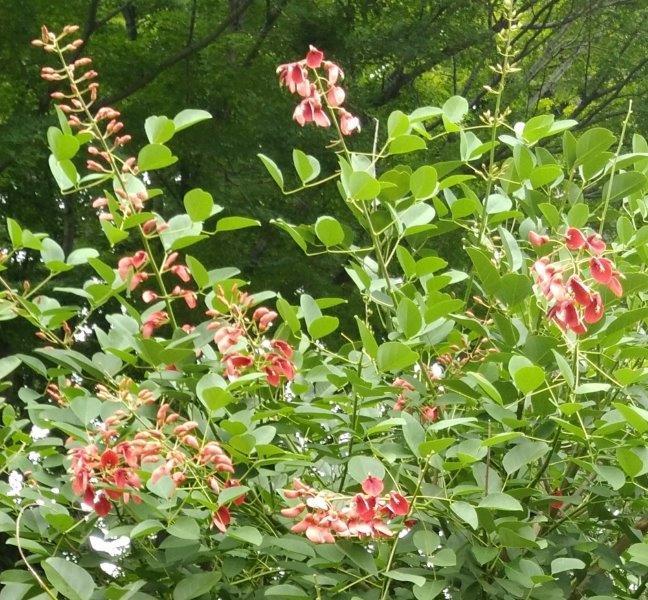
On the way back from the East Gardens toward Hirakawa-mon, there is a corner of prefectural trees. Amid a sea of green leaves I found a red flower in one spot. Kagoshima Prefecture’s kaikozu (Erythrina crista-galli), also called American deigo — photos at left above; a close-
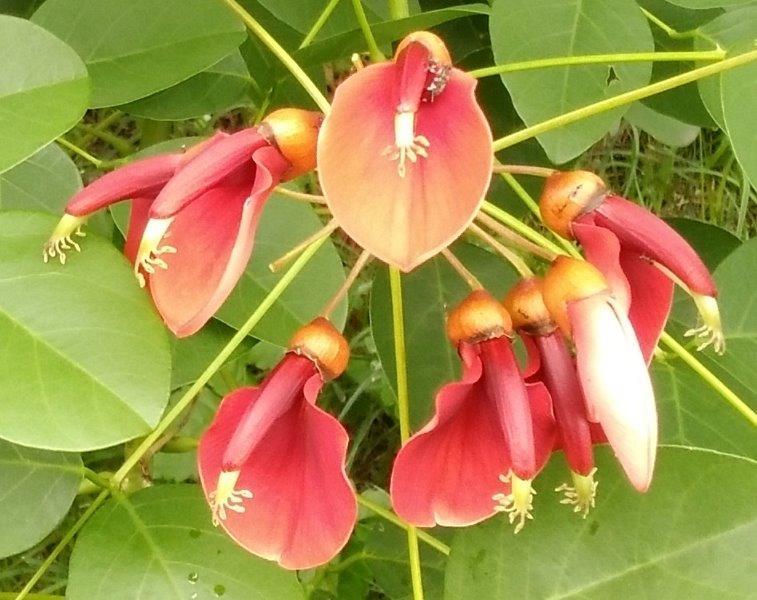
up is left below. Native to South America. The prefecture’s website says:
“It was chosen for the tropical mood it evokes. A deciduous tree of the pea family, it grows to about five meters and from summer into autumn bears red flowers 4–5 centimeters long. The contrast of the red blooms, which appear two or three times a year, with the green leaves is vivid and thoroughly southern.”
It is said to have reached Japan in the late Edo period, so perhaps Segodon (Takamori Saigo) also looked at these red flowers and felt his resolve for the Restoration rise.