

The Palaceside Building appears on VISIONARY (https://lexus.jp/magazine/), the lifestyle media published on the official site of Toyota’s luxury brand LEXUS, under the title “A Treasure Among Japan’s Office Buildings.” Quite a phrase — high praise indeed. Thank you.
VISIONARY runs articles and columns in six categories: CAR, CULTURE, CRAFTMANSHIP, EXPERIENCA, SPORT and TECHNOLOGY. Being Lexus, the pages are as polished and luxurious as you would expect.
The Palaceside Building was taken up in the “Column” section of CRAFTMANSHIP, in “Eight Japanese modernist buildings architect Sou Fujimoto says deserve attention now” (https://lexus.jp/magazine/20171206/121/cra_jpn_architecture.html) (posted in December 2017).
It is short, so we reprint the text as is.
“A masterpiece by the young Shoji Hayashi, and a treasure among Japan’s office buildings. The contrast between the solid cylindrical core and the light office floors is beautiful. The exterior, born of rain gutters like a row of wineglasses and airy sunshades, somehow recalls traditional Japanese architecture.”
Hayashi, mentioned in the text, led Nikken Sekkei’s Palaceside Building design team in his thir
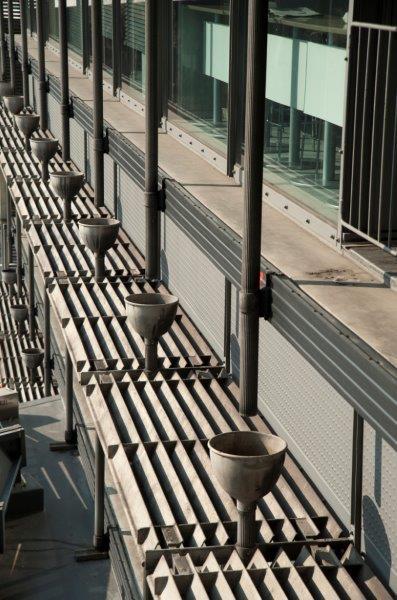
ties. The “rain gutters like a row of wineglasses and airy sunshades” appear in the photograph on the right of the column screen at the top. They sit at the windows and are a little hard to see, so please look at the photo at right. Seen from the side they are easier to grasp. For more than half a century since completion, specialists have often praised them as combining beauty and utility.
Columnist Fujimoto heads an architecture office and is a much-watched rising architect, winner of the Japan Architecture Award, the JIA Newcomer Award and many others.
The other seven of the eight are as follows.
① Kenzo Tange’s supreme masterpiece — Yoyogi National Gymnasium (design: Kenzo Tange, completed 1964)
② An overwhelming interior like a prehistoric cave — Tokyo Cathedral (design: Kenzo Tange, completed 1964)
③ A beautiful fusion of Japanese tradition and the modern — Tokyo Bunka Kaikan (design: Kunio Maekawa, completed 1961)
④ Another world in the city, buried in green — Institut Franco-Japonais (design: Junzo Sakakura, completed 1951)
⑤ A dynamism typical of modern architecture — Taro Okamoto Memorial Museum (design: Junzo Sakakura, completed 1954)
⑥ A glimpse of modern Japan’s tenacity — Nissay Theatre (design: Togo Murano, 1963)
⑦ A masterpiece overflowing with originality — Musashino Art University Eaganodai Campus (design: Yoshinobu Ashihara, completed 1962)
All are masterpieces of the 1950s and 1960s. Among office buildings, the Palaceside Building is the only selection.