
Mainichi Building Co. held its fiscal 2018 Advanced First-Aid Training over three days, July 9–11, bringing together Palaceside Building tenants, building staff, partner-company staff and people from the “sister building,” Mainichi Nihonbashi Building. The program, run in earnest since 2014 with the goal of “at least one person who has completed advanced first-aid training per workplace,” had 71 participants this time.
The course is practical, centered on CPR skills. After a full eight hours from 9:00 a.m. to 5:00 p.m., with a lunch break, the Tokyo Fire
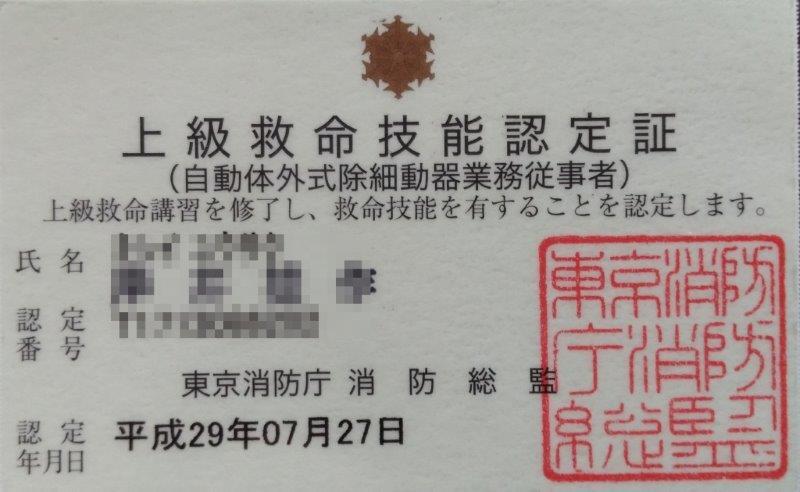
Department issues an “Advanced Lifesaving Skills Certificate” (photo at right). It is valid for three years; a half-day (three-hour) refresher after three years renews it.
On the 10th a one-day course for new certificate holders was held in Mainichi Hall on the first basement level, with 41 people. On the 9th and 11th, refreshers for those who trained three years ago were held in a conference room of the Mainichi Building office on the fifth floor; 31 people took part in all.
Instructors come from the Tokyo Disaster Prevention and Emergency Association. After a brief explanation,
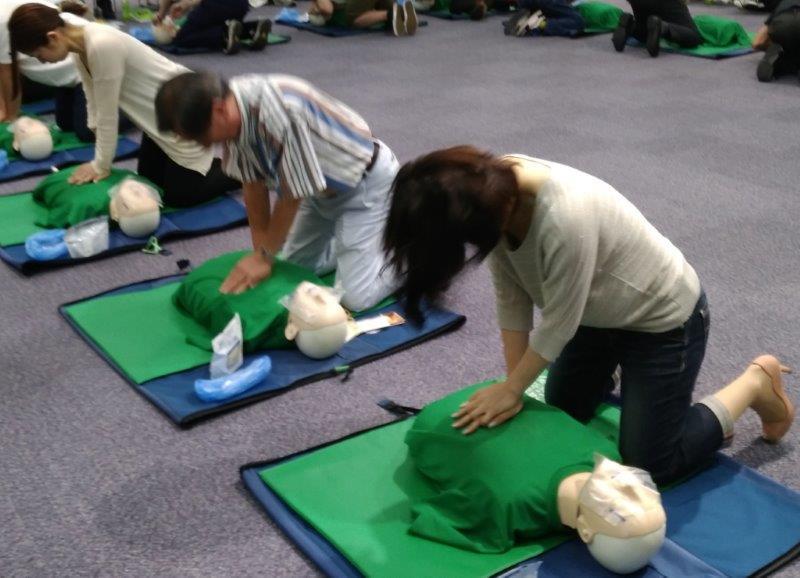
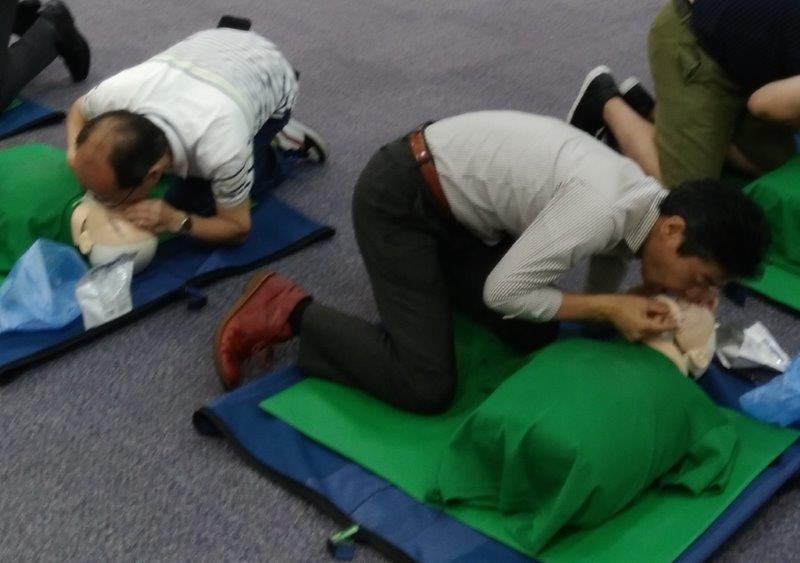
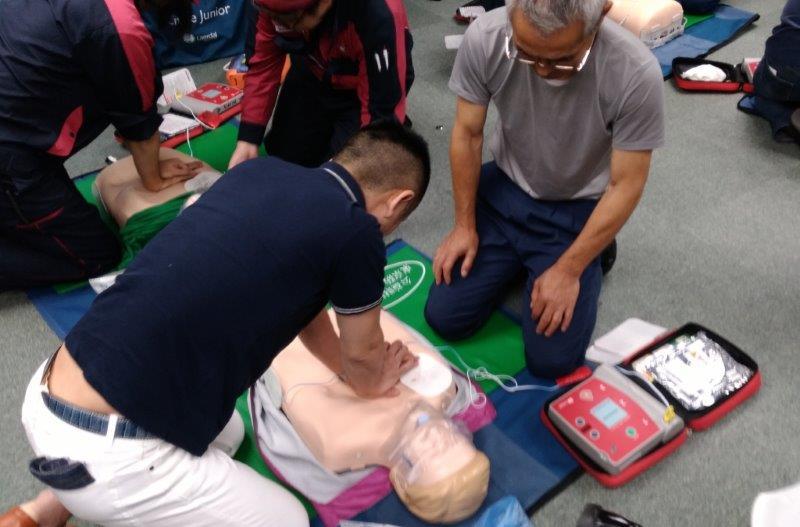
it is all practice. Using a torso dummy as the casualty, you call “Are you all right?”, check breathing and the heart, and if cardiac arrest seems likely, start chest compressions. Place the heel of the hand at the center of the chest, stack the other hand, put your weight on it and press so the chest sinks about five centimeters with the ribs (photo at left above). After 30 compressions at 100–120 a minute, give rescue breaths: fit a mouthpiece, lift the chin, pinch the nose and blow twice into the lungs (photo at left center). Then back to compressions — the rule is to keep going until the heart moves.
If the heart fibrillates and loses its pumping function (ventricular fibrillation), the tremor must be stopped and a normal rhythm restored. The device for that is an AED (automated external defibrillator). Operating it is a key theme of the course. You open the box
, switch it on, stick pads on the chest, deliver a shock and return to compressions — a sequence learned hands-on (photo at left below).
First-aid courses include a half-day “ordinary” course and a full-day “advanced” course. This building runs the advanced one, covering CPR not only for adults but for children, infants and newborns. Pressing a small child’s chest as you would an adult’s could crush it, so for “children” under 16 you press the lower half of the sternum with one palm until one-third of the chest thickness sinks; for “infants” under one year you press slightly below the center of the chest with two fingers. That practice was also taught.
First aid and other care were taught as
well.
Thank you to everyone who took part. Well done.