

The Palaceside Building held an earthquake-response drill on the 20th. About 50 people took part, including Mainichi Building Co. staff and personnel from the first-floor-west Disaster Prevention Center and the sixth-basement Central Control Room.
Centered on first response when a large quake hits, the drill is repeated three or four times a year with day, night and other settings changed.
This day it began at 10:00 a.m. The scenario, however, was night, about 11 hours later. The point was first response by only the security staff of the 24-hour Disaster Prevention Cen
ter and the facilities staff of the Central Control Room, assuming Mainichi Building employees were not present.
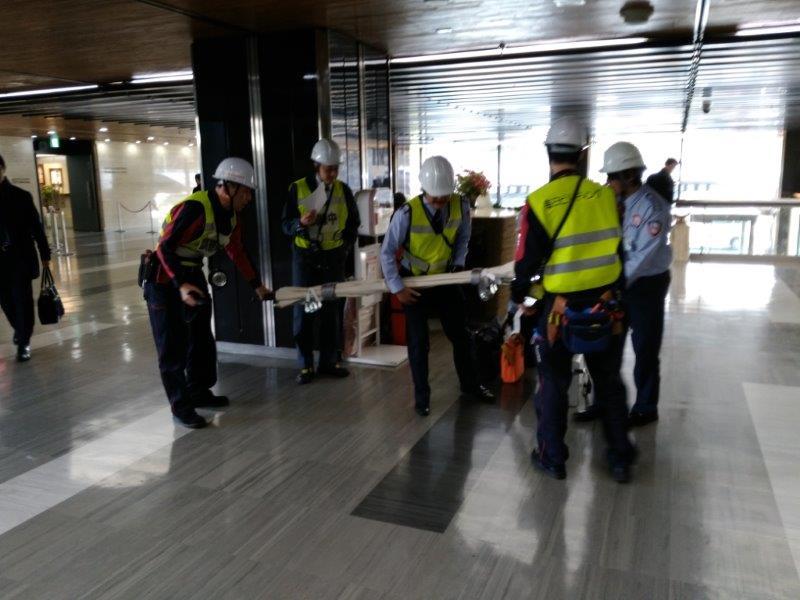
It started with the assumption “a lower-6 earthquake has occurred.” A temporary HQ was set up at the Disaster Prevention Center. Over time, reports came in — “east outer wall at risk of collapse,” “elevator trapped on west third floor,” “someone fallen and injured in the east entrance hall,” “leak in a shop,” “fire in the cafeteria,” “office ceiling collapse” — and the HQ wrote them on a whiteboard and issued instructions (topmost photo). For the injured person at the east entrance, for example, they did not actually carry someone, but staff brought a stretcher to the site (be
hind building reception) (photo at right). Mainichi Building staff were posted at each “scene” to check how the response went.
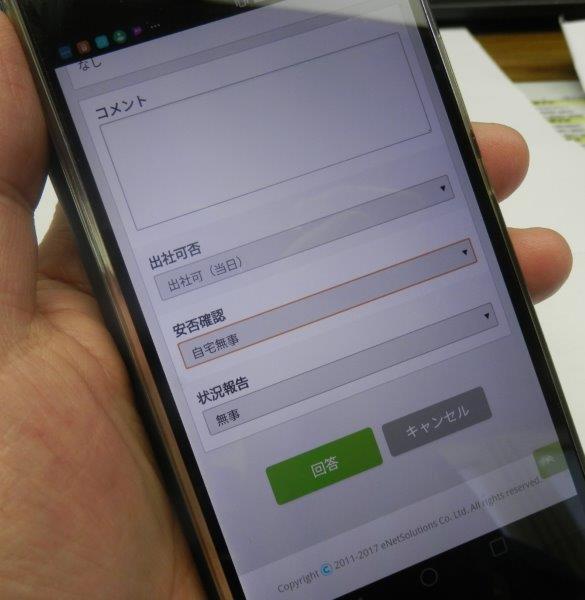
Mainichi Building staff who did not go to the scene were, in the scenario, at home or elsewhere; they did not rush in. As first response they practiced body protection (under desks) and, for the “safety-confirmation system” that emails all staff at once, actually sent mail to everyone, who then opened the dedicated site or app on their phones and, following the screen (photo at left), entered “safe at home,” “can come to work” and so on.
The Palaceside Building will keep training toward a safer, more secure building.