
An abrupt question: whether Palaceside Building is male or female. The answer comes at the end; first, a book that features the building.
Tokyo Modern Architecture Walk (X-Knowledge, A5, 207 pages, softcover, 1,800 yen before tax) has just been published (photo above is the cover). The author is architectural historian Shunsuke Kurakata; Shinobu Shimomura took the photographs. The building also appeared in the same publisher’s Tokyo Buildings the World Can Be Proud Of (by Kenji Miyamoto, November 2013).
The concept of Tokyo Modern Architecture Walk is that you can still catch the “scent” and “air” of the Showa era, which is drawing fresh attention ahead of the Olympics. It pairs
with the earlier Tokyo Retro Architecture Walk (50 buildings from before the war).
The book covers 48 handsome, beloved buildings and apartment houses born in the high-growth years, grouped into five areas such as “Marunouchi, Hibiya and Shinbashi” and “Shibuya and Meguro.” Palaceside Building leads the eight entries in the “Ueno and Imperial Palace area” (not a grouping we often hear) and gets six pages.
We almost forgot: in the prologue, “An Invitation to Modern Architecture,” of the ten photographs used in all, only Palaceside Building appears twice — the core (elevator tower) and the cast-aluminum sun louvers. We take that as confirmation that the building represents modern architecture in function as well as looks.
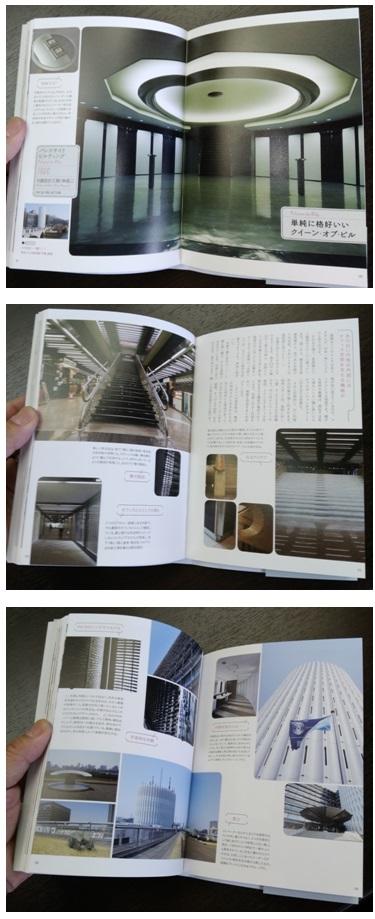
The Palaceside pages are 120–125. They open with a double-page of the core lobby, noting that the elevator call buttons stand independently. That choice surely reflects the sensibility of the author and editors (photos at right, above).
The next spread shows the east-entrance stair and zelkova handrail, the round cutouts in the marble wall that separates the men’s and women’s restrooms under the east first-basement stair, and the “Dream Stairs,” among other details (photos at right, middle).
The last two pages cover the core’s exterior, the west-entrance umbrella (large canopy), the sun louvers and the rooftop garden (photos at right, below).
In just six pages, the book neatly captures the building’s character and charm.
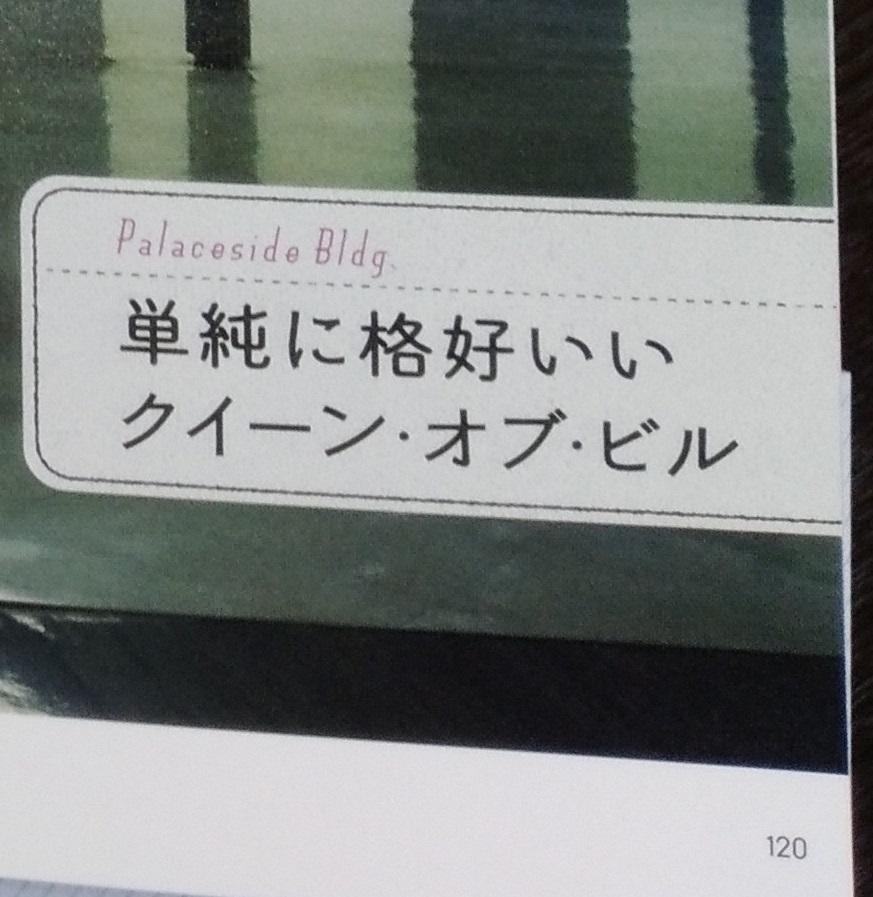
Now the riddle. The answer is “female.” It is on page 120. In close-up the text reads, simply, “a cool Queen of Buildings” (photo below). Why a queen? The book does not say
. It is the author’s designation. The white cores do perhaps feel feminine. How would you see it?