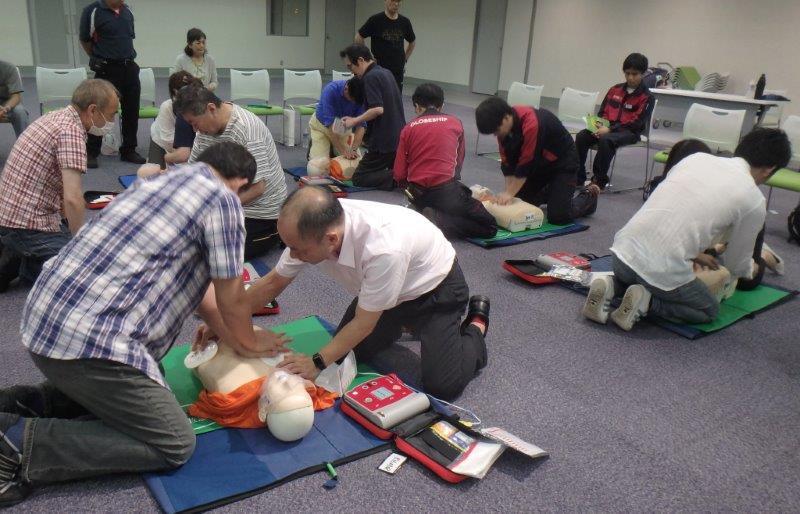

On the 6th Palaceside Building held its 2017 Advanced Lifesaving Course at Mainichi Hall on the first basement, bringing together tenants, building staff and contracted-company employees. The goal, pursued in earnest since 2014, is “at least one Advanced Lifesaving Course graduate per workplace,” so that sudden illness or injury — especially cardiac arrest, when every minute counts — can be met. Seventeen people took the course this time.
An instructor from the Tokyo Disaster Prevention and Emergency Association led eight hours from 9:00 a.m. to 5:00 p.m., with a lunch break, and the work was intensive. Many courses mean sitting through lectures and fighting sleep; this one is above all hands-on. After a short briefing, participants raised their voices, used their bodies and repeated drills devoted to helping someone in extremis.
Such courses are a public qualification taught and certified by municipal fire bureaus or headquarters such as the Tokyo Fire Department. There is a half-day Standard Lifesaving Course and a full-day Advanced course. This building runs the Advanced one; a major feature is that it covers not only adult CPR but also resuscitation for children, infants and newborns.
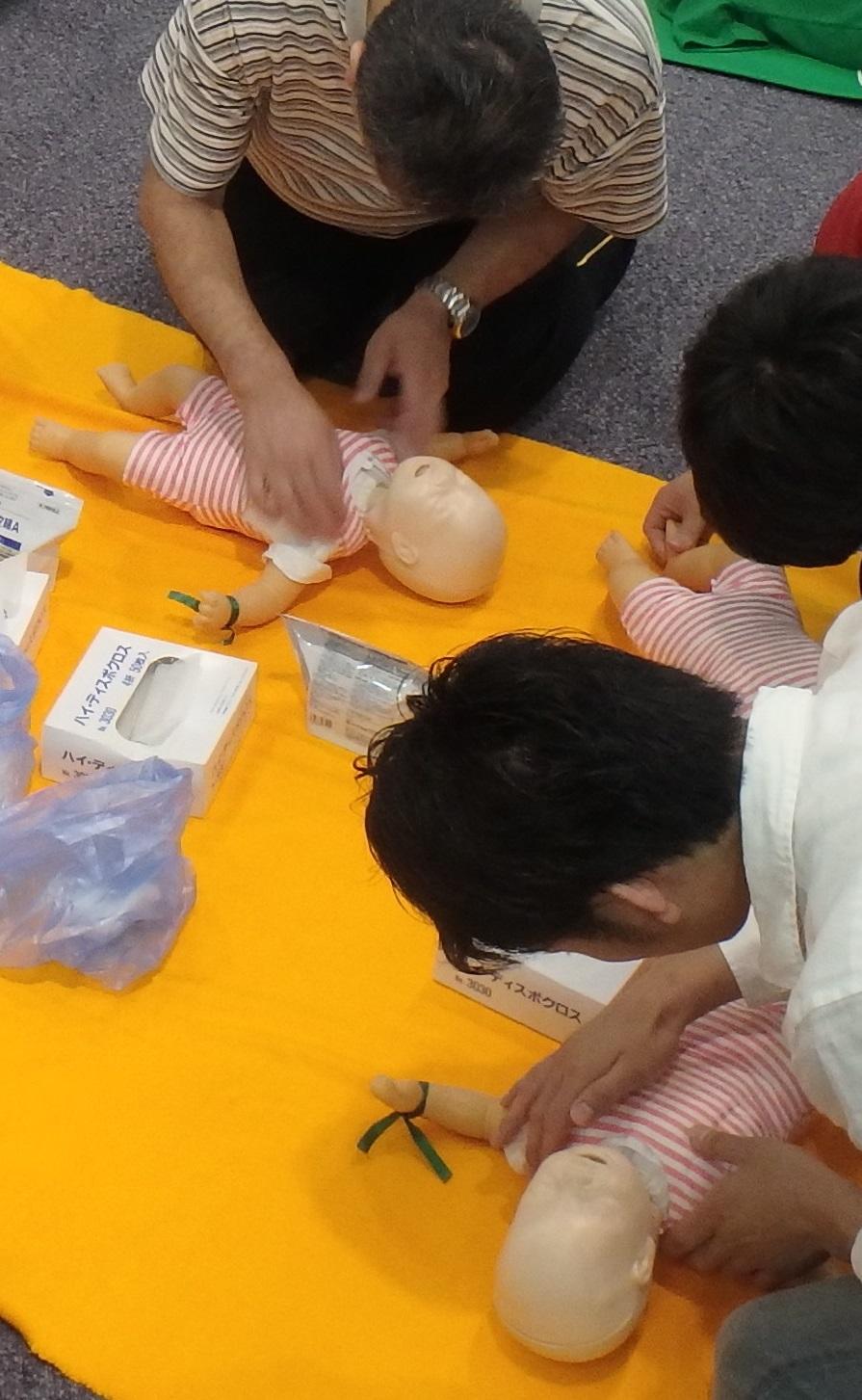
The method for restarting a stopped heart and lungs is chest compression. People often say “artificial respiration,” but resuscitation is in fact two parts: chest compression to move the heart, and rescue breaths to fill the lungs.
For adults, the heel of the hand is placed at the center of the chest, the other hand stacked on top, and the chest is pressed so that the ribs sink about five centimeters (photo above). The same force would crush a small child, so for “children” under 16 the lower half of the sternum is pressed with one palm until a third of the chest thickness sinks, and for “infants” under one year the area slightly below the center of the chest is pressed with two fingers (photo at right).
After 30 compressions at 100–120 a minute come two rescue breaths, then compressions again — until an ambulance arrives. Try it and you find it heavy labor. In practice several people would have to take turns.
A further
key to saving a life is operating an AED (automated external defibrillator) (photo at the end). Bring the machine, switch it on, and it talks you through the steps; follow calmly and it generally works well.
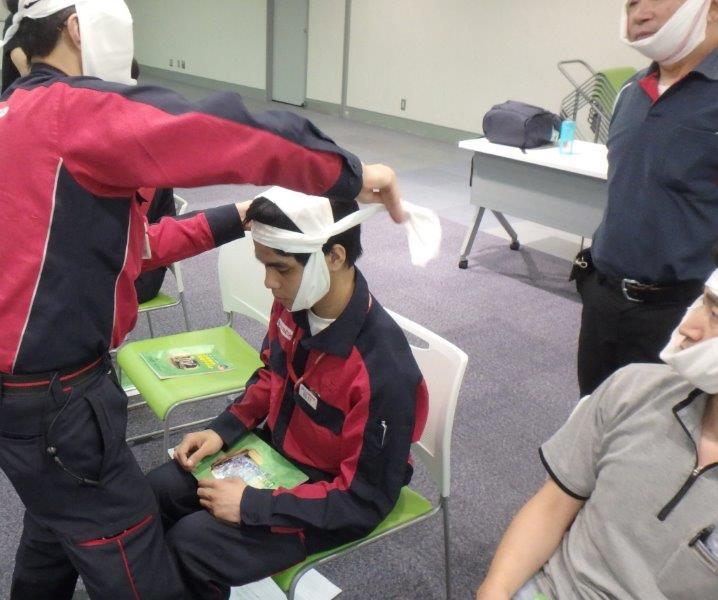
First aid also covers burns and fracture immobilization; this time participants learned to use a triangular bandage to stop bleeding from a head wound (photo at left) and to sling an injured arm.
Everyone completed the full course and passed. A Fire Chief–certified “lifesaving skills certificate” will be issued later.
Thank you to all who took part. Well done.