

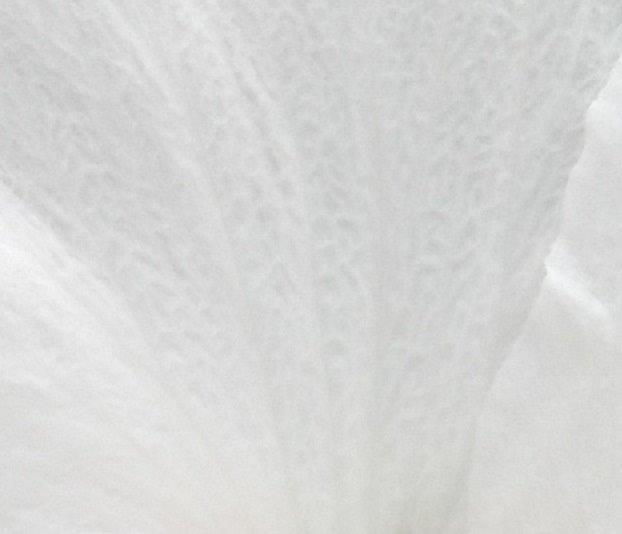
Now, what are the photos above and at right? Is the one above white chocolate? The one at right, lace fabric??
The reveal comes later. Slipping out of Palaceside Building, I took a long-overdue stroll through the East Gardens of the Imperial Palace (Edo Castle). The destination was the lawn of the former Honmaru. I entered at Kitahanebashi Gate and passed beside the tenshu platform.
Compared with May and June, the plants too are in their summer-fatigue season, but the liveliest bloom seemed to be rose of Sharon (mukuge). It was flowering in the planting toward Fujimi Yagura, at the far side of the lawn south of the tenshu platform — roughly beside the site of the Great Corridor of Pines. A close-up of the pollen at the center of the flower is the opening photo above. A close-up of the petals, which are not leaf veins — they are a flower — but look as if they have a fine openwork, is the photo above at right.
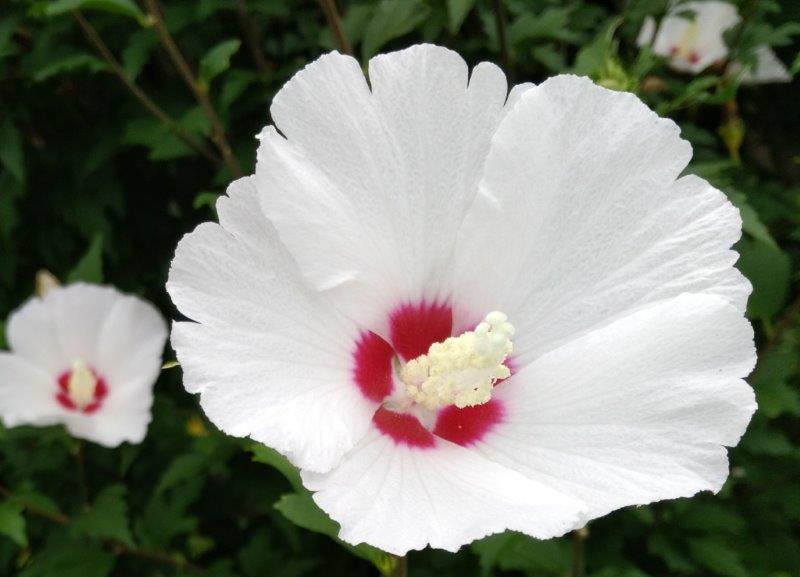
The flower as a whole is the photo at left.
Mukuge is a deciduous shrub in the mallow family, Hibiscus genus, native to China. It is also called hachisu. Widely planted as a garden tree, it is also indispensable as a summer tea flower.
The character is 槿; it is also often written with the Chinese 木槿 (mùjǐn) and read “mukuge.”
It usually stands about three to four meters and, from July to October, bears beautiful flowers in white, pink, purple and even red. Blooms are about five to ten centimeters across. Forms include single, semi-double and double; the photo appears to show five petals.
A single white flower with a red center — the “soko-beni” type — is said to have been favored by Sen Sotan (Rikyu’s grandson, founder of the Sotan school) and is also called “Sotan mukuge.” The photo does not look like a single bloom, but this may be the image of Sotan mukuge.
On the 2nd the fierce heat eased a little, and walking brought only a light sweat. On blazing days one hesitates to stroll, but please enjoy a walk around Edo Castle in the gaps between the heat.