

Hot days continue. In newspaper cliché, “as the thermometer climbs, so does power use.” Though “unagi-nobori” — climbing like an eel — is a phrase one sees less now. Perhaps it has grown shopworn. Personally I like it: a carp leaping a waterfall is too fierce, a salmon swimming upstream risks being eaten by a bear, while an eel is a little humorous.
Anyway, power. In the summer of 2011, after the Great East Japan Earthquake, the government issued a power-restriction order; the country saved electricity against a stern 15 percent cut and rode out the crisis. Energy-saving investment then advanced across society. This building has invested as well, switching common-area lights to LED, and we hear tenants have been greening lights and other equipment.
Even so, as time passes the memory of shortage fades, and calls for saving energy grow quieter year by year.
We have to push a little harder. So from July 1 Palaceside Building has entered its annual “power-saving period” (through September 30). As usual, the more visible steps include the following.
・Lights at the east and west first-floor entrances
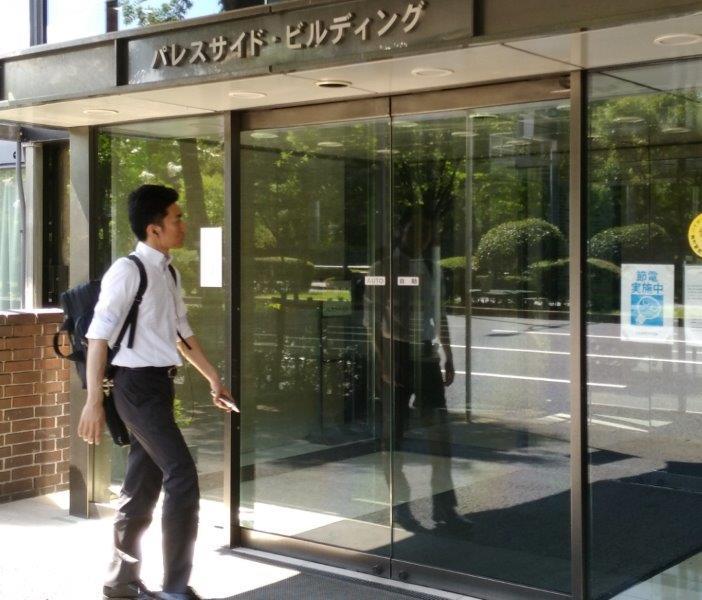
are off from 13:00 to 16:00
・Perimeter lights in the men’s restrooms, from the entrance to the washbasins, now come on at 18:00 instead of the usual 16:00
・Some parking-garage exhaust fans are stopped
To explain these steps, posters in blue type and illustration asking for cooperation — “Power saving in progress” — are up at the east and west elevator halls (photo above), the east main entrance (photo at left) and other doors of the building.
At Mainichi Building Co.’s fifth-floor office, lights are turned off at lunch (noon
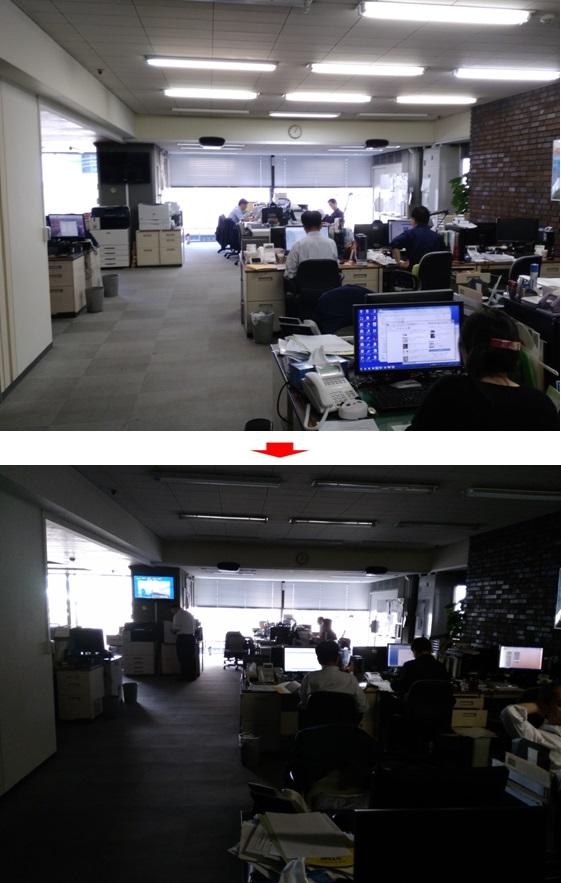
to 1:00 p.m.) and other savings are practiced (photos at right, below).
At the same time, to keep building life as comfortable as possible, air conditioning on weekday mornings after Sunday and other closed days is started an hour earlier in summer. HVAC is off on closed days, so heat builds up and it takes time to cool the next morning.
This summer looks hot. We ask tenants for continued understanding and cooperation on energy saving.