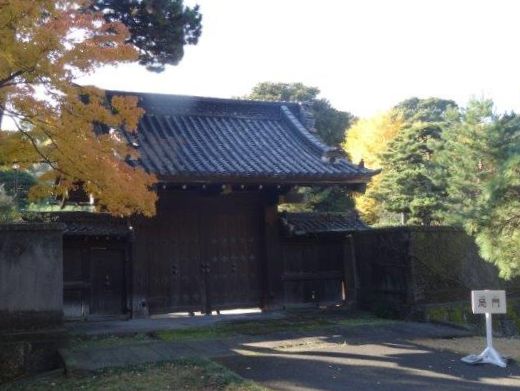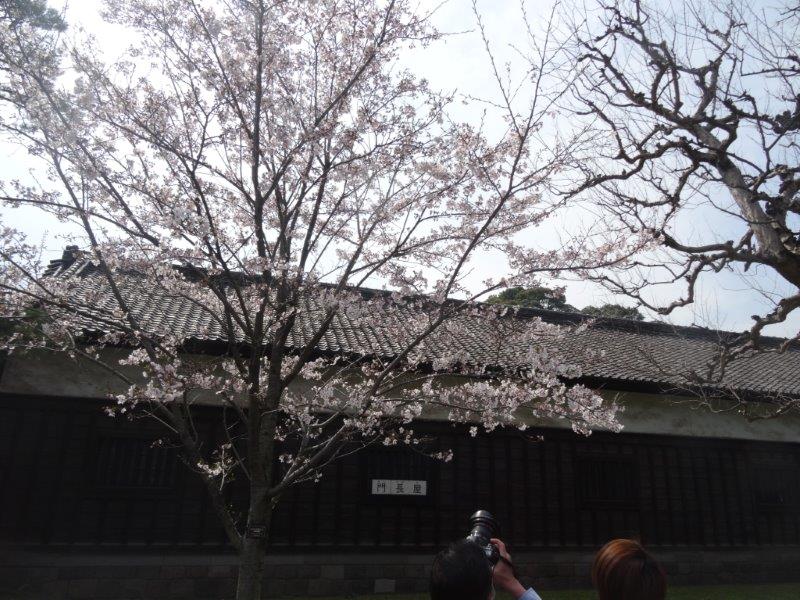

Directly across from Palaceside Building, Fujimi Tamon at the far side of the former Honmaru plaza in the East Gardens of the Imperial Palace (Edo Castle) has been open since autumn 2016 — I wrote that in March after the new year. This is the sequel.
Being able to go inside means you can look west. And “Fujimi” invites the hope that in winter, at least, Mount Fuji…
The conclusion, sadly: you cannot see Fuji.
The photo above is the view from a Fujimi Tamon window. The windows that face the moat just below are, as I wrote in March, first of all for
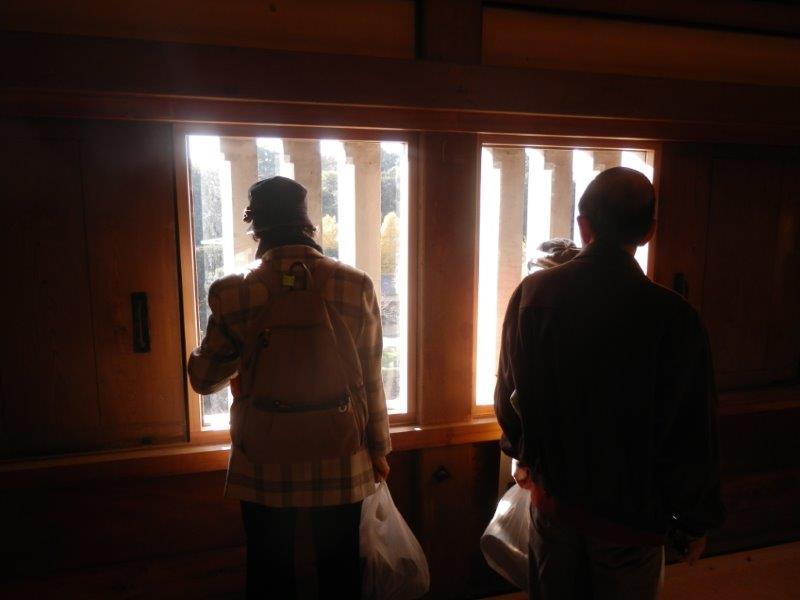
defense, so they are tall, narrow lattice-like slits, and you look through the gaps. The overall feel at the window is like the photo at right.
Did shoguns once enjoy Fuji, and also cherries in spring and autumn leaves in fall and winter? You can taste a little of that mood. The photos are from last autumn’s foliage season.
What you see from the window is shown in the photos at left, below.
In the foreground is Hasuike Moat, dividing the Honmaru from the Nishinomaru. Inui-dori along it is a main north–south road through the palace grounds. Cherries and maples are planted; as this blog has often written, it is opened to the public in spring cherry season and winter foliage season. (In winter 2016 and spring 2017 public opening was suspended for tree-renewal work.)
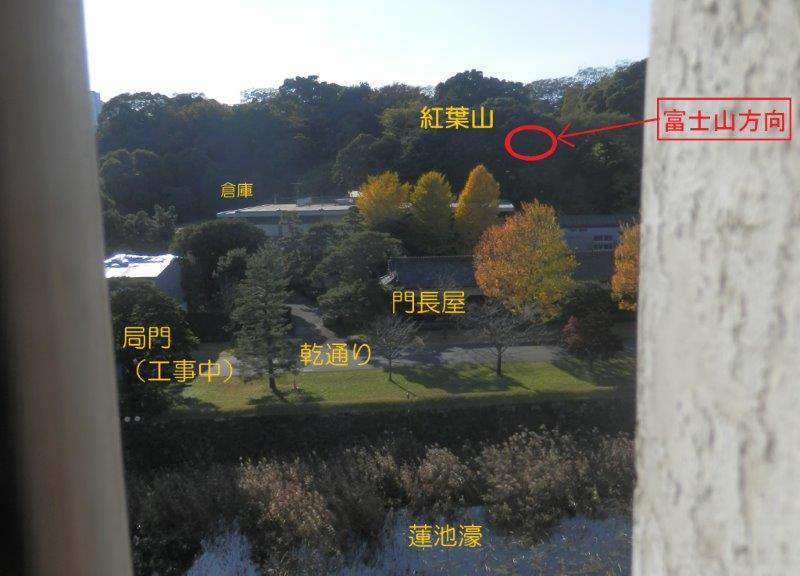
Along Inui-dori are Tsubone Gate and Mon-nagaya. Both date from around 1887 (Meiji 20), when the Meiji Palace was built. Tsubone Gate takes its name from the women’s quarters that once stood here; the photo shows it under construction. Mon-nagaya is a two-story wooden storehouse with a gate in the center. The last photos are shots from when Inui-dori was open: the first is Tsubone Gate (December 2015), the second Mon-nagaya (March 2016).
Straight ahead of the tamon is Momijiyama. In the Edo period a Toshogu stood on the summit. Today there is the Momijiyama Imperial Silkworm House. It goes back to Empress Dowager Shoken (Empress to Emperor Meiji). In 1871 she revived court sericulture, long interrupted, in Fukiage Garden. After another break it was restarted in 1908 by Empress Teimei (Empress to Emperor Taisho). The Momijiyama house was newly built in 1914 and passed to Empress Kojun (Empress to Emperor Showa) and then to Empress Michiko. Each year the Empress feeds mulberry leaves to the silkworms in the “gokyuso” rite; this year it was on May 22 and was in the news.
Finally, Mount Fuji. It was once visible in the red circle in the photo at left, above, but landscaping of Momijiyama in the Edo period hid it. Now it is a “Fujimi-tamon where Fuji cannot be seen.”