

Central Tokyo moves from Somei Yoshino through double-flowered cherry to azalea. Hesitate a little and the season is gone before you can savor it. Come to think of it, the dogwood in the garden — I thought “it will bloom soon,” and next time I looked more than half the petals had fallen. (;^_^)
So the photo above is from April 19, beside the statue of Wake no Kiyomaro. A shot from peak viewing, though there was no wind.
I like how cleanly the building is reflected in the moat.
Every morning, walking from Otemachi toward Takebashi, when you glance toward Palaceside Building around the intersection in front of the Japan Meteorological Agency, the view is quite fine.
But as Fumiko Hayashi wrote, a flower’s life is short… (Not that everything is hardship.)
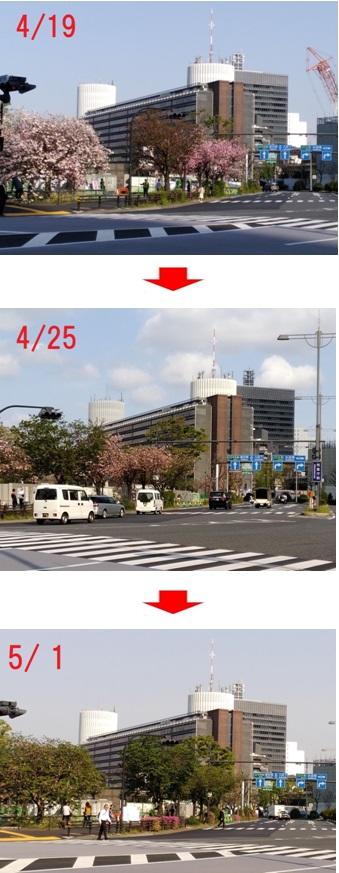
The photos at right, from the top: April 19, April 25, May 1. Truly, like a fleeting dream, time races by….
Cherry trees, by the way, are the Prunus subgenus of the plum genus in the peach subfamily of the rose family (there are other views). That further splits into sections such as Cerasus, Microcerasus and Miyamazakura. Mutations are many and breeding has been active, so there are many kinds; Japan’s most popular Somei Yoshino is a Japanese garden cultivar from a hybrid of Edohigan and the endemic Oshima cherry. It is well known as a clone, propagated by grafting from a single distinctive tree among the hybrids.
Double-flowered cherry, for its part, is not one cultivar but a general name for cherries that bloom in layers. There is much I do not know precisely. (〃'∇'〃)ゝsigh