

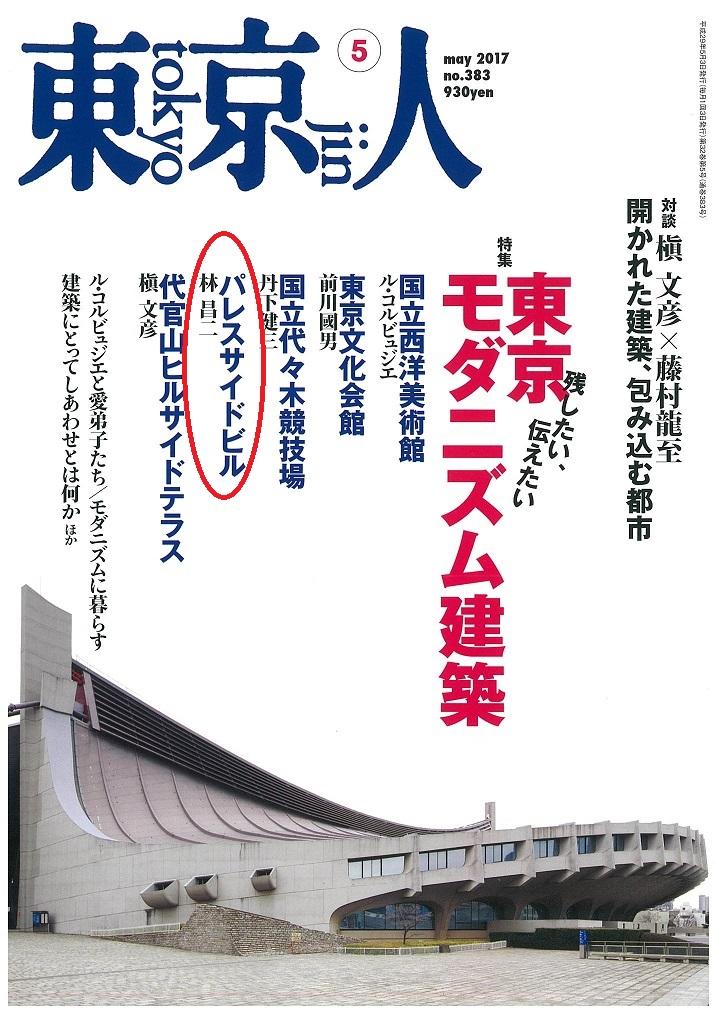
The May issue of the “new-style urban general magazine” monthly Tokyo Jin (photo at right is the cover) featured Palaceside Building in its special.
This issue’s special is “To Keep and to Pass On: Tokyo Modernist Architecture.” Anchored by “Five Modernist Buildings I Want to Leave Behind,” chosen by noted architectural historian and critic Taro Igarashi (professor, Tohoku University Graduate School of Engineering), it is a 71-page package including “Ten Building Types I Want to Leave Behind,” a conversation between two architects of different generations, Fumihiko Maki and Ryuji Fujimura
, “Le Corbusier and His Beloved Disciples,” and “What Happiness Means for Modernism (the problem of preserving modern architecture).”
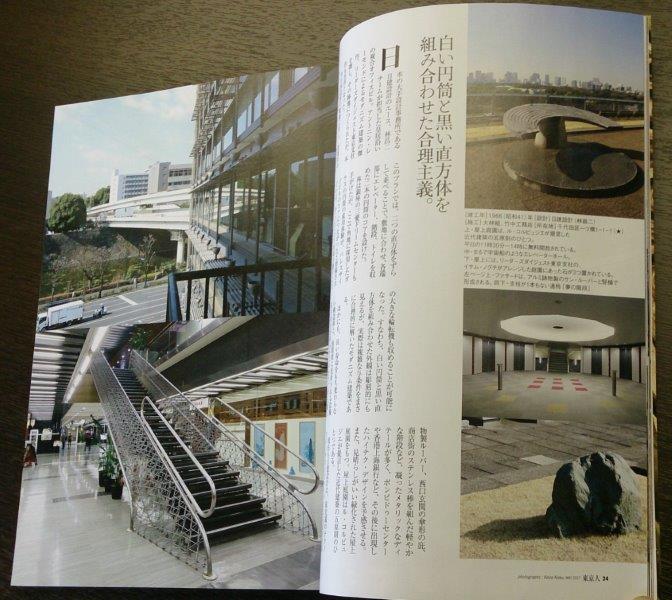
Palaceside Building, designed by Shoji Hayashi (Nikken Sekkei), is treated over four pages as one of those opening five. First a double-page full view lands with a bang (photo at the top). Quite powerful.
The next spread (photo below) places five photographs — the rooftop view guide boards, the elevator hall, the Dream Stairs and more — left and right, with the article between them. As the headline “Rationalism combining a white cylinder and a black rectangular solid” puts it: “By detaching the core there is no need to put elevators in the center, so the rectangular volumes can… maximize office area and also house the large presses in the basement. In other words… the exterior can look sculptural, but it is in fact modernist architecture that solved complex given conditions in a truly rational way.”
It is also praised for “many elaborate metallic details that anticipate the high-tech design that later appeared in the Centre Pompidou and the Hongkong and Shanghai Bank”
.
We feel we must keep running the building to a standard worthy of such praise.
The other four of the opening five are as follows (“…” is the magazine’s main head; designers in parentheses):
・National Museum of Western Art, “A World Heritage site as a monument to the reception of modernism” (Le Corbusier)
・National Gymnasium, now Yoyogi National Stadium, “A masterpiece that faced Japanese tradition” (Kenzo Tange)
・Tokyo Bunka Kaikan, “Architecture that becomes one with the landscape of Ueno Park” (Kunio Maekawa)
・Daikanyama Hillside Terrace, “A happy relationship between architecture and the city” (Fumihiko Maki)