
Usually carp streamers come after the cherries fade; this year the blossoms lasted so long that the streamers arrived before they fell. Palaceside Building’s spring-to-early-summer fixture, the carp streamers, went up this week in the central corridor of the first-floor and first-basement arcade. They are scheduled through Tuesday, May 2.
The in-building
Palaceside Building Meitencai (chair Hiroaki Okada, president of Sakae Co., which runs Tea Room Hana), a volunteer group of restaurants and shops, has displayed them every year at this season for eight years so people can enjoy a traditional custom full of the season. From the first-floor corridor railings and ceiling, streamers, a black carp, a red carp and a blue young carp hang as if swimming through the atrium (photo above). Above the east and west “Dream Stairs” linking the first floor and first basement, a seven-meter “warrior banner” hangs on each side. Smaller carp streamers can also be seen at the doors of member shops.
The streamers and warrior banners are fine work from Watanabe Dye Shop, a kon’ya in Gujo Hachiman designated an intangible cultural property of Gifu Prefecture. They are dyed in the Gujo honzome technique handed down for more than 400 years: cloth with patterns drawn by hand in rice-paste resist is dipped again and again in a vat of indigo, wood ash, lime and wheat gluten, then rinsed in winter in the Yoshida River that runs through the center of Gujo Hachiman. The deep colors are a point of
pride.
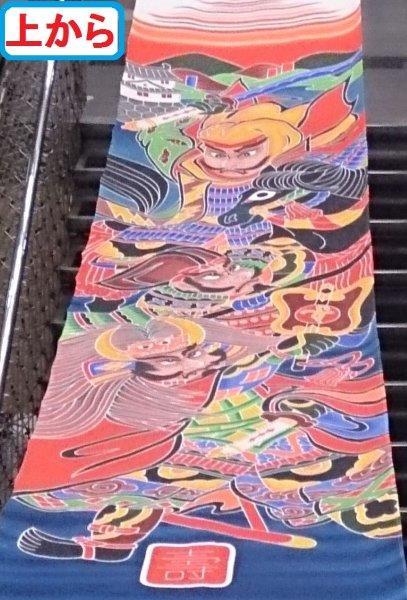
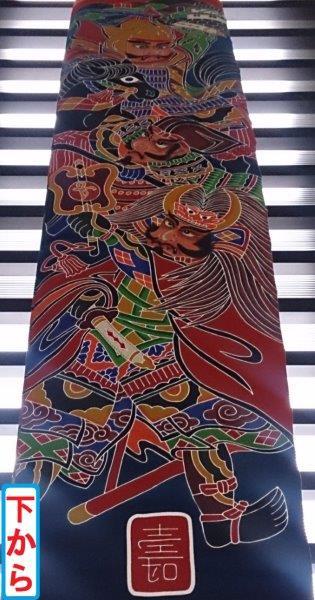
A question. The two photos at left show the warrior banner over the east Dream Stairs, seen “from above” and “from below.” The design is the Battle of Kawanakajima — the famous moment when white-hooded Uesugi Kenshin (upper) charges Takeda Shingen’s (lower) headquarters, a staple of warrior banners. Front and back are left-right reversed; which way is the correct view, from above or below?
The answer is “from above.” At the very bottom of the from-below photo is the character for “longevity,” upside down. The from-below view looks sharper; that seems to be a matter of the light.
Besides Shingen and Kenshin, one more figure is painted. We tried to solve who in this blog on April 27, 2015. To recap:
“Facing the same way as Shingen, confronting left-facing Kenshin, gripping a long black pole (likely a spear shaft), and wearing no helmet — he is thought to be Shingen’s retainer Hara Osumi-no-kami Torayoshi. … Tradition has it that Kenshin, sword raised, rode alone into Shingen’s camp and struck from horseback; Shingen caught the blow with his war fan but was wounded in the arm. Then Hara, Shingen’s ‘chugen-gashira,’ thrust out Shingen’s spear. He missed, but struck Kenshin’s horse at the knee; the horse reared and bolted, and Shingen escaped by a hair.”
We hope you enjoy the banners, including that aside.