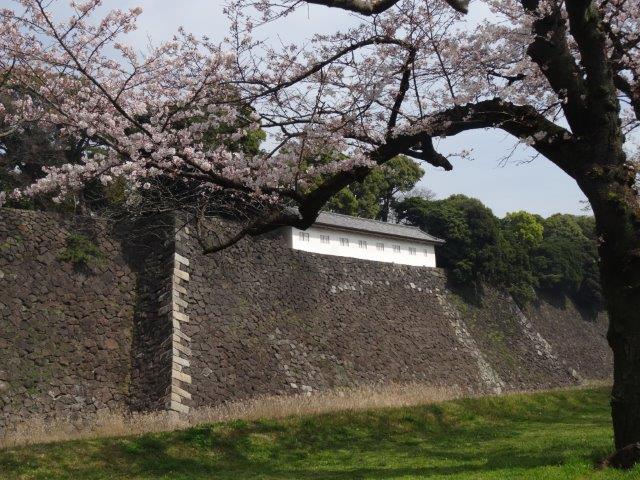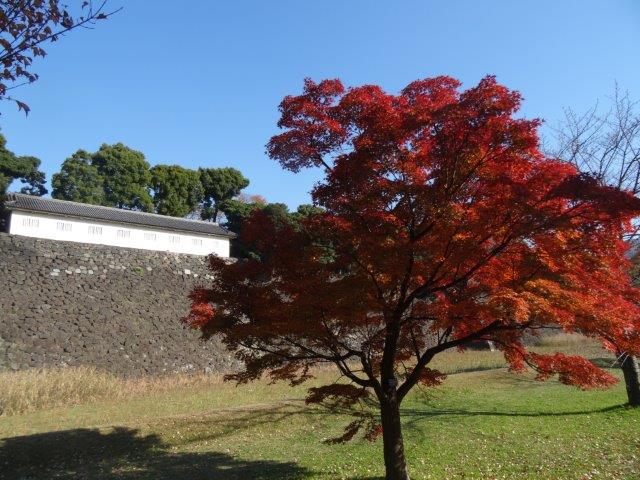

Fujimi Tamon, at the far side of the former Honmaru plaza in the East Gardens of the Imperial Palace (Edo Castle). Did you know its interior has been open since autumn 2016?
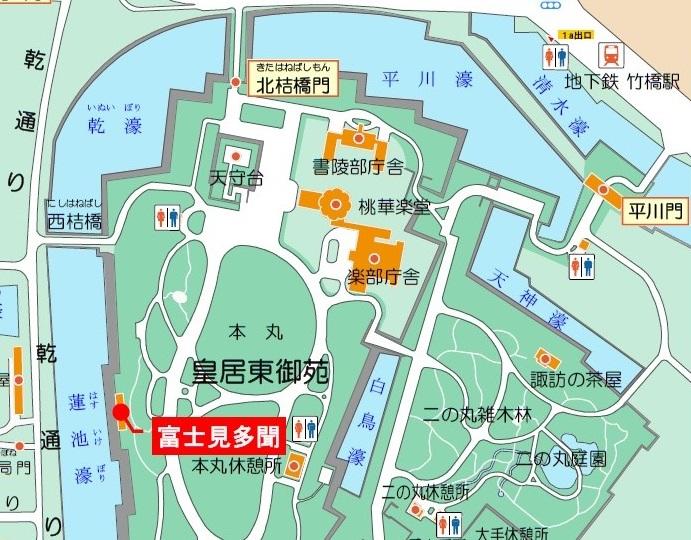
For the exact location see the map at right (from the Imperial Household Agency site). Slip out of Palaceside Building, enter the former Honmaru from Hirakawa Gate directly opposite or from Kitahanebashi Gate on the way up Kii-no-kuni Slope toward Daikancho; it is behind the bamboo grove and stone storehouses.
A “tamon” is a longhouse built on castle stone walls from the late Sengoku period. It was a stout defense from which bow and gun fire met attackers, and also an arsenal. In peacetime
it served many uses: stores of weapons, tools and documents, or quarters for ladies-in-waiting.
The Edo-period Honmaru was ringed by as many as fifteen tamon; only this Fujimi Tamon survives.
The text inside says the exact build date is unknown but may be around 1659 (Manji 2), when the Tokugawa shogun’s position was already stable and defense was less needed.
The photo at left
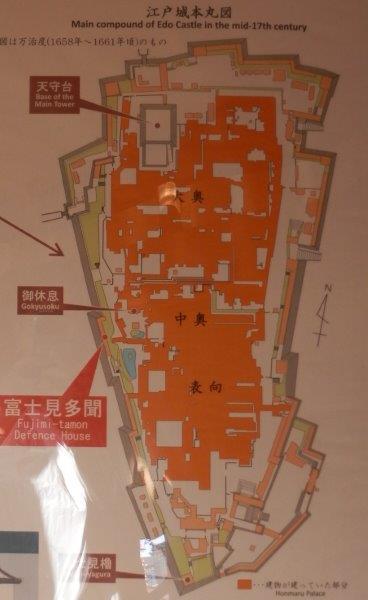
is a plan posted inside (from when the tamon was built). From its place near the “okyusoku,” the shogun’s everyday living rooms in the Honmaru palace, the name “okyusoku-dokoro-mae tamon” also survives. There are traces of fusuma, so Fujimi Tamon may have had uses besides storage.
Apart from use, its role as castle ornament was surely important. It stands on stone walls about 20 meters high facing Hasuike Moat — a fine figure. It is well seen from Inui-dori along the moat, though that road is not usually open. Since 2014 it has been opened to the public for a few days in spring cherry and winter (December) foliage seasons; the first photo below is March 2016, the second December 2014, precious shots from those openings (winter 2016 and spring 2017 openings were suspended for tree-renewal work).
The Chiyoda Ward Tourism Association site describes Fujimi Tamon’s stone walls as follows.
“The east, south and west faces all bend sharply. It is said to have been a device to leave no blind spot when attacking an enemy at the foot or on the wall.” (http://www.kanko-chiyoda.jp/tabid/254/Default.aspx)
In any case, the white-walled figure is quite beautiful.