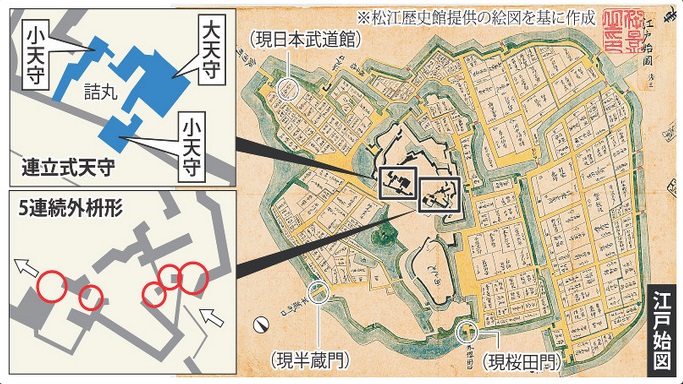

News about Edo Castle (the Imperial Palace) across from Palaceside Building filled the papers in early February. A plan of the oldest class, showing the castle as Tokugawa Ieyasu built it, had been found: “Edo Hajime-zu,” held by the Matsue History Museum in Matsue (photo above). It had been in the collection, so it is not strictly a “discovery”; what is new is that specialists first narrowed the date to “around 1607–09.”
The sheet is a 27.6 × 40 centimeter plan. It shows the complex structure of the “Tsume-no-maru” inside the Honmaru and the walls, and names that seem to be residents on surrounding mansions.
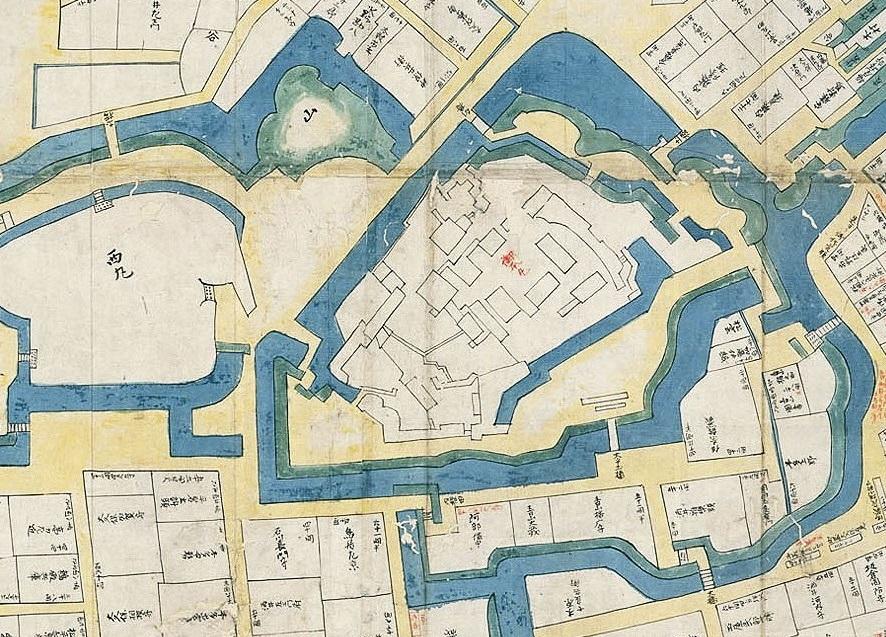
Until now the oldest was thought to be the “Keicho Edo ezu” (Tokyo Metropolitan Central Library), dated around 1608 (Keicho 13) (photo at right, above). Compared, the Keicho plan does not even clearly separate stone walls from buildings — in a word, rough. The Edo Hajime-zu shows forms and building links in black, and the tenshu stands out more clearly. A “small tenshu” north and west of the “great tenshu,” joined by yagura and walls, can be
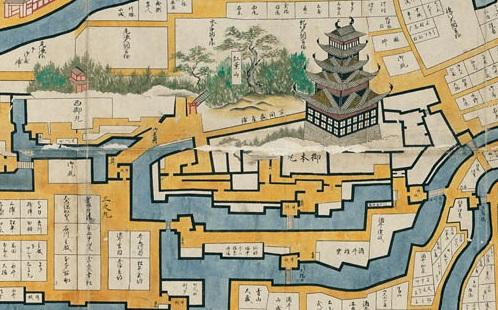
read from it.
There is also the “Bushu Toshima-gun Edo-sho zu” (same library), said to have been drawn in Kan’ei 9 (1632) (photo at right, below), with the tenshu shown in three dimensions.
Edo Castle’s tenshu were Ieyasu’s “Keicho tenshu,” the second shogun Hidetada’s “Genna tenshu” rebuilt in 1622–23, and the third
Iemitsu’s “Kan’ei tenshu” of 1636–37. The last burned in the Meireki Great Fire of 1657 and was never rebuilt.
The Bushu Toshima plan likely shows Hidetada’s Genna tenshu.
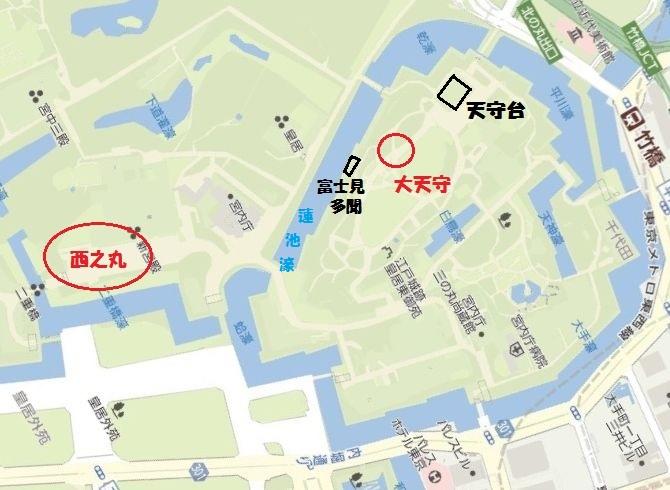
Let us check the tenshu’s place by comparing these three old plans with a present map (photo at right).
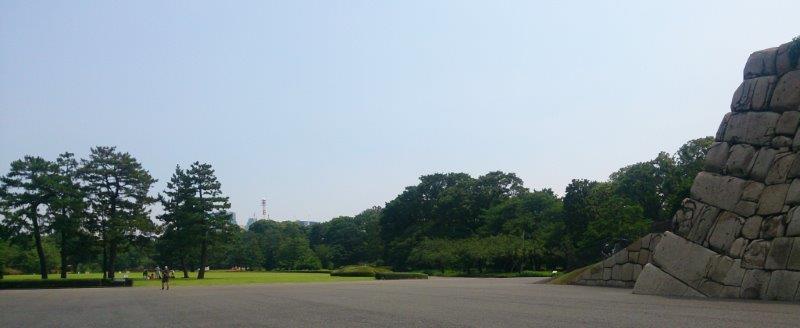
The Keicho tenshu sat mid-lawn of today’s former Honmaru, around the former Ooku near Fujimi Tamon. The Genna was around Umebayashi-zaka, the Kan’ei near today’s tenshu platform. In the photo at left, shot from beside the platform toward the former Honmaru, Ieyasu’s Keicho tenshu would have risen near the center.
Back to the Edo Hajime-
zu. On the south of the Honmaru, five “soto-masugata” in a row — passages made to snake by stone walls so invaders could be attacked from front, rear and sides with bow and gun — can be confirmed; see the figure below (from The Mainichi Newspapers). It is the same defense Kato Kiyomasa, famed castle builder, used at Kumamoto Castle.
The Edo Hajime-zu is one sheet of “Gokuhi shokoku shiro-zu” donated to the city by a Matsue resident; because it did not include a plan of local Matsue Castle, its existence was forgotten for more than 60 years. Treasures still sleep across Japan. Let us hope new “finds” continue.