

Shibui Biru (by Nobuko Suzuki, photos Seiji Shirakawa) was published in summer 2016. Palaceside Building is in it; now Michikazu Kono, editor of Shinchosha’s quarterly Kangaeru Hito, has taken up the book in weekly newsletter no. 708 (delivered February 9, http://kangaeruhito.jp/articles/-/1960) and introduced Palaceside Building in detail (photo above).
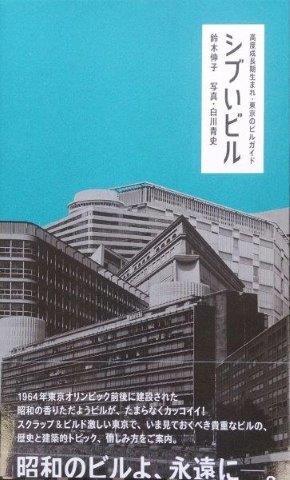
Shibui Biru has the blue-sky photo above as its cover; in close-up it looks like the photo at right, and Palaceside Building is in it. The full title is a little long: A Guide to Tokyo Buildings Born in the High-Growth Years: Shibui Biru. Publisher Little More describes it as “a guide that reports on commercial, entertainment, hotel and office complexes newly built amid the rapid urban development of the high-growth years and long loved since, introducing in photos and text each building’s role as urban equipment and its architectural flavor and charm.” The obi reads “Showa buildings, forever—.”
The book is B6, 128 pages. Four chapters: “1 Yurakucho and Shinbashi are sacred ground for shibui buildings,” “2 Shopping in now and stylish spaces,” “3 Entertainment time gorgeous & retro and fun,” “4 Office buildings you want to stride through.” Chapter 1 covers Tokyo Kotsu Kaikan and New Shinbashi Building; 2 the Nihonbashi Takashimaya addition and Sony Building; 3 Hotel New Otani and Rosa Kaikan (Ikebukuro). And in 4, which takes about half the
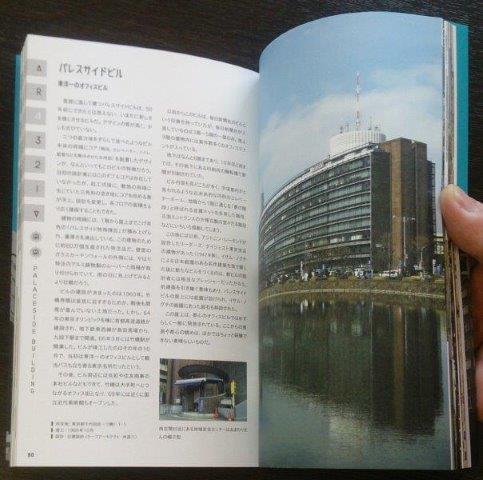
pages, Palaceside Building leads (photo at left). Also Sankaido Building (Tameike Crossing), Meguro Ward Office, New Tokyo Building and Kokusai Building (Marunouchi).
The Palaceside text uses the opening catch copy of 50 years ago, “the finest office building in the Orient,” and writes that it “still feels new… the design is high quality and not the least dated.” Over eight pages, mainly photographs, it describes features and sights: the east and west cores (elevator towers), the stainless-woven “Dream Stairs” linking the first floor and first basement, the round cutouts in the wall of the first-basement restroom under the east main entrance. It also notes that the rooftop garden is open by day, and that the garden stones were moved from an Isamu Noguchi Japanese garden at the former Reader’s Digest building that stood here before Palaceside was built.
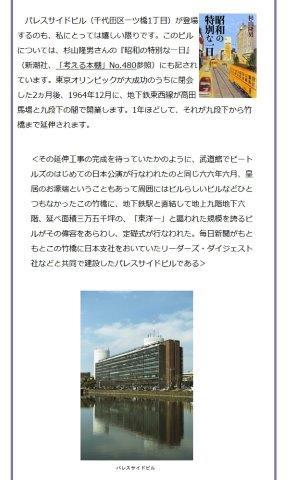
Editor Kono of Shinchosha, who wrote the newsletter, is a noted editor who served as editor of Fujin Koron and Chuo Koron at Chuo Koronsha (now Chuo Koron Shinsha) before moving to Shinchosha. In this issue, after writing of Shibui Biru that “it is a delight for me that Palaceside Building (Hitotsubashi 1-chome, Chiyoda Ward) appears,” he also takes up A Special Day in Showa (by Takao Sugiyama, Shinchosha) and introduces at length the Palaceside passages (photo at right).
“That even after forty-five years (51 at this writing — ed.) this building keeps a newness that does not show its age, and does not yield an inch to the row of shoulder-thrusting super-high-rises, is above all because of the beauty of its architectural form and richly individual style, and because it faces the Imperial Palace moat under deep green — the finest site — and, while harmonizing with the view, makes skillful use of that superb view. … The building has plenty of moving sights: the rooftop garden open to the public, the elevator hall like a space station, the advanced design of the stairs. The author’s knowing how to press those points, in just the right measure, is irresistible.”
Kono closes: “The fate of ‘shibui’ buildings is, one may say, a theme of our time for Japan, asking the value of ‘memory.’”
We feel again the responsibility of managing a building that is valued so.