
Out of Palaceside Building for a stroll to Edo Castle (Imperial Palace) “Nijubashi.” A sequel to September 14.
Last time I wrote that getting off at Chiyoda Line “Nijubashimae,” almost straight ahead of the Kusunoki Masashige statue in the Outer Gardens, is the “Imperial Palace Main Gate Stone Bridge,” and just beyond it another, the “Imperial Palace Main Gate Iron Bridge”; that “Nijubashi” formally means the iron bridge; and that the stone and iron bridges together are also called “Nijubashi.”
In history three large incidents bear the name “Nijubashi.” That is today’s story.
The largest is the January 2, 1954, “Nijubashi Incident.” Crowds came for the usual New Year general greeting; on “Nijubashi” a pile-up killed 16 and injured 65 — a disaster. Incident, but an accident. The photo at the very top is the January 3 Mainichi morning society page that reported it.
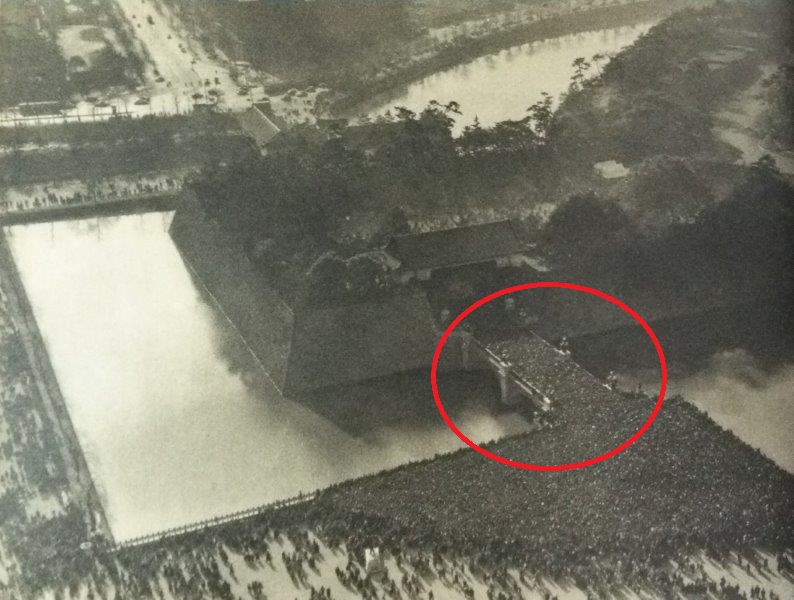
Imperial Guard Police and the Marunouchi station of the Metropolitan Police were understaffed; police admitted a security flaw and Justice Minister Ken Inukai and others condoled the victims, but Imperial Guard and MPD accounts clashed and they seemed to shift blame. In every age the same. In the end nine police-related people were disciplined, but it did not become a criminal
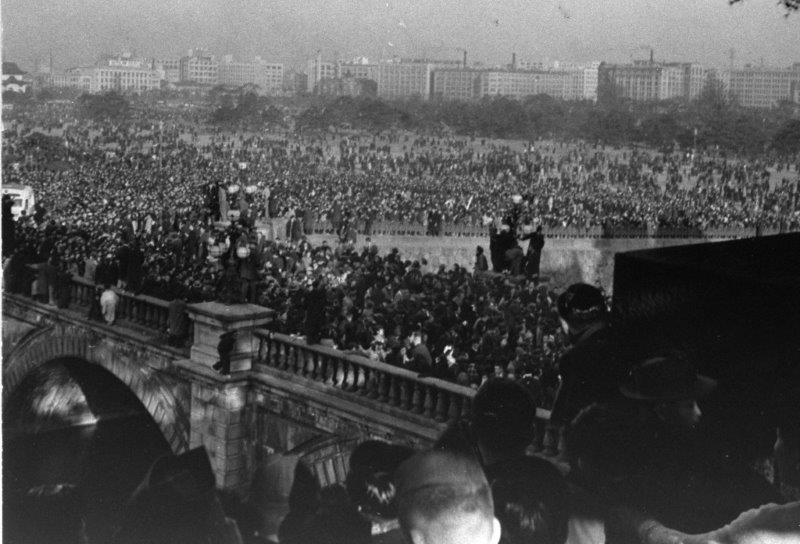
case.
The bridge at the scene is hard to tell from the paper, but looking at the photo at upper right (Asahi Graph, January 20, 1954) and other scene photos at lower right, of the two bridges above it is clearly the “stone bridge” (see the photo on this blog the 14th). So strictly, “Nijubashi = iron bridge” is not the case.
The other two are prewar, bomb-related.
The first Nijubashi bomb incident: March 17, 1922 (Taisho 11), worker Ryujiro Fujita, seeking to hand a petition to Emperor Taisho (the Prince Regent) and enter from Nijubashi, lit a bomb he carried and died on the bridge.
The second: January 5, 1924 (Taisho 13), Kim Ji-seop of the Korean independence group Shanghai Uiyoldan tried to rush the palace and threw grenades at police (none exploded); Kim received life (later reduced to 20 years) and died in prison in 1928 (Showa 3).
Both, again, were on the “stone bridge”; the name “Nijubashi Incident” is inexact, but perhaps one need not be picky…
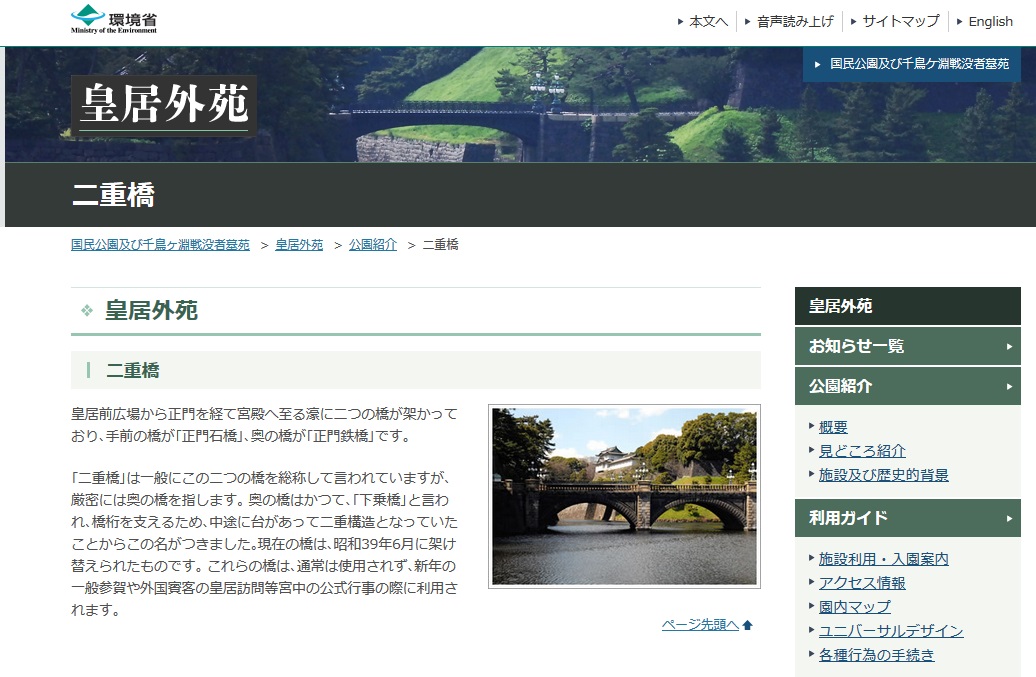
By the way, the Environment Ministry site that manages the Outer Gardens, on its “Nijubashi” page (photo below), says “‘Nijubashi’ is generally used for both bridges together, but strictly it means the farther one.” The photo, though, is the stone bridge; the farther iron bridge is not seen. At least both bridges’ photos should be used. Otherwise it may feed the widespread idea that “stone bridge = Nijubashi.” What do you think?