
Slipping out of Palaceside Building for a stroll. The other day I wrote of the “former decorative lamps of the Imperial Palace Main Gate Stone Bridge” in the East Gardens of the Imperial Palace (Edo Castle).
When the decorative lamps on the “Imperial Palace Main Gate Stone Bridge” from the plaza into the palace were renewed, the old ones were moved and kept.
To recap that “Imperial Palace Main Gate Stone Bridge”: get off at Chiyoda Line “Nijubashimae,” almost straight ahead of the Kusunoki
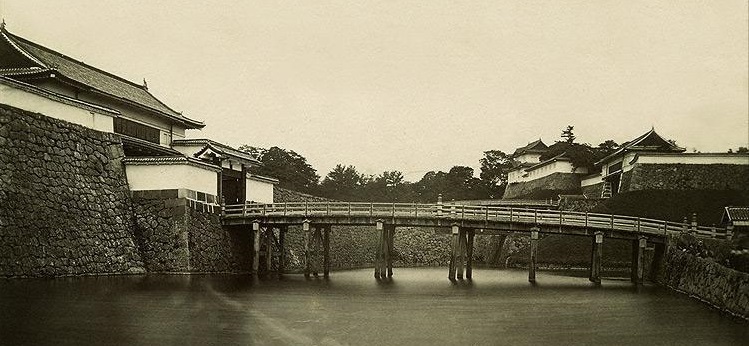
Masashige statue in the Outer Gardens; the wooden “Nishinomaru Ote-bashi” from the Edo period (photo at upper right) was replaced by this stone bridge when the palace was built in the Meiji era (started March 1886 = Meiji 19
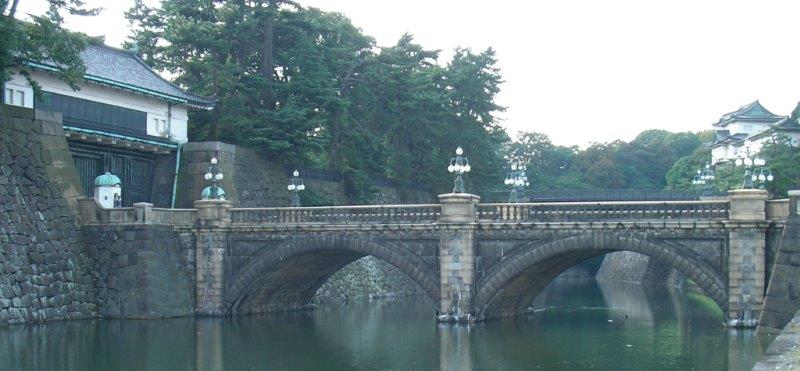
, finished December 1887). Okayama granite, 35.3 meters long, 12 meters wide, piers of two circular arches, a megane-bashi (photo at lower right).
That aside, today’s topic is “Nijubashi.”
Because many people seem to think the “Imperial Palace Main Gate Stone Bridge” is Nijubashi. Is it not? Two arches do look like a double bridge, but Nijubashi is another. Yes, the photo at the very top. It is not “double,” but it is “Nijubashi.”
Nijubashi’s formal name is “Imperial Palace Main Gate Iron Bridge.” Iron, as the name says. In the Edo period it was “Nishinomaru Gejo-bashi”; in the Meiji era it was rebuilt as iron. March 26, 1888 (Meiji 21) — about three months after the stone bridge. After the war, in 1964 (Showa 39), when the Imperial
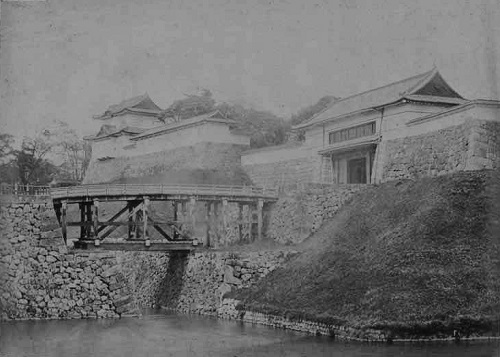
Palace was built, it was replaced with the present iron bridge.
To check the name “Nijubashi,” a photo I found online is the photo at upper left. Under the upper bridge you can also cross at a lower level. That is the “double.”
Online this photo has
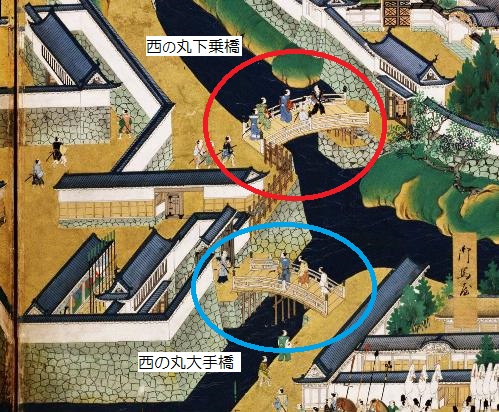
two captions: “Edo-period wooden bridge” and “the first iron bridge rebuilt in Meiji.” The photo somehow looks wooden, but the Edo “byobu ezu” (lower left) Nishinomaru Gejo-bashi (red circle) is not double.
I am not sure, but this “two-level stack” is the source of the name “Nijubashi.”
The “iron bridge” and “stone bridge” together are sometimes also called “Nijubashi.” Strictly wrong, of course, but look closely at the middle “Ote-bashi” / “stone bridge” photo: faintly beyond the near bridge, can you see the “Gejo-bashi” / “iron bridge”? That makes calling both together Nijubashi feel possible.
Either way, Nijubashi is a popular name, not the formal one.